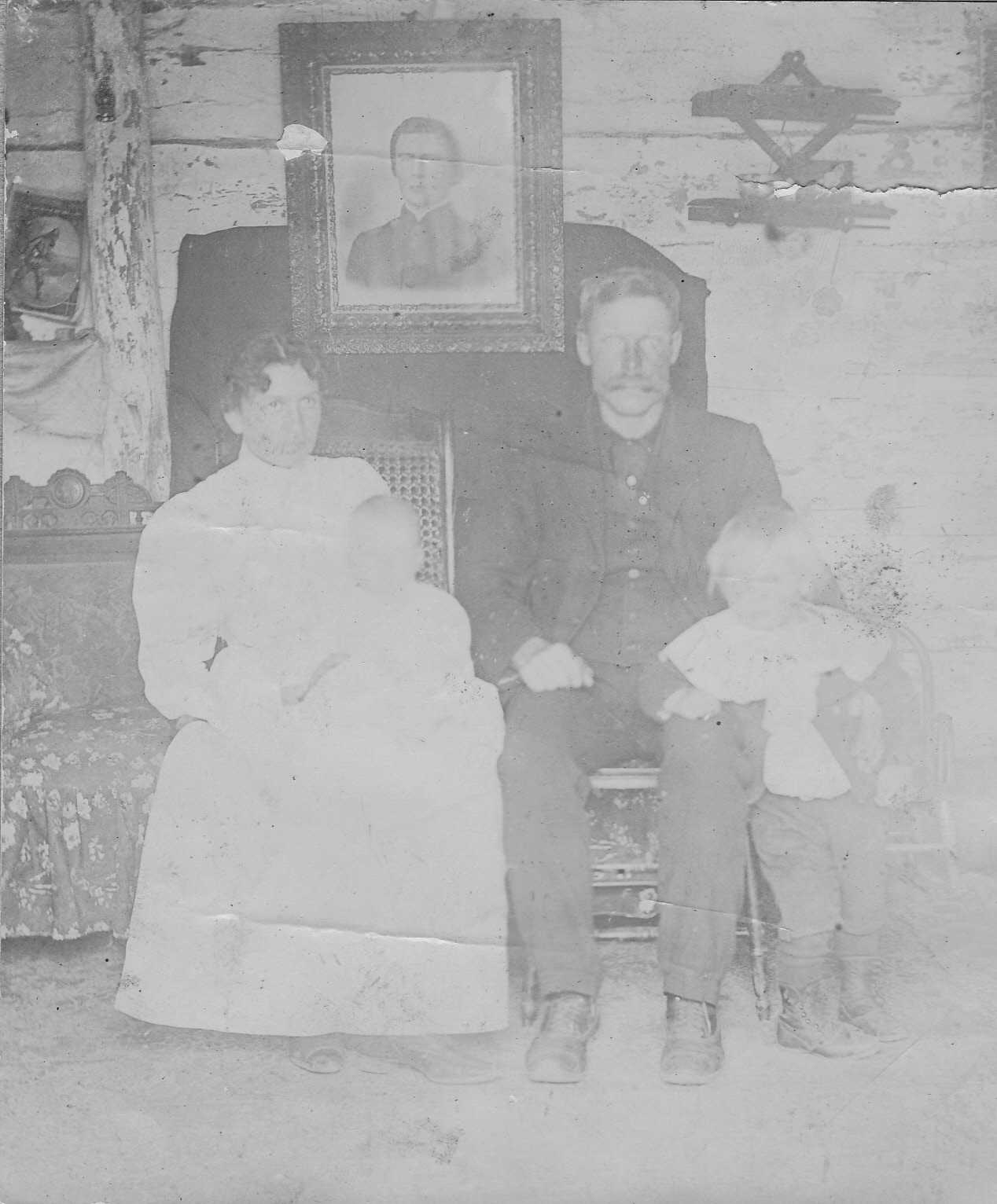
My great great grandmother, Annie, was purportedly married three times - first, at a very young age, to an elderly invalid, the second to a Civil War veteran who had abandoned two wives before marrying her and would go on to marry three more times after their divorce, and the third to the “love of her life.”
Annie disappeared during her divorce in 1899, having “fled the state,” according to court documents. In 1932, she joined her family in Creede, Colorado shortly before her death.
Who was this mystery woman? Who were her parents? Who was the elderly, invalid relative her family forced her to marry so that she could care for him without forfeiting her honor? Where was Annie for all those years after her divorce from her second husband? Why is Annie the only relative in the cemetery who does not have a headstone?
Annie E. Cheney - my ultimate brick wall and the abiding obsession that drives my family research.
Stories
When I was a little girl, my maternal grandmother, Josephine, would tell me stories of her childhood. She described their arrival in Creede (a small mining town in Colorado) sitting on the back of their covered wagon (not a Calistoga, she would say) watching the residents silently gathering on their front stoops to observe their passage through town. She was 14 at the time and had a shadowy foreboding about this town – with good reason, it turned out, for within the year, her beloved brother, Bob, would be buried in the cemetery above town, a victim of the 1918 Flu Pandemic and her parents, Robert (Lynn) and Maude, would be divorced. She always referred to it as the worst year of her life, although she grew to love Creede, marrying a local boy, raising four children, and spending the next 62 years of her life there.
One of my favorite stories was of her maternal grandmother, Annie. The story she told was of a woman forced to marry at a very young age to care for an invalid old uncle. “It wasn’t proper, you see, for her to bathe and change him if they weren’t married,” she would whisper. After he died, Annie married a “scoundrel” by the name of John Farney Woodruff. He had been a brave hero in the Civil War, but he was a dreadful family man, carousing with “loose” women and shaming Annie time after time. When he was seen by the town folk escaping from a burning “house of ill repute” in Cripple Creek, Annie had had enough. She gathered up all her children and left Mr. Woodruff.
“But then,” my grandmother would say in a wistful voice, “my grandmother met the love of her life, Mr. Fry. I used to sit for hours listening to her tell of her wonderful life with Mr. Fry. He was so romantic, and he loved my grandmother so.”
I had always been mildly curious about Annie, but it took a visit by my second cousin, Linda, to light the flame that has become my passion for the past several years. As we looked through family pictures we had both collected, Linda would say, “But where did Annie come from? Who were her parents? It’s such a mystery!” We set out to find the answers to those questions but discovered that, although there was plenty of information about John Woodruff and his other wives, family historians and even a published genealogist had completely skipped over Annie, his wife of 22 years and mother to eight of his twelve children. How could that be? Linda was right! This was a real mystery!
My cousins and I have been able to assemble a pretty clear picture of Annie’s life while she was married to John, but who her parents were and anything about her life before she married John in 1877 and after they divorced in 1899 remains a mystery hidden behind a seemingly-impenetrable brick wall.
Birth and Death
Several phone calls, a trip to the Adams State University Nielsen Library Reserves, and a letter to the Colorado Archives produced Annie’s obituary1 and death certificate.2
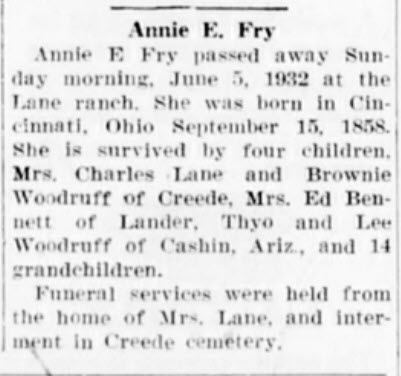
Annie’s death certificate offered similar information, but with one new clue: her father was born in France.
With all this information, I would surely be able to uncover her life’s story. Annie’s father may have been born in France, his last name was Cheney, and they had lived in Cincinnati, Ohio when Annie was born. I smile when I remember how naïve I was.
Marriage
The 1880 census3 caught the family together in Lone Oak, Missouri — the only time they'd ever be recorded that way, since no 1890 census survives and the marriage would end in divorce before 1900. Full census detail, and the rest of the children who followed, are on Annie's page.
Divorce
Browsing around through the Colorado Historic Newspapers Collection uncovered a shocking bit of information! John had sued Annie for adultery and desertion!4 That didn't quite match Annie's story about leaving John because of his infidelity!
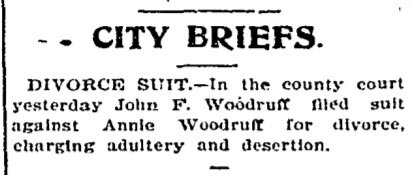
City Briefs. DIVORCE SUIT. --In the county court yesterday John F. Woodruff filed suit against Annie Woodruff for divorce, charging adultery and desertion.
The story apparently made the rounds — a rival paper, The Victor Record, ran a considerably less discreet version of the same news the very next day, naming Annie's lover outright and putting a date on her departure.5
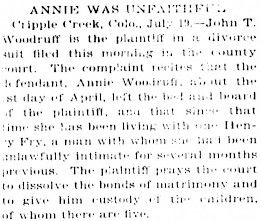
ANNIE WAS UNFAITHFUL. Cripple Creek, Colo., July 19. -- John T. Woodruff is the plaintiff in a divorce suit filed this morning in the county court. The complaint recites that the defendant, Annie Woodruff, about the 1st day of April, left the bed and board of the plaintiff, and that since that time she has been living with one Henry Fry, a man with whom she had been unlawfully intimate for several months previous. The plaintiff prays the court to dissolve the bonds of matrimony and to give him custody of the children, of whom there are five.
My cousins and I speculated that John must have been bitter about Annie leaving him, so filed suit against her as a way to save face and ruin her reputation. My cousin, Kathy, uncovered a divorce record6 with more information about their marriage and about their children:
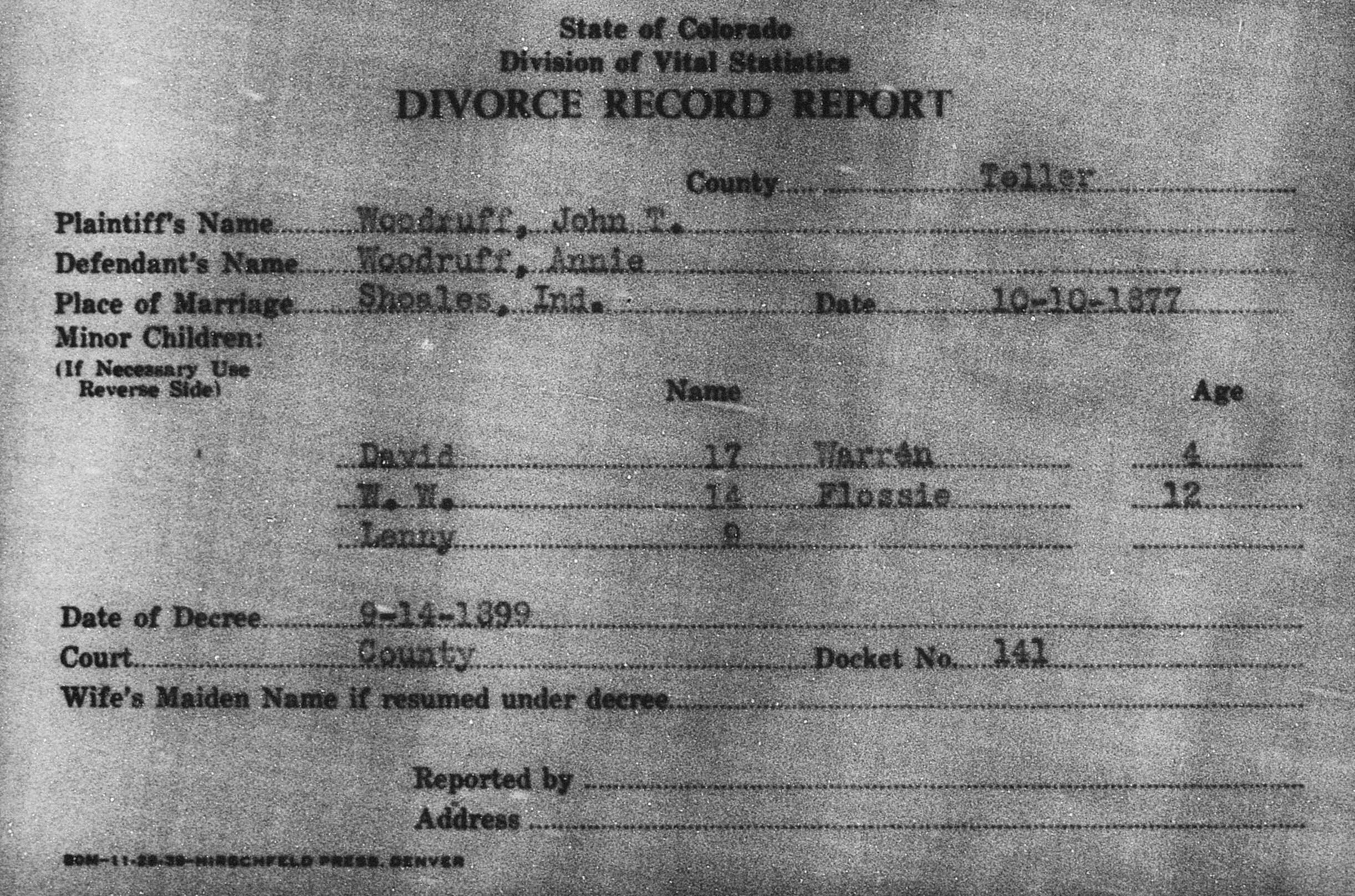
Several letters and calls to the Colorado Archives revealed that not only did they not have the original divorce records, they didn’t even have this record report. According to the clerks, this indicated that the records were most likely misfiled. Time after time, my inquiries were met with, “I’m sorry, we have not been able to locate those records.”
Darn it!
My big break came during a trip to Denver. I was only blocks from the Colorado Archives office, so I walked over. I'd corresponded with them remotely for years, always met with some version of "we have not been able to locate those records." Now, in person, the woman at the counter searched and came up empty too. I started to turn away.
Then a tall gentleman standing behind her, just passing by, glanced at her screen. "Don't add the record number there, put it in here." Her face changed. "It looks as if these records are in our downtown storage facility. Do you have time to wait?"
"Yes. However long it takes."
I nearly lost my breath. Years of being told these records didn't exist, and a stranger walking by had just spotted, in ten seconds, what an archive full of professionals had missed.
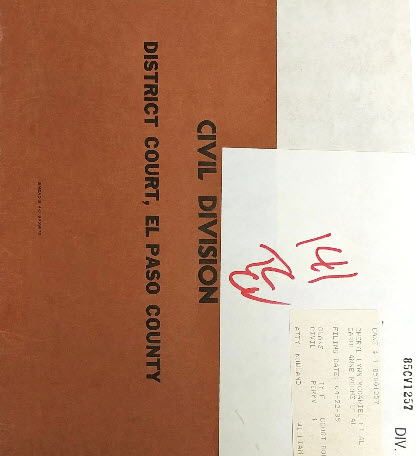
An hour later, a man wheeled in a cart holding a thick legal file pocket. "Careful, my dear, these are very fragile." The pages were so delicate I couldn't bring myself to run them through the copier myself; the clerk quietly did it for me.
I tucked everything into my briefcase, caught an Uber back to the hotel, and sat down to see what a divorce case, seen from the inside, actually looked like.
Annie did not show up for her divorce hearing and, according to the Teller County sheriff,7 she had fled the state. In the pleadings, John accused Annie of having an affair with one Henry Fry, employed at the Holthusen Ranch. This was a very big clue, as Annie’s third husband had always been referred to only as “Mr. Fry.” In addition, John declared that he had ample means to take care of their five minor children.8
The jury, hearing no objection from the absent Annie Woodruff, found in John’s favor, awarding him custody of the minor children and finding Annie guilty of adultery and desertion.9
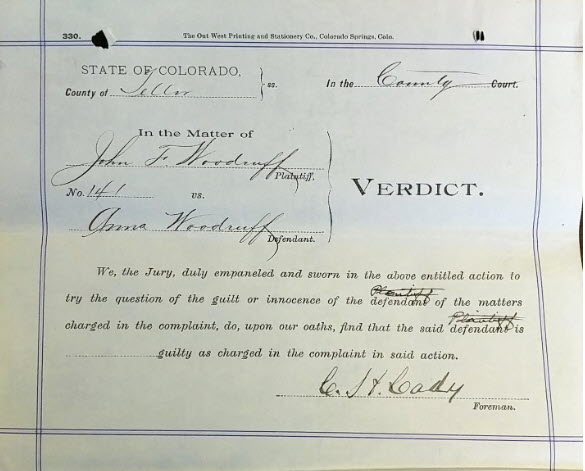
State of Colorado, County of Teller, in the County Court. In the Matter of John F. Woodruff, Plaintiff, No. 141, vs. Anna Woodruff, Defendant. VERDICT. We, the Jury, duly empaneled and sworn in the above entitled action to try the question of the guilt or innocence of the [originally "Plaintiff," struck through, corrected by hand to] defendant of the matters charged in the complaint, do, upon our oaths, find that the said defendant is guilty as charged in the complaint in said action. C. S. T. Cady, Foreman.
Whether or not Annie originally left John because he had humiliated her one too many times, and whether she had taken her children with her when she left (as she'd told my grandmother), it is clear that by the time John sued her for divorce, Annie could not be found and John had possession of the minor children. Maybe the stories she told my grandmother were a romanticized whitewashing of a scandalous affair. But as I discovered later, John had deserted his first wife after all three of their children died within the first year of their births, he abandoned his second wife and infant son to marry Annie, and was married three more times after Annie left him. My grandmother and her sister always referred to their grandfather as "old John Farney" with a curl to their lips and a snarl in their voices. We will never know what actually happened between John and Annie, but it is my strong feeling that Annie did leave John because of his infidelity, finding a new love in Henry Fry, and that John responded to her desertion by publicly shaming her, exerting his male advantage to gain custody of the children, and running her out of town. I recently found a 1910 Trinidad, Colorado directory entry10 that lists an Anna Fry, widow of Henry. If this is, indeed, our Annie, then she and Henry had only about 11 years together before his death.
Where is Annie?
Perusing local newspaper archives, I discovered that Annie had visited her daughter, Maude Lane, a few times shortly before she died. The gossip columns reported her as a visitor from Walsenburg, Colorado.11 But where had she been from the time she and John divorced in 1899 and her visits to Creede 20 years later? As it turns out, one of the few clues to her whereabouts was presented to me through a mysterious incident in our livingroom, which, incidentally, is located only a few yards from where Annie died in 1932. I was seated cross-legged on the floor, surrounded by old pictures, records, and odds and ends my deceased uncle had stored in an old file box. I came across several items that contained some darling postcards addressed to my grandmother when she was a child and then some blank greeting cards. I put the items with information on them in one pile, then started to keep the blank cards, but thought, oh, geez, I have so much “stuff,” I don’t need to keep these.
As I reluctantly tossed them into the plastic trash bag beside me, one postcard12 floated through the air, out of the arc the others had taken, and landed on the floor in front of me, writing side up. At first I couldn’t believe what I was seeing! This postcard was addressed to Mrs. Annie Fry. The author was her daughter (my great grandmother) Maude. She was writing to her mom in Trinidad, Colorado, telling about her kids, wishing her mother a merry Christmas and happy New Year, and closing with, “Mama, why don’t you write?”
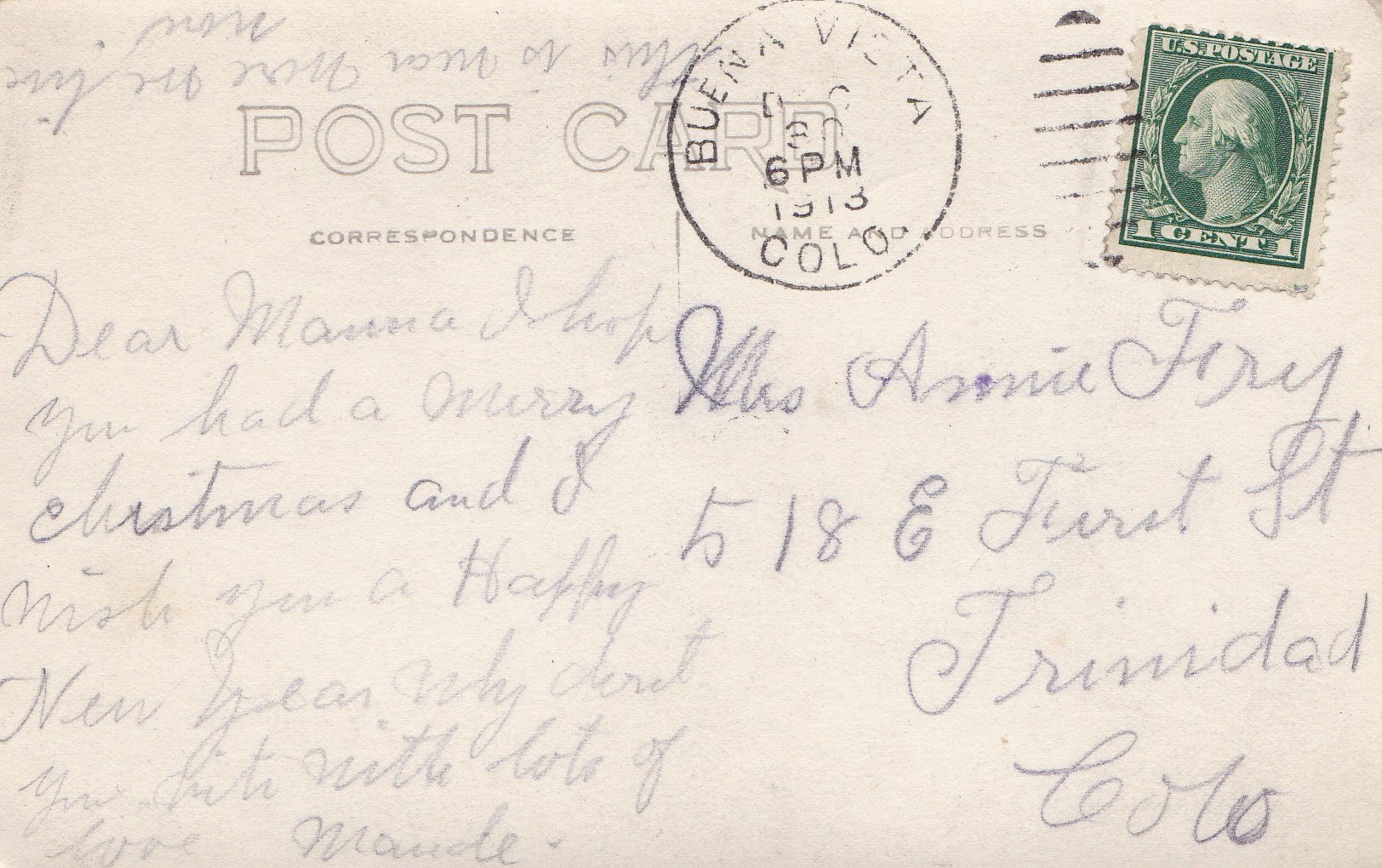
I was trembling as I picked up the card and looked at the postmark. December 30, 1913. Annie was right here in Colorado in 1913! I jumped up, holding the postcard to my chest as if it would fly away as easily as it had drifted in. I started walking in circles, mumbling, “Oh, my God, oh, my God!” and then, overcome with this discovery, jumped up and down in sheer ecstasy, screaming, "Oh, my God, oh, my God!" My husband raced into the room and tried to calm me down, saying, “What’s the matter? What’s wrong? Are you hurt?” I looked at him as if he’d appeared out of a dream and showed him the postcard. “Look, Annie was in Trinidad in 1913! Look, Randy!” His eyes glazed over, he got a serious look on this face, and said, “Jesus, Shannon, I thought something happened to you.” As he walked out of the livingroom shaking his head, I smiled and thought, “Something did happen to me and you will NEVER understand!” – a thought I’ve had about several people over the years who do not share my passion in family research.
Annie, Remembered
Not everything I've learned about Annie came from a courthouse file or a census page. Some of it came from the people who actually knew her — secondhand now, filtered through a generation or two, but no less real for that.
My cousin Linda once tracked down and interviewed Lee Roy's son, not long before he died, and he told her a story I still can't quite explain. He said his family had come to Creede once to visit Maude and her children, but they left early — his father, Lee Roy, had decided that Maude's grandchildren were "hoodlums and miscreants" and he didn't want his son around them. Whatever Lee Roy actually witnessed remains a mystery, because by every other account Maude's family was well regarded in Creede, and her grandchildren went on to be, by all reports, high-achieving kids. What this handful of children could possibly have done to earn that verdict from their own great-uncle, I have no idea. I just know Lee Roy packed up his family and left.
Then there's the ear trumpet. Annie's great-grandson, John Jackson, used to tell us how he and his brothers and cousins would take advantage of her hearing horn, silently mouthing words at her as if they were talking. She would lean in closer and closer, straining to catch what they were saying, and when she finally realized she'd been had, she'd chase the whole pack of them down, calling them "little rascals." Her great-granddaughter, Polly Davis, remembered the same trumpet — and remembered, too, that after Annie died, the grandchildren kept it to play with.
Polly gave me my favorite image of Annie, though, and it's a small one. Annie was, by every family account, a petite woman who dressed formally and always wore proper button-up boots — never seen without them. When she died, Polly, just a child herself at the time, saw her laid out in the parlor and noticed her small feet showing in their socks beneath the hem of her dress. Knowing how particular her great-grandmother had been about those boots, and how she'd always complained of cold feet, Polly quietly slipped over and pulled Annie's dress down to cover them.
References
- 1. ↩ “Annie E. Fry” obituary, Del Norte Prospector, “The Creede Section,” 10 June 1932, p. 2, col. 2, par. 14.
- 2. ↩ “Annie E. Fry” obituary, ...
- 3. ↩ 1880 U.S. census, Bates County, Missouri, population schedule, Lone Oak, p. 214A (stamped), dwelling 36, family 37, J. F. Woodruff; image, Ancestry.com (http://www.ancestry.com : accessed 25 October 2020); citing NARA microfilm publication T9, roll 673.
- 4. ↩ “Divorce Suit,” (Cripple Creek) Morning Times, 20 July 1899, p. 1, col. 6, par. 3.
- 5. ↩ “Annie Was Unfaithful,” The Victor Record, vol. 4, no. 107, 20 July 1899.
- 6. ↩ Colorado Division of Vital Statistics, “Divorce Record Report,” Teller County, Docket No. 141, John T. Woodruff v. Annie Woodruff, decree dated 9-14-1899, recording marriage as 10-10-1877, Shoales [Shoals], Indiana; certified copy provided by the Colorado State Archives.
- 7. ↩ El Paso County, Colorado, District Court Records Case # 85001257; John T [sic] Woodruff v. Anna Woodruff, divorce; original documents, Teller County Colorado, Court Records, Denver Archives Location 100383, Doc[?] [archive location card cut off in original]; Sheriff’s Affidavit, service attempted, Anna Woodruff cannot be found and is believed to have fled the state. Signatures: James T. Stewart, Sheriff by J. D. Harrigan, Undersheriff.
- 8. ↩ El Paso County, Colorado, District Court Records Case # 85001257; John T [sic] Woodruff v. Anna Woodruff, divorce; original documents, Teller County Colorado, Court Records, Denver Archives Location 100383, Doc[?] [archive location card cut off in original]; Plaintiff’s declaration, means and willingness to care for minor children.
- 9. ↩ El Paso County, Colorado, District Court Records Case # 85001257; John T [sic] Woodruff v. Anna Woodruff, divorce; original documents, Teller County Colorado, Court Records, Denver Archives Location 100383, Doc[?] [archive location card cut off in original]; Verdict, signed C. S. T. Cady, Foreman.
- 10. ↩ R. L. Polk and Company, 1910 City Directory: Trinidad, Colorado (Detroit, Michigan: R. L. Polk and Company), p. 106, Anna Fry (wid Henry); Ancestry.com, U.S. City Directories, 1822-1995 [database on-line], accessed 25 October 2020.
- 11. ↩ “Mrs. Annie Fry,” (Creede) Creede Candle, 8 September 1923, p. 3, col. 2, par. 22.
- 12. ↩ Postcard, Maud [Davis] to Mrs. Annie Fry, 518 E. First St., Trinidad, Colorado, postmarked Buena Vista, Colorado, 30 Dec 1913; illustration captioned "Chalk Creek Cañon near St. Elmo, Colo."; original in Shannon's possession.