"Hell Cats And She Ghosts": Part One
Part One runs from the book's printed page 2 through page 13: two short stories, two pages of family photographs, six further stories (one, "T-Bone," illustrated with a reproduced 1943 Colorado motor vehicle title), a page of World War II photographs, and two more stories, ending with "Curiodditie s." This site's own part division is noted in the book's introduction on the main page for "Hell Cats And She Ghosts."
Pink and Blue Booties
Some seventy years age, before hi-tech and equal rights activists, little girls could be little girls and develop their imaginations, little boys could be little boys and develop into little hellions. Little girls had their imaginary tea parties and the stork brought little dolls that just fit into little baby buggies to be paraded around so adults could "ooh" and "aah" over the rubber dolls with the glass eyes and tell them, "Oh my, it looks just like you," then ask, "Is it a boy or a girl?" The little girl doesn't have the faintest idea because the stork brought it and he didn't tell her if it was a boy or a girl. So...mothers came up with the idea of pink booties for girls and blue booties for boys to solve this embarrassing problem.
Little boys were more interested in frogs and snakes and learning how to smoke without choking or getting sick. They couldn't have cared less about the sex of play dolls in play baby buggies. They were aware that the stork had brought them, personally, from his baby factory and that their dads were going to shoot the damned stork but they had never seen him and presumed it came in the night. If it brought those little play babies, too, that was beyond their comprehension though they felt the stork and Santa Claus must be in cahoots. Whatever or however, they knew the stork was a very busy bird and if he didn't slow down he would be filled full of buckshot.
That imaginary world was a wonderful place to be. If something about it wasn't quite right you could blink your eyes and change it. When my mother needed my stick horse to sweep the kitchen I could crawl into the Essex sedan with my cousin Lee and tour the country. It was on jacks, didn't have gasoline or a battery and chickens roosted on the seats but that didn't deter us until Lee tried to cross the railroad tracks and a train hit us. We rolled out of it to safety as chickens squawked and Aunt Caroline ran out to see why we were laying stretched out on either side, unmoving. It took a whole lot of imagination to put it back together after that wreck and it never did steer right again.
We grew older and the little girls who had been our age and had tea parties were now older than us. We had reached fourteen years of age with changes in basic metabolism that made the smell of perfume delectable, the addition of curves and bumps on the girls who had wanted us to play house with them eight years before noticeable and alluring. We couldn't understand this change however we were comfortable with it and were ready to play house. Our uncles had told us the story of the stork was a myth, if you wanted a baby you took a box of candy to a girl and let nature take it's course. We learned that advice was a myth, too, because there are no fourteen through sixteen age girls. When they reach puberty they blink their eyes and, suddenly, they are seventeen and eighteen years old. That took more imagination than putting the old Essex sedan back together after a train demolished it.
Clifton "Lee" Davis was born in Creede, Colorado. He enlisted in the U.S. Marine Corps in 1943 at the age of 17 years. He was wounded in battle on Saipan Island of the Marianas. He returned to Creede where he mined for years with his brother, Frankie, and, later, they ran "The Pick & Shovel Rock Shop". Lee died in 1997 of congestive heart failure. We were best friends as well as cousins and explored our small world with a derring-do that equalled feats of our heroes and surely brought grey hairs to the heads of our mothers.
Printed page 2. "Some seventy years age" for "ago" is printed as shown. This story's mention of Lee's 1997 death is the source of an earlier, superseded guess that the book was printed "after 1997"; "Curiodditie s," later in Part Two, gives the firmer date of 2001 or later.
Snakes Alive
"The Ranch", that was all we ever called it, a homestead of 160 acres at the mouth of Sawmill Gulch stretching to within 300 yards of the Rio Grande to the north and abutting the Barber place to the west. First recorded in Chester Garnier's name, for whom the next gulch west was named, then sold to Carl Gilbreath who, in turn sold out to John Dabney.
The ranch, as we knew it in the 1920s was in the hands of our grandparents, Charles and Maude Lane, who had a firewood and mine prop business, sold milk and eggs to Creede residents, raised hay for a trio of horses and three milk cows, raised vegetables and helped raise grandchildren. I was a grandchild who loved that environment and enjoyed it for several years.
In a good year, so called when a winter snowpack was above average, Sawmill Gulch ran water from a spring just above the old sawmill site. The main spring was in an oval park at the head of the gulch but disappeared in slide rock before appearing near the mouth of the gulch. The spring afforded water for a "spring house" that kept dairy products cool and filled half a wooden barrel that had formerly been a whiskey keg. The half barrel had a small iron pipe running from a rocked-in sump to nestle in the oval where the bung had been and direct a stream containing silt and whatever critters could crawl into the sump to fill the barrel for drinking water and the always full tea kettle on the Home Comfort range for hand washing. We bathed in the Rio Grande on warm days, not at all in cold weather.
I don't know which uncle to credit for acquainting us with horse hair snakes but after seeing the first one slithering around in the silt at the bottom of the barrel we were hooked. We were told only fresh hairs jerked from the mane of a horse, not cut, could become snakes. We believed everything our uncles told us. They were older, they were wiser and much of their lore came from the mouth of Garnier Gulch where Mr. Barber operated a distillery. After a visit to Mr. Barber's still we noticed improvements in their tales, though their eyes became bloodshot and they lost control of their legs for short periods. Grandmother Lane took a dim view of the source of their knowledge and they missed many meals in a recovery period far from her kitchen.
As I remember, it took two weeks or longer to transform a horse hair into a snake. The best time to pluck hair from a horses mane, we learned from dodging hooves, was when they were hitched to a wagon. They resented losing these long hairs and rattled both single trees and the doubletree with shod hooves when we got greedy. The uncle told us the snakes could never be taken from the barrel or they would bite us and then die.
That information could have been left unsaid, I wouldn't have touched one with a ten foot pole.
We checked from the first day of immersion to see any signs of movement and when we weren't doing chores we were on our knees peering into the barrel. Never have I been as excited as the day I saw my very own snake slowly form an "S", straighten and do it again. I had the grey hairs from the horse named Shorty and Charlotte had brown hairs from the bay horse, Chub. There was no doubt in our infantile minds that we had performed a scientific feat equal to Mr. Barber's magic of drawing spirits from a tub of sour mash when we saw our snakes writhing from one side to the other in the bottom of the barrel.
In trying to explain the complexities of our experiment to my teacher that fall she gently led me through the stages of evolving parasites attaching to the hairs to eventually make it seem that they were alive. After losing Santa Claus two years earlier this was far too much for a small boy to accept.
Printed page 2. "A homestead of 160 acres" gives the Lane ranch's approximate size; John's grandparents Charles and Maude Lane are elsewhere on this site.
The Ranch and Family Photographs
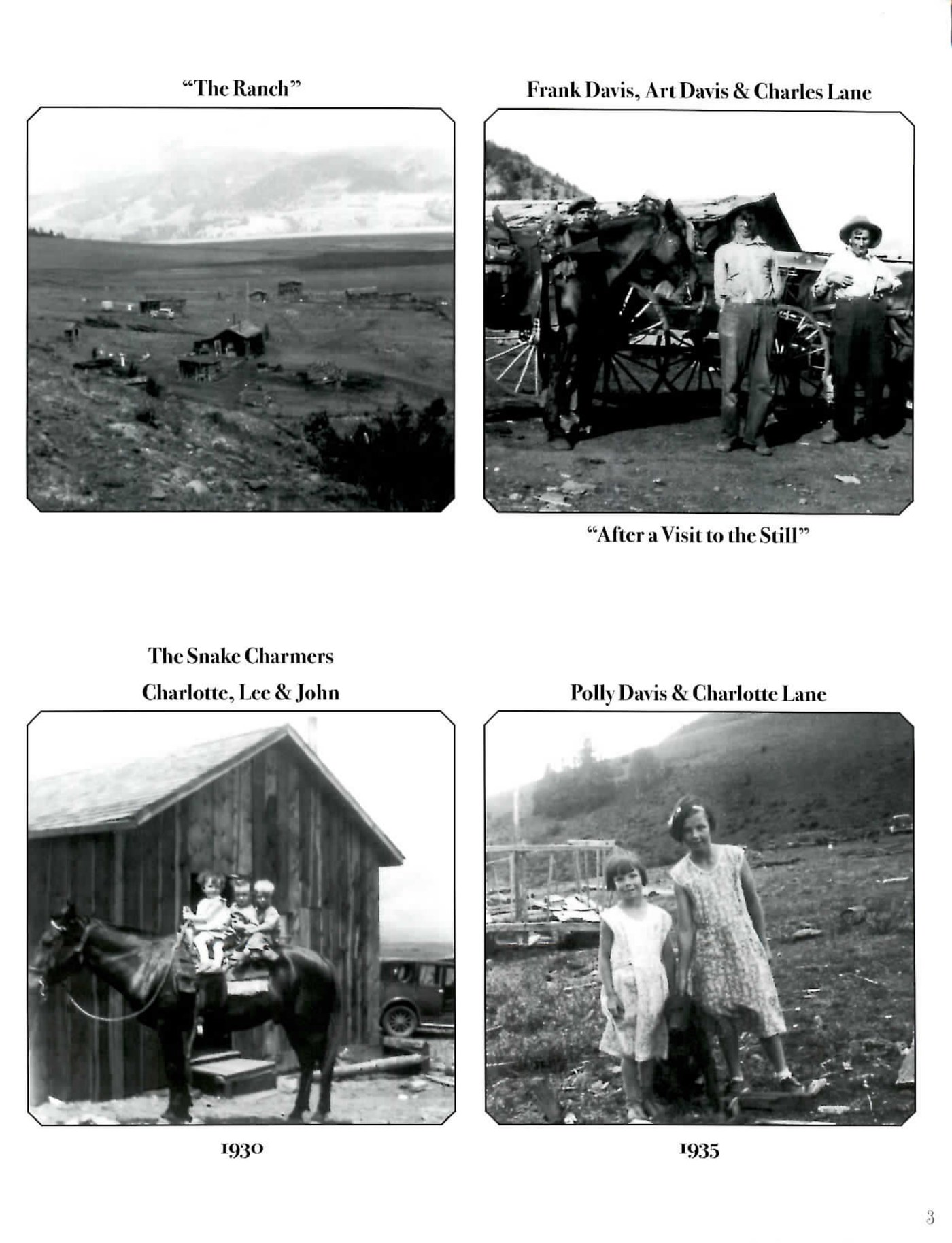
Printed page 3, an unnumbered page of photographs with no story text. Reproduced here as a single composite image so the original layout and captions stay together.
Jackson Family Photographs, 1921–1945
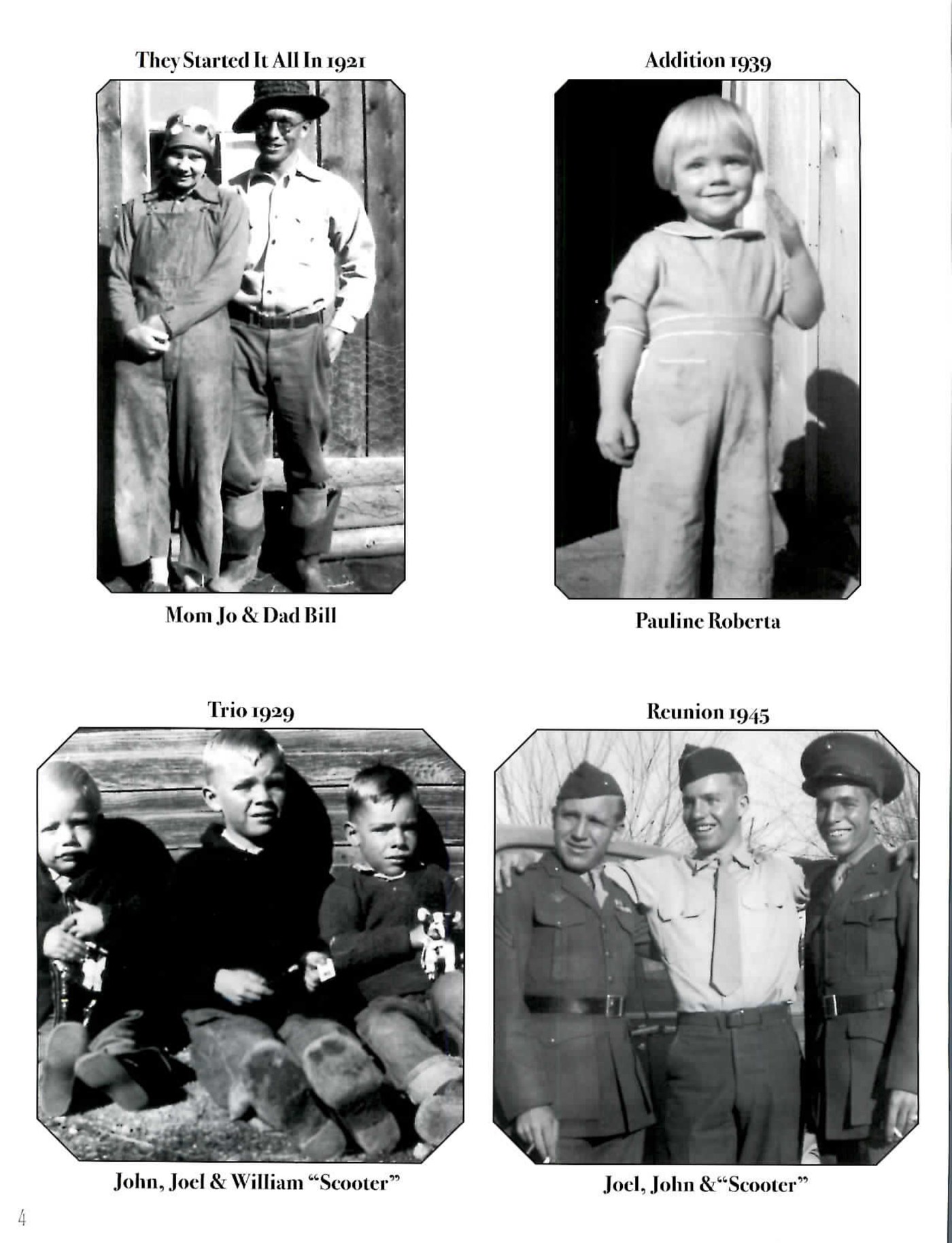
Printed page 4, an unnumbered page of photographs with no story text. Reproduced here as a single composite image. "Mom Jo" and "Dad Bill" are Josephine and William T. Jackson Sr.; Pauline Roberta is Pauline "Bubbles" Jackson Bates, John's sister; Joel and William "Scooter" are John's brothers.
Working Stiffs
In the year 1937, when the school bell was muted in May, I went on full time employment at a tourist resort owned and operated by Billy and Loraine Wills in Hinsdale County. This was my first summer away from my grandparents at the Lane ranch and was a serious adjustment, but with a salary of one dollar per week plus room and board an up and coming lad couldn't turn it down. Harold McCaulley, son of our shoe cobbler Dan McCaulley, was older and hired by Billy to help in pack trips to Lost Lakes to gather trout eggs in spawning season and as a fishing adventure for tourists. I was the chore boy. I carried wood to the cabins to keep the bins full and I carried trash back, helped the tourists catch fish and, occasionally, was rewarded with a horseback trip to the lakes. Harold and I bunked together in a small cabin but we ate all meals in Loraine's kitchen.
It was an exciting summer and I saved the sum of $19.00 which my father invested for me in postal savings. This was the start of a savings program that enabled me to finance our first mining venture with $2,100.00 in the year 1949. I know, I know, that is a pittance in today's dollars but in 1949 a compressor and drill could be rented for $125.00 per month, used rail and pipe purchased for $20.00 per ton and 10¢ per ft. respectively, and a 50-pound box of dynamite for less than the price of two bags of potato chips today.
The $2,100.00 went fast even coupled with donations from various sources and failure was a bitter pill to swallow, however we profit in knowledge with every failure and if we won with each gamble life would become very boring. I can assure the readers I have rarely been bored in my mining career. I tried to get experienced help, not always possible on a shoestring budget, but I found that Creede had some dependable and ambitious young workers willing to listen and to learn. In 1954 I hired Paul Hosselkus to help tram ore from the Holy Moses #2 tunnel. Paul was just 18 years old and had lost part of a hand in a blasting cap mishap several years before. It would seem to follow that Paul would want nothing to do with mines or explosives but I never had cause to regret hiring him. Sick or hurting he was on the job on time, had no apparent fear of the hole and performed like a veteran. Unfortunately I was at the end of my rope, financially, so the job was short-lived and I couldn't fully compensate him for his ambition and loyalty.
In the year 1969, financing came through via Allan and Clara Phipps and The Colorado Fuel, Iron and Steel Company to form Gateway Access Corporation in preparation of driving a 2,500' tunnel northwest in Nelson Mountain from the former Midwest property and 1920s Colewood tunnel. Experienced miners were in short supply due to the entry of Homestake Mining Company in our area and I was getting panicky when a young fellow drove up to the tunnel site in a red Ford pickup with New Mexico license plates. I had blasted to solid rock and was capping square sets for the portal when he got out, looked the place over, and asked if I was hiring. He was skinny as a rail and I thought would never be able to cut the mustard using heavy drills and 200 pound lengths of rail. He could sense my hesitation and told me he had been working in uranium mines and knew he would fit in. He had his wife and two small kids in the truck, looked me square in the eye, and added, "I need the work."
That was my introduction to James Morrow who proved to be an exceptional worker and common sense miner. His parents had a gas station and store in Poncha Springs so he had roots in Colorado.
Jim and I drove the tunnel 100 feet before the next top hand was hired. That was Michael "Mahone" McClure, a home town lad who came from a mining family and fit in with no problems. Teamed with Jim Morrow, Mike picked up the rhythm we had set in advancing 7 1/2 feet per shift and the tunnel went like clockwork with expenses well in a range that would complete the tunnel with extra for drilling core holes.
Jim and Mike liked their beer and the fumes were overpowering in the early morning hours. I learned to judge the degree of their competence or incompetence as the compressor was warming up and we sometimes shoveled snow or stacked timber for an hour in cold temperatures before I felt safe in escorting them underground. We can all be thankful that James Morrow and "Mahone" McClure weren't with the British troops in the Revolutionary War. General Washington's troops, in order to save powder and shot, were commanded to not shoot until they saw the whites of the enemy's eyes. Jim and Mike would have waded right through the colonial soldiers as in all the time I worked with them I never saw the whites of their eyes.
Creede is in good hands. With historians like Jan Jacobs and entrepreneurs like Ken Wyley to maintain the flavor with publications and staging mining contests the people who gave it a special aura will not be forgotten.
Printed page 5 (bordered as a boxed page in the printed book). "Capping square sets" is printed as shown, likely "dapping" or "tamping" in the original miner's usage; kept as printed.
Double Heart Failure
Bryan, Tommy and Bernie were having a few drinks and swapping stories in a local bar when a message was relayed to Bryan, County Coroner, that an elderly lady had passed away in a suburb of Creede and his services were needed. They were all acquainted with the family and assumed there was no urgency so Bryan called a mortuary in the valley to send up a hearse. There would be at least an hour's wait for the vehicle to transport the body in a nighttime drive over dirt roads and family or friends would be at the home to comfort the grieving husband.
They continued drinking with Bernie who was just finishing a long winded tale of South Pacific female islanders with sailors on leave when a pair of headlights rounded a lower corner and headed slowly up main street. Bryan left to stop the gentleman then returned to ask Tommy to come along and help.
It had been nearly 90 minutes since the death message had been delivered. The lady was obviously far gone as Bryan searched for vital signs and Tommy sat in the kitchen offering condolences and help to the husband. Bryan walked into the kitchen after his examination and pulled a rickety chair near the table to fill out the necessary forms with the help of the husband. Where he was to fill in "Cause of Death" he wrote "heart failure coupled with old age". Heart failure was a staple of the times and covered everything but gunshot and stab wounds.
The hearse was a modified 1938 Ford station wagon with little to offer other than the stretcher holding the body. Bryan and Tommy were squatted on either side of the stretcher for the ride back to the bar and Tommy was chiding Bryan about his choice of words about cause of death, "I noticed you put down heart failure coupled with old age. Did you think coupling with her old husband caused heart failure?"
Bryan was laughing at Tommy's question when the lady suddenly sat up and asked, "Where are you taking me?" They nearly jumped out of their skin and were totally speechless. As suddenly as she had sat up her eyes rolled back and she collapsed with one final gasp and quiver. The coroner and his assistant were greatly relieved.
Printed page 7 (bordered as a boxed page). No surnames given for Bryan, Tommy, or Bernie.
Hell Cats of a Different Breed
There were ranchers who fit well in Key LeZotte's hell cats and she ghosts category. The Dabneys, Emmett and John, had ranches near Spring and Clear Creeks and in the spring moved cattle from the corrals at Wason, where they were hauled in on the D&RG Railroad, to summer pasture near Spring Creek Pass. They usually camped a night or two at Wason Ranch to have everything in order before the drive began and enjoyed spirited night life in Creede.
Bill Lewis had a tin covered shed behind the Mercantile building where he kept grain and salt for both cattlemen and sheepmen. There was a hitching rail just north of the shed for horses and Sis Parson's Beer and Billiards Parlor on the corner of main street was less than a half block away. Roy Phillips bought and ran the business after Sis died and he also catered to cowboys.
Near midnight one night, as the drovers were leaving Creede, Emmett decided to practice steer roping on an outhouse that sat near the road with a path to an occupied home. He fashioned a beautiful, wide loop, twirled it over his head a couple of times and let go. His aim was perfect and when the loop dropped over the slanted roof he half hitched the rope to the pommel of his saddle and spurred his horse. The biffy dropped with a thud and he dragged it several yards before galloping back to retrieve his lasso.
Unfortunately there was a lady inside on a late night run and she was screaming at the top of her lungs. The cowboys stood the building upright, rescued the fair damsel and escorted her to her residence. She was both frightened and mad. The next day she was still mad and Emmett was summoned into municipal court where he was fined $25.00 and costs.
Both Emmett and John became miners in later years during winters in Creede. Emmett was part owner of the Midwest Mine in the early 1940s where he and John Van Buskirk tunneled by hand. John worked with George Logue in an inclined raise of the Amethyst mine in 1947-48 near a stope where I was working.
When Emmett was in failing health in the Monte Vista Community Hospital Inez and I dropped in to see how he was coping in confinement. There was little change in this grand old man, he told stories, laughed and insisted on walking with us to the door. He was clad in his western hat, cowboy boots and a hospital gown. His bare butt exposed with every step.
Printed page 7 (bordered as a boxed page). Emmett and John Dabney and Roy Phillips are not otherwise identified beyond what is given here.
T-Bone
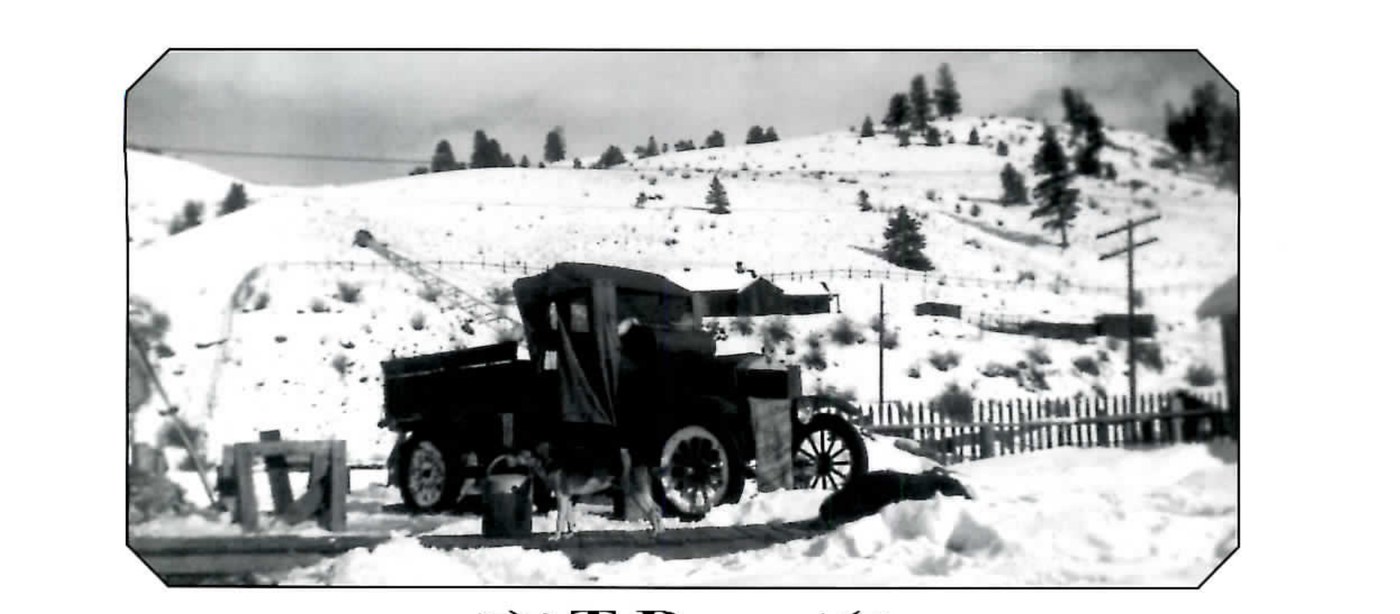
My first automobile, purchased from Dan McCaulley for $20 in 1942. A very dependable truck that served me in work and play until 1951 when I sold it to a fellow from Del Norte for $20. The dragline boom visible in the background was connected to the first power shovel we had seen and brought the Dallas Filley family to Creede in the early '30s. Dallas ran the machine with boom attachment to set the heavy, steel pipe in place at the Santa Maria Reservoir. In 1943 William Kolisch Sr. fired up the old brute and loaded it on a flatcar at the depot for shipment to a coastal port, then on to Russia as part of the lend lease agreement we were told. The house in the background on the hill belonged to George Horne, the only black man in Creede and our good neighbor for years.
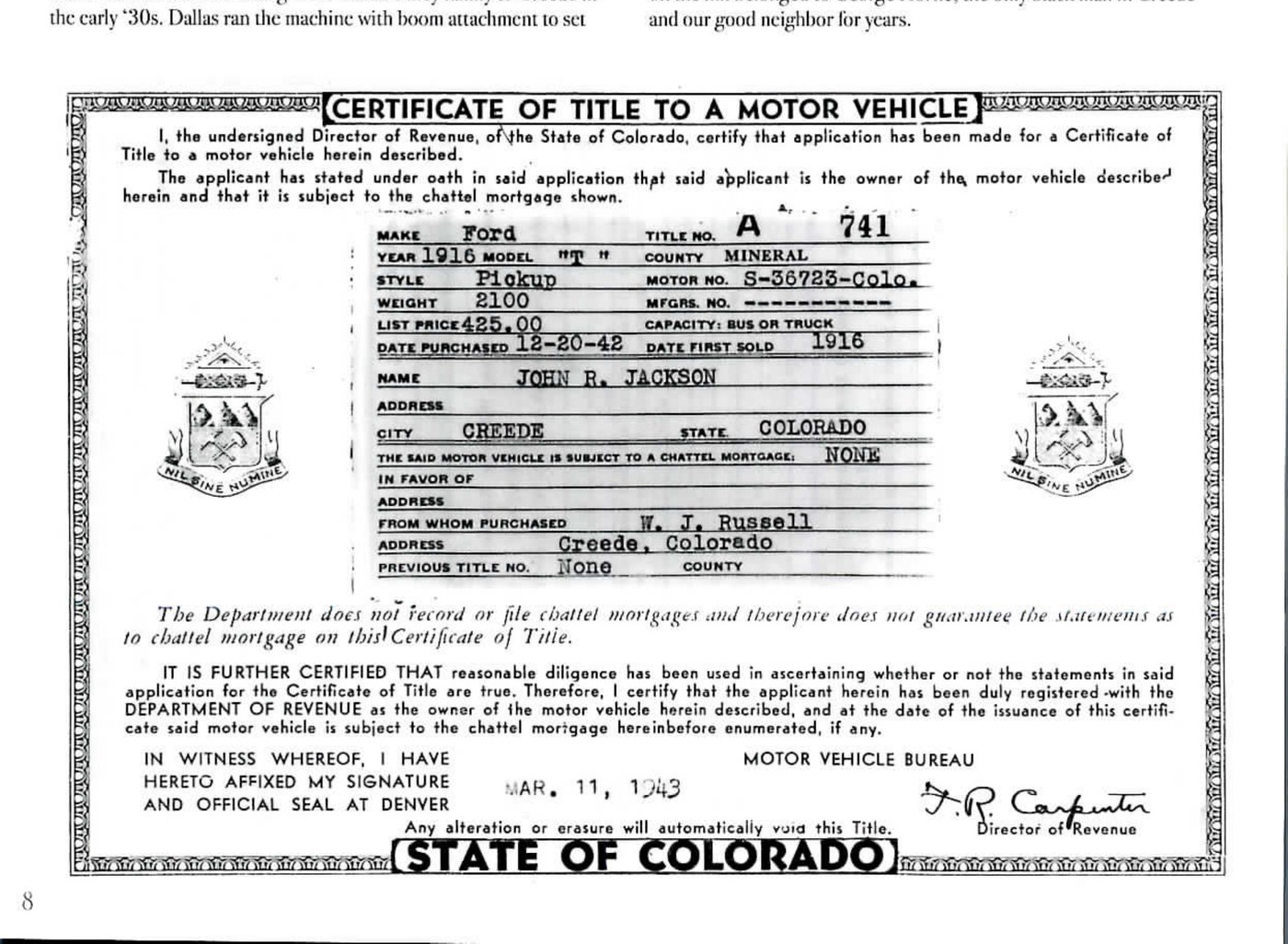
Printed page 8. The certificate gives the truck's motor number as S-36723-Colo., weight 2,100 pounds, list price $425.00, purchased by John from W. J. Russell of Creede on December 20, 1942, title issued March 11, 1943, no chattel mortgage. Racial language is the author's own description of a neighbor; kept as printed.
The Bullet Belt
In the year 1934 my father drove Sheriff William Orthen to a National Sheriff's Convention in Denver where he was presented with a Colt .45 caliber revolver in recognition for his service and being the oldest active sheriff in the nation.
Bill had a pearl handled .38 caliber revolver which he felt was all the firepower he needed and gave the new revolver to Dad. This made two revolvers to grace our household. The other was a .44 caliber with a heavy holster and bullet belt. They both hung in a closet off our kitchen where we three boys could look but not touch.
Mom Jo meted out punishment for minor infractions but when it came to major crimes like lying, stealing or sassing a neighbor she spoke the dreaded words that turned our knees to jelly, "Your father will use the bullet belt on you when he gets home."
Dad had a razor strop he used in the house if he was in a hurry but if Mom Jo had promised the "bullet belt" we went to the woodshed where he would remove the holster from the belt and order the chosen one, "Bend over the chopping block and hold your pants tight".
If it was me I would be crying lustily before he had the holster off. He would hang the belt in front of my face and ask, "Are you ever going to do that again?"
"No," I would blubber.
"I can't hear you," he would say.
"No!" I would shout.
"I still can't hear you."
I would scream, "No, no, no!"
With that he would work the belt through the loop on the holster and I was free to return to the kitchen where Mom Jo would have tears in her eyes waiting to hold me and tell me she still loved me. Dad would step between us and warn her, "Let him remember this for a day or two."
I never told Joel or Scooter that Dad hadn't really whipped me. They would ask how many times he laid it on and if any of the bullets had come out of the belt. It wasn't a real whipping if bullets didn't go flying from their pouches. I didn't offer anything over my sobs that might catch me in another lie.
After all these years and remembering their cries I'm sure their treatment at the hands of our father, Bill Jackson, was exactly the same as mine but I have often wondered if our Mom Jo knew of his method of punishment. All she ever heard were the screams, "No, no, no!" and her tears were so genuine. Too, she always found a way to comfort us after a bullet belt thrashing and Dad was out of sight.
Printed page 9 (bordered as a boxed page). John's account makes clear the belt itself, not the bullets, was the instrument, and that his own crying was performed rather than real; whether his brothers' experience matched his own is left as his own supposition, not asserted as fact.
The Lawbreakers
My father, William T. "Billy" Jackson, was undersheriff to William Orthen for many years in the late 1920s and 1930s. Sheriff Orthen was in failing health and Dad assumed more and more of his duties until Mr. Orthen decided he had had enough suffering and ended his life with a single shot to his heart, late one night, on the steps of a Creede business house. There were many suicides in that period of Dad's service and each one took its toll on him. They were all friends and old timers. He never talked about the deaths when he returned but there was a period of a week or two, after being called out, when he liked to be alone and come to grips with the loss.
I just ran across his 1918-1919 record of service in the United States Marine Corps. The honorable discharge reads "Character – excellent" and it made me very proud of this fellow who broke up a shooting war between two local moonshiners in 1932, arrested a few unsavory characters and flattened a fellow lawman with a left cross. He had his right arm broken cranking a Model T Ford, it had never healed right and the cop wasn't expecting a punch from left field. Dad stood only 5' 9" and never weighed over 145 pounds but he never flinched under pressure. The fellow lawman was Creede's town marshal, briefly. He was a big fellow, boisterous and hadn't endeared himself to the town council or the citizens. The council had asked him to resign, he thought Dad was behind the request and was giving him a tongue lashing when Dad decided enough was enough and fed him a knuckle sandwich that very effectively ended the quarrel.
In 1933 a pair of farmers from the Saguache-Center area were peddling potatoes at a dollar per hundred pound sack in Creede. Vern and Eugene were well known in Creede, came to dances with their wives and were considered honorary citizens. This was the beginning of the great depression and money was tight so they also traded for anything of equal value. On this trip pickings were slim. On the way home, just past Blue Creek, a deer crossed the road in from of them and stopped on the upper bank to watch them drive by. They weren't willing to go home empty handed so they shot it. They were just loading it in their truck when the game warden, Clarence Goade of Alamosa, drove up with his Chesapeake retriever on one of his infrequent trips. They were caught red handed, returned to Creede for trial where they were fined and sentenced to ten days in jail.
The town of Creede and Mineral County were also short of dollars then and Dad's arrests of perpetrators of minor crimes and tramps were kept out of court for the most part. He and Sheriff Orthen usually fed them one meal and escorted them out of the town limits with a stern warning to never return. A tramp or two wandered back but others were more than willing to continue on their way once seeing the poverty of the town and the condition of the jail.
The arrest and jailing of Vern and Eugene was a different story and needed a different approach. Dad solved the dilemma by unlocking their cell at 8:00 each morning and going on to his county treasurer's post. Vern and Eugene would then be on their own to walk from the jail to our house on the west mesa where Mom Jo would feed them breakfast. After breakfast they would roughhouse with Joel, Scooter and me for an hour or so before meandering back to jail. If they saw someone they knew they visited on their way ending up back in their cell with magazines and a Denver Post to read until Dad took them to the hotel for a free meal at 5:00 in the evening.
Vern and Eugene never forgot this trust in them by Undersheriff Jackson and brought us a sack of potatoes with every visit to Creede, however they left Mr. Goade's deer alone thereafter. They have grandchildren in Saguache County at this date who may have heard them tell of their ten day vacation in Creede.
Printed page 9 (bordered as a boxed page). Sheriff William Orthen's suicide is also referenced from Get Grandpa Off The Thunder Mug's "Please Moo Before You Drop In," where John's father is the one who found him; Vern and Eugene are given no surnames.
World War II Photographs
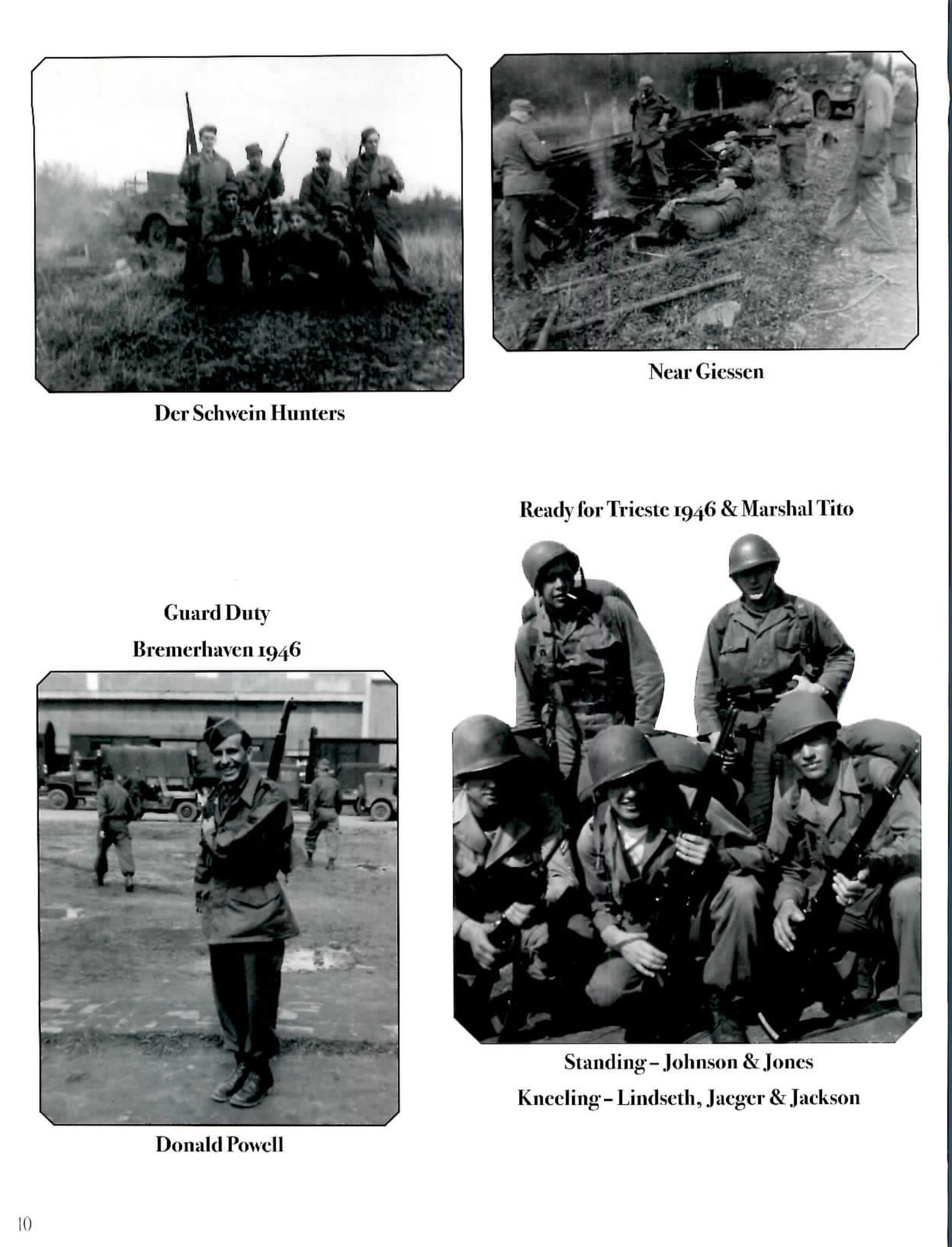
Printed page 10, an unnumbered page of photographs with no story text, following "Der Schwein Hunters" (below). Reproduced here as a single composite image.
Der Schwein Hunters
Early in the year 1946 the occupation of Germany had become routine after initial blunders and our platoon sergeant, Company F, 332nd Engineers, was planning a hunt near Giessen. In the waning days of the shooting war then Cpl. Jim Kent and his squad had surprised some feeding wild schwein and he had since wanted to return and bag a boar.
We were on our way. Sgt. Michael Kanuch of the motor pool, Sgt. Kent, Mess Sgt. Joe Hawkins, Cpl. Kenworthy and Privates Duncan and Jackson crammed into a Weapons Carrier carrying four bottles of Cognac, six rifles, sleeping bags and rations for two days. I couldn't believe the good fortune of Duncan and Jackson with lowly positions in Company F cadre to be invited on such an excursion until Sgt. Kent suggested we bring along all our cigarettes. Neither of us smoked but were allotted one carton per week and cigarettes bartered much better than occupation scrip or German Marks. We learned we would need many cigarettes, kippen as the Germans called them, before the weekend was over.
Cpl. Kenworthy was moving us along the Autobahn at a steady 35 miles per hour clip with one bottle of Cognac drained when we came upon a Military Police Jeep near an overpass. One MP was on the overpass with a radio and carbine and another was at the rear of the Jeep waving us to a stop. Kenworthy began slowing when Kent yelled "Don't stop, give it hell and go around him." We swerved to the left narrowly missing the soldier as he stepped out thinking we were stopping, when we emerged from under the overpass Kenworthy had the vehicle floor-boarded. The canvas top was flapping against its frame, the engine was roaring and it was hard to make myself heard as I asked Kent why we didn't stop, he grabbed the flapping canvas and yelled, "Because we sort of borrowed the Weapons Carrier, have a drink and shut up."
I was scared as hell but did as he directed, pulled a bottle from our gear and took a hefty slug. As I tipped it up I could see the MP on the overpass sighting the carbine and puffs at dust catching up with us on the roadside. I beat on the canvas and begged Kenworthy, "For God's sake stop, he's shooting at us!" I barely got the words out when the warm Cognac hit the pit of my stomach and came back up. As I was hanging onto the spare tire retching we came to a side road which Sgt. Kent ordered Kenworthy to take, throwing me to the other side on top of Duncan as the Jeep and the two MP's sped by on the Autobahn.
There was no way we could return to the previous route so we followed a narrow dirt road to a river where an old man and a slender boy, perhaps fourteen years of age, were sitting by a makeshift ferry moored to a dock of sorts and held in place by pulleys attached to a cable securely anchored on both sides of the river. Another, smaller cable, ran from posts on either aide holding that cable above the water. Kanuch could speak passable German and negotiated with the old fellow to ferry us across for two packages of cigarettes. Kenworthy eased the truck onto the raft and, surprisingly it sank very little. The old gentleman gave each of us slotted clubs and showed us how to hook the slots over the cable and pull to propel the raft to the other side. It went smoothly and within an hour we were heading east on another narrow road that Sgt. Kent assured us would lead to safety and good hunting though by this time he was drunk and not sure where we were.
We rounded a curve where two middle-aged Germans were cleaning an irrigation ditch. Kent ordered Kenworthy to stop and he and Kanuch walked back to the men. With much arm waving and excited ja ja's from the Germans, Kanuch determined we were in schwein country and the gentlemen would guide us. For two packages of Duncan's and Jackson's cigarettes they would put us on stands and they would drive the schwein to us. They took us to the end of what appeared to be about ten acres of heavy brush, spaced us along the sides and far end, and cautioned us to be careful and not fire in their direction. They told Sgt. Kanuch to be patient because they had to sneak to the other end and it would take much time to run the schwein our way. We waited...and waited, ... and waited. By dusk it was apparent we had been duped, all we could do was try to find a spot to camp with fresh water and a little wood to start a fire and warm up.
We were late risers. The Cognac had served us well, we all had hangovers and the thoughts of returning to a possible court martial didn't help at all but we gathered ourselves together, loaded the Weapons Carrier and were back at the ferry just after noon. The old fellow and the boy were on the far bank lazing in the sun. Kent hollered at them and motioned for them to bring the raft over to our side. The old man held the boy by the shoulders as he spoke to him rapidly and the boy then slid into a small rowboat and rowed to us. The current swept him in an oval pattern but he expertly let it help as he turned the craft. I grabbed the prow to beach it and Kanuch walked down to talk to him. The boy laughed as Kanuch began assembling words to get our message across. "I speak English," the boy advised and went on, "That is my grossfader (grandfather) and he would like six packages of cigarettes before we can bring the ferry."
Kanuch passed the request on to Kent who was still nursing a headache. "Tell him to go to hell," Kent barked, "he's only going to get two packs."
The boy rowed back to his grandfather and we could see them talking animatedly with the boy laughing and pointing our way. He climbed in the boat again and crossed in even less time than before. "Mein grossfader said to tell you he has already been to hell because of soldaten (soldiers) like you and he must have six packages of kippen because of the extra weight of all the schwein that you killed." Sgt. Kent was livid, the veins in his neck bulged, his bloodshot eyes wanted to leave their sockets and he was choking on the swear words jammed together on his tongue as he remembered the German farmers who had promised to chase "beau coup" schwein to us. They must have passed the word about the great American schwein hunters. The boy opened the pockets of his jacket to receive the cigarettes and looking directly at Sgt. Kent said, "My grandfather wants you to hurry because the French like American lorries (trucks) and they," he began giggling, corrected himself, "will have a patrol here soon." Kent was reduced to a pitiful groan. When we crossed the river we had entered the French occupation zone and if they seized the Weapons Carrier we would really be in hot water.
I never learned what strings were pulled to keep us out of the stockade when we were finally back with our unit but I did ask Sgt. Kent why he didn't tell us we were in a stolen Weapons Carrier. He answered, "You probably wouldn't have gone with us if you had known and we needed your cigarettes".
We went on several legal hunts after the first escapade and Sgt. Kent killed his boar near the town of Giessen where we had initially headed. I believe we all developed a healthy respect for the old Ferrymaster and his grandson. It took a lot of courage to stand up to a group of the former enemy armed with rifles and win a token victory.
Printed page 5, out of sequence with "Working Stiffs" and "Double Heart Failure" and printed before them in the book despite the higher printed page number; kept in the book's own order. "Aide" for "side" is printed as shown.
Hero For A Day
We were the entire cadre of the 1907th L.S. Company overseeing the disposition of 124 German prisoners of war. 1st Lt. Richard O'Neill from a midwestern state and PFC John Jackson from Western Colorado, assigned to the 332nd Engineers, attached to the 1907th because Lt. O'Neill had fractured his right hand knuckles in a disagreement with another officer and was doing penance and because I could use a typewriter and was able to fill out forms.
Lt. O'Neill had been married shortly before he enlisted in the Army. He was smart, dedicated and rose to the rank of 2nd Lieutenant when his unit was surrounded by German troops in the "Battle of the Bulge" and subsequently captured. As a prisoner of war all he dreamed of was his prim, pretty wife and home cooking.
The war ended, he survived intact and was among thousands with enough points to be returned to the states for discharge and not shifted to the Pacific theater where battles with the Japanese were still raging. He arrived in his old home town with several other heroes on a train that whistled and tooted in celebration as the steam engine edged the coaches to a platform at the railroad station.
The crowd cheered as the veterans of war in Europe stepped out with their barracks bags shouldered. Lt. O'Neill spotted his wife and in-laws in the first row and made for them. After a short speech by the mayor they were free to go.
The father-in-law drove them home in his 1940 Chevrolet griping all the way about the hard times they endured as the war progressed. Recapped tires, gasoline and food rationing and so little sugar he had to stop using it in his coffee. Dick was properly sympathetic as he marveled at his good fortune to be back with his wife after two years of dodging shrapnel from artillery bombardments and bullets from machine guns and rifles.
The in-laws' home was a two story affair with the guest bedroom, which Dick and Heather would share, directly over the old folks' bedroom. He unpacked his bag, in the bedroom as the ladies prepared the evening meal. Near the center of his accumulation he had stored the only war mementoes he was able to glom onto in their rush to relocation centers and assignment to troop transports headed home. He pulled out the German helmet and bayonet to show his father-in-law who was still trying to impress on Dick how the home folks had suffered, too, and later he would show him all the war bonds they had purchased to help the united effort. Finally, around 11:00 P.M., Dick was able to get his bride in bed. He snuggled to her, ran a hand through her long blonde hair, and made a suggestion. She pulled away and said, "Oh honey, we can't do anything here, Mother would hear us. Tomorrow you can look for a job and then we can get a house or apartment of our own and start a family."
Lt. Richard O'Neill was doing his best to understand her reasoning as he mulled over the other events surrounding his homecoming when a neighbor's dog began barking. He watched the hour hand of a windup clock on the dresser creep around to 3:00 A.M. without a letup by the dog. He could no longer cope with his many frustrations. He vaulted out of bed, grabbed the bayonet and tore out of the house. It took several minutes to corner the dog and he was oblivious to lights blossoming in windows of houses nearby as he ran the bayonet through the dog's yapper and silenced him. He turned from the still quivering dog, nude save for his shorts and a bloody bayonet in his hand, to face two very nervous policemen with flashlights and drawn guns who had been called at the height of the commotion.
His in-laws demanded his wife divorce him, the neighbors insisted he be jailed for killing their dog and his wife begged him to get psychiatric help. He thought it all over as he was being booked with everyone offering advice before he was led to a cell. He re-enlisted the next day and here we were, a year later, resting in a Jeep after a prisoners' check as he recounted his triumphant homecoming followed by banishment and divorce. He wondered if things might have gone differently if they had rented a hotel room instead of going to the in-laws' home, laughed and added, "No, I never did like that overbearing bastard and I don't think we could have ever got along."
Printed page 11 (bordered as a boxed page). John names himself among the 1907th's cadre and tells the story as Lt. O'Neill's own, recounted to him afterward; the dog's killing is left exactly as told.
Hell Cats
It was a Saturday night in 1949 when industry was thriving in Mineral County and its proceeds supporting three bars in Creede. One major mine producing steadily, two smaller mines shipping, on occasion, and three sawmills stacking up lumber and mine props. We worked six days per week and Saturday night was for socializing with a day off to recuperate before returning to the dark holes or timbered hillsides on Monday.
We were in the Rainbow Bar and Grill where seeds of unrest were most apt to sprout with loggers and miners tearing up the turf and each other. If the patrons were in a peaceful mood the owners provided a slam bang dragout with much swearing, and blood letting. "The Great White Ape", female half of the partnership, was belligerent enough when sober, when drunk she was as likely to spray the place with slugs from a .25 caliber pistol as to scratch and bite anyone within range.
On this night it looked like we might reach "drink up time" at 2:00 A. M. without a scuffle when a long-legged redhead thought her husband was paying too much attention to a logger's wife. It began with a few words of warning, a spilled drink and a bump or two then erupted into full scale war. I had learned to get my back against a wall after being coldcocked in a near riot one night by a round house punch thrown from somewhere to my right. I was standing with my elbows on the bar watching Bryan Beck and Pug Sutherland mix it up on one side while George Logue and a spud roller were trading punches on the other side. The next thing I knew I was sprawled near Bryan and Pug who were now wrestling and grunting by the rail. With people scattering to make room for the redhead and the brunette, Woody Wintz and I took a stand near the end of the bar where we could cover each other.
This wasn't your ordinary screaming, hair pulling contest. These gals had several bouts behind them with their husbands and flirting bar gals, they were throwing punches like pros.
The floor between the booths and stools didn't have enough square feet for the combatants and they ended up in the street with divided rooting sections, miners for the redhead and loggers for the brunette. The redhead had seriously underestimated the strength and endurance of the brunette. Within minutes she was on her back with smeared mascara and trickles of blood working into her curls from each nostril. The loggers won that one, but wait until next week.
Printed page 11 (bordered as a boxed page). No surnames given for the redhead, the brunette, or "The Great White Ape"; Bryan Beck, Pug Sutherland, George Logue, and Woody Wintz are named.
Survival of the Fittest
When visited by friends we haven't seen for years invariably, one will mention how lucky I am that Inez hasn't killed me. It isn't all luck. Much of my self preservation is due to calculated psychological survival. I'm not sure what that means, either, but it sounds technical so I slipped it in. I must admit I have tempted her many times and the only valid reason she hasn't dispatched me to eternal sleep is because I let my insurance policy lapse.
In 1951 I bought her a brand new .30-.30 caliber hunting rifle so she could join me in cold, wet hunting forays around Creede. She coped well most of the time and seemed to enjoy being out in the wild save for one trip that began in East Willow Creek thence up Third Gulch to a series of parks that ended near Half Moon Pass with the return hike via Farmer's Creek to Wason Ranch. Our footprints covered about twelve miles and if I hadn't taken her rifle the last three miles I'm sure she would have plugged me and then told the sheriff she thought I was an elk. She, alternately, threw rocks at me and cried until she was too tired to pick up a rock and too dry to wring out a tear. The next year she guided herself.
A few years later I arrived home at a late hour in less than honorable condition after a sterling performance by the "Upper Willow Creek Glee and Choir Club" conducted by Newt Turnquist, of a Denver mine equipment firm, until he was unable to lift the baton and direction was taken over by Eugene D. McClure, manager of Tomkins Hardware Company. When a member finishes such exhausting rehearsals the last thing he wants to hear is a carping wife reminding him of his failures as a husband.
I loaded the rifle, levered a shell in the chamber and told her, "Okay, you get the first shot and you had better make it a good one!" She dissolved in tears and the crisis was over.
See! That's what "calculated psychological survival" means. If I had just known of the curative powers of jalapeño peppers during those years we would have had less problems. She has joined me in eating one pepper at lunch each day. A mild pepper will leave her speechless for 30 minutes, a pepper spouting fire from both ends mutes her for a full two hours.
Printed page 12. Told throughout as comic exaggeration of John's marriage to Inez, including the loaded-rifle anecdote; kept as printed.
Graveyard Poker
The moon was full and the tidal pull
made the timbers creak and groan
in the Last Chance shaft where a natural draft
brought forth a quavering moan
Near the end of our shift in a square set drift
mucked out, timbered and clean
the rail spiked true for the day shift crew
Frick Nelson, Gus Prince and Al Dean
We learned at the station of a minor complication
when Red belled for a lift to the collar
the skip got hung when a guide rail sprung
the overtime would gain us a dollar
With nothing to do 'til the maintenance crew
got everything back on track
Bill says "What the heck" and pulls out a deck
"a little poker will take up the slack"
A make shift table on top of old cable
was level enough for a deal
he shuffled the cards for his mining pards
though he knew each one by feel
A hair raising feeling as Bill started dealing
made me turn to a ghostly arrival
an eerie apparition with roots in perdition
searching for means of survival
A rumbling cough dislodged a thick broth
of silica dust and green phlegm
that he spat toward the wall, rolled into a ball
and quivered in silent requiem
I fingered three Jacks and tried to relax
from a haunting premonition
things wouldn't go right on this fateful night
with this refugee from perdition
Relieved when I saw, two Kings on the draw
a full house the very first caper
I scribbled I O U, ten dollars would be due
the bearer of this slip of paper
Red says "I'm through" and Bill folded, too
as the ghost slowly pushed in his poke
a prospector's pride, gold gleaming inside
this wraith was going for broke
My senses went numb as the stub of a thumb
fanned his cards to see what he drew
he whispered "I'll call if it's winner take all
and your soul goes with the I O U"
It was then I remembered a miner dismembered
at this very shaft, I was told
crushed by a skip that fell from the lip
I shuddered and said, "I'll fold"
Printed page 12 (bordered as a boxed page). A closing poem in the ghost-story tradition of the book's title; no note in the text on which mine's Last Chance shaft is meant.
Ed and Cherokee
Ed McCargish was not a hell cat or a she ghost in the sense that Key LeZotte perceived such but he was different. Ed had been a coal miner in Trinidad before coming to Creede and was pretty much a loner for the first couple of years working in mines controlled by Emperius Mining Company.
I first worked with Ed in the year 1947 when he timbered for me in an open stope. Big timbers were solidly wedged and I felt comfortable drilling from them, less comfortable when we ate our lunch at noon break. Ed had a large, purplish growth on the wrist of his right hand. I didn't ask about it though I did wonder why he didn't have it removed. Every lunch period the main topics of conversation revolved around the Pope and Priests and in a most unfavorable light. When he felt we were well enough acquainted, the story unfolded of his broken marriage allegedly fostered by a Catholic Priest. He had tried to kill the fellow and injured his wrist therefore the growth and he would keep it to constantly remind him of his wife's infidelity and the Priest. The visits disturbed me and I was relieved when Ed replaced Paul Weaver on the hoist serving our level.
The old Irishman was a good worker and a fair poet. He published a small booklet of his rhymes and through it had somewhat of a fan club in Creede which, in turn, directed his attention from Priests and the current Pope so we had a much better relationship and I hired him to help in hoisting and timbering at the Phoenix mine. He reeked of garlic that he constantly nibbled and a couple of the men complained of the smell, however he was punctual and never missed a shift.
I first picked up Art Davis each morning then drove by the Creede Transportation Company garage where Ed would be waiting on the step under cover of an overhanging roof. It was winter, early 1952, and just as Ed stepped on the running board of the truck his other foot slipped on ice and he hit on the back of his head with a sickening thud. I ran around the truck to help Art get him on his feet sure he would have a concussion and would need medical help. He had on a stocking cap under his old, black felt hat that partially cushioned his fall and when I dusted the snow off his hat and asked him how he felt he climbed in the truck without answering.
That ride to the mine will never be forgotten. He let loose with interconnected swear words that formed a satisfactory description of Priests and Popes, in his opinion, for the first two miles then he launched into a tirade about the F. B. I. and J. Edgar Hoover who had his house bugged and watched his every move. I had made up my mind, by this time, to take the rest of the crew to the mine and return Ed to town for a visit with Agnes Egan, a registered nurse, and very likely a hospital stay. When we reached the mine Art stepped out first followed by Ed who grabbed his lunch pail and started for the dry room still ranting and raving. He had barely cleared the rail leading to the portal when he, again, challenged a patch of ice with the same results, a sharp crack to the back of his head that resounded in the thin morning air. He was noticeably dazed, sat for a few seconds and, as I helped him to his feet, said, "I must be getting old and clumsy." He didn't remember the first fall nor the ride to the mine and insisted on putting in his shift. He never again mentioned Priests, Popes or J. Edgar Hoover.
Only a few years before this session with Ed I was an ore hauler for Creede Transportation Company on my way to the Amethyst Mine with a passenger who called himself "Cherokee". He was quite drunk, noisy and waving his arms from window to window as he sprayed the dashboard and my right cheek with tobacco juice. He looked wild eyed at me and confided, "I'm really an F.B.I. agent and I've been working undercover here. You'd better watch your step because you're on the list." I was a seventeen year old smartalec kid and I had violated laws in various ways but I was certain no violation was serious enough to merit being on a F.B.I. list.
Ed McCargish had a different personality that worried me but he never scared me. Old Cherokee scared the hell out of me and I believe he fit well in Key LeZotte's category of "Hell Cats and She Ghosts".
Printed page 13. Ed's head injuries and paranoid talk of the FBI are told as separate, back-to-back falls; John draws no medical conclusion beyond his own worry, and none is added here.
Curiodditie s
Most of this prattle is being written in February and March, 2001, to combat cabin fever. If I'm sitting at my desk with my brow furrowed Inez believes I am deep in thought and leaves me pretty much alone. One time when she checked she found the furrowed brow was caused by a glassful of prune juice that worked without warning. She approaches me carefully now with her nostrils flared.
Creede made Ripley's "Believe It Or Not" in 1944 as you have noted. Mineral County's elective offices paid very little in its juvenile years and those in office held other jobs, simultaneously, to make ends meet. My dad was treasurer of the county, clerk of the district court and a butcher for A. H. Major which, combined, brought in $130.00 monthly, equal to a male teacher's salary. Johnny Weaver, county assessor, was a foreman at the Commodore mine during his term in office. Bill Swinehart, county sheriff following William Orthen, worked at both mines and mill for a living wage. Herbert Barnhart was the only county officer, long time county clerk, who didn't have additional employment at that time.
Of interest and I have always thought a curioddity, we had two families of Weavers in the county. Arthur and Minnie Weaver owned a resort, Antelope Park, and had four children, Stanley, Ivan, Woodrow and Minnie. They were all Republicans. Thomas and Mary Weaver also had three boys and a girl, John, Billy, Paul and Mary. They were all Democrats. Both Ivan Weaver and Billy Weaver were town electricians in different periods. I worked for Billy one summer replacing power poles and also worked with Paul at the Amethyst mine. I was around all but Mary, who had moved to Pueblo, and could never detect the political difference. Under the skin I believe we are all Americans.
The following isn't exactly a curioddity but I have no other place to put it without changing the index. A word battle erupted between a bar owner and his wife late one night as she was totalling the day's receipts and stuffing them in a money bag that also contained a .25 caliber pistol. He needed a little cash and she wanted to hold all for deposit. It became more than a word battle with a punch or two thrown when she grabbed the pistol and aimed it at his midsection. A dear friend of mine stepped between them and asked her to put the gun down. She responded by shooting him. The slug entered by his belly button and exited near his left kidney missing her husband completely. The moral to the story is: If you must take sides in a domestic dispute stand firmly "behind" the husband.
Printed page 13. "Some seventy years age" elsewhere in the book and "curioddity"/"Curiodditie s" here are printed as shown; this story's opening line, dating the writing to February and March 2001, is the firmest date given anywhere in the book. Mineral County's Weaver families are two of several same-surname, unrelated households noted across John's books.