"Get Grandpa Off The Thunder Mug": Chapter I
Chapter I runs from printed page 1 through page 9 and holds seven stories: a running gag the author calls the "Creede Running Crew," staged seductions with a decoy named Rosie and a jealous "husband" who fires blanks at the mark; a memory of the author's mother's family roughing it at a mining camp near St. Elmo; a summer on the county road crew and the older men's barroom talk; a deer poached from the family car; a maggot-infested ham and venison; and a mouse that fouls a mine-camp water tank. The first story's central character is introduced by a boyhood nickname that is a racial slur. The book prints it without comment or explanation, in the story's title and text, and it is kept here exactly as printed.
Jigaboo Bowels Out
The Great Depression wasn't all hardship and empty bellies. In our little mining town of Creede the sidewalks were unrolled on Saturday night and western music filled the air on Main Street when Loyd Wanzer, Howard Midkiff and a mouth harp playing young fellow from the CCC barracks went into action between Jimmy Rearick's cafe and Stanley Weaver's beer parlor.
Loyd Wanzer was a left handed fiddle player and Howard Midkiff played both banjo and guitar. They had a fur lined thundermug to receive donations. One of our group, a long legged kid we called Jigaboo danced as long as the band played. We thought Jigaboo was a stave or two short of full round as he cut capers on the sidewalk and flung his feet in circular motions over his head. We clapped and yelled when he was at full throttle sure that in one of his gyrations a leg would wrap around his neck and throw him into the next county.
A quartet of fun lovers, Elmo, Slim, Al and Bryan, who were all in business at the time occasionally ran a newcomer during the summer to liven things up. When the time was right and they had a good prospect they would get a young gal to play the part of Rosie whose husband worked night shift. The main scene involved a cabin in Sunnyside near the Silver Horde Mine where Rosie received visitors without her husband's knowledge. She would be reading by a coal oil lamp with a bed in the corner as the main prop when two of the four conspirators brought the "mark" to Rosie. They would draw straws to see who went in first and the mark always got the short straw.
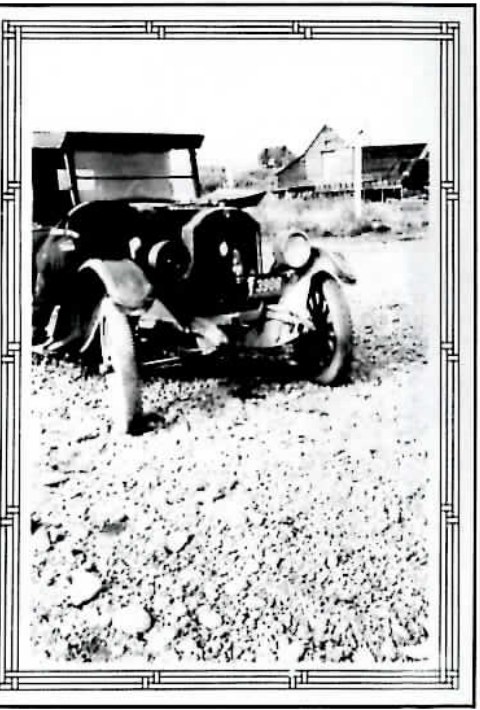
If I can get old Betsy running
I'm gonna go where green grass grows
where folks ain't heard of Rosie
and the milk of kindness flows
Jigaboo had reached eighteen years of age and it was time for him to enjoy some of the wonders of the world. Elmo approached him and asked if he had ever visited the little gal in Sunnyside? Al brought them a beer and they began small talk about Rosie's qualifications in bed. After another beer they really had Jigaboo's attention and Al said they would take him along if he had two dollars for the fee. He didn't but Elmo offered to ante up if Jig promised to pay him back within a week.
The run went off without a hitch. Just as Jigaboo was handing Rosie Elmo's two dollars the jealous husband burst in the room screaming, "I knew you were the one coming to see my wife while I was at work." With that he aimed a long barreled revolver at Jig's head and told him he was going to blow his brains out. Jigaboo was trying to explain the situation when Elmo and Al came charging in to save him and Elmo received the first shot right in the brisket where a blood bag had been placed. Al yelled, "Run Jigaboo, for God's sake run, he's going to kill us all." And Jigaboo ran as pistol shots reverberated in the canyon.
Poor Jigaboo lost control of both bowel and bladder as he tore up the hillside to safety. It was over a week before he could be coaxed from hiding to learn that Rosie and her husband had left the country and Elmo would recover from his wound. Their words were convincing enough, but Jigaboo always wondered about the heavy set fellow in the movie theater, he looked enough like the jealous husband to be his twin.
"Jigaboo" is a racial slur. The book gives the character no other name and offers no explanation for the nickname; nothing here identifies him. The photograph and verse, captioned "Jigaboo (the dancer) Changes Spark Plugs," are printed in the middle of this story's second page, where they interrupt a sentence; they are moved here to the nearest paragraph break and the story's wording is repaired around them. The image shows a car in a farm yard, not a person changing spark plugs; the book does not explain the mismatch. This staged "Rosie" con is the same one described in "Strung Out to String Up," next, and the same one behind the Whiskey Drinking Contest photograph in the book's front matter, captioned there as the "Creede Running Crew." The Silver Horde Mine and Sunnyside also appear in the "Blond Bomber" stories elsewhere on this site.
Strung Out to String Up
A four star performance of the "running crew" occurred in 1936 when a genuine municipal water works was being installed for Creede with a dam and intake in East Willow Creek canyon thence piped six feet underground to the town proper.
The foreman of the contracting company had just received a haircut in Elmo's barber shop and they were discussing the progress of the water job. The shop was deserted save for the two of them and Harry felt it was an opportune time to inquire if Creede had a red light district. He told Elmo he had been in town over a month and was getting a little hard up. Elmo told him they didn't actually have a whorehouse, but a little gal in the south end of town helped them out when her husband was on night shift. He added that Mel had changed shifts that week, he thought. He'd check to make sure and if the coast was clear he would escort him to Rosie's and introduce him next Saturday night after he closed his shop.
The running crew had nearly four days to set up props and gather extras for the cast. Saturday night, 8 o'clock sharp, Elmo and Harry drove near Rosie's house in a 1934 Chevrolet pickup, parked in a dark alley and went on foot to the rear door where Rosie greeted them and led them to the living room. Elmo introduced Harry and said he'd wait outside so as not to embarrass them. He had just started to open the door when he was knocked aside in a flurry of action as Mel burst in and fired one shot just before two law officers, right on his heels, grabbed him. Elmo was just getting to his feet when Slim explained that they had seen Mel running toward the house with a gun and knew someone was going to get the hell shot out of them.
Harry was crouched by the bedroom door in shock, Rosie was crying in a far corner as Slim ordered Harry, "On your feet, we're taking you and Elmo to court, this kind of business has gone on long enough and, bigawd, we're going to stop it." Bryan put handcuffs on them they had borrowed from the real marshal and the culprits were marched to a waiting car.
They were gathered in the court-room, Judge Archie "Spud" Fellows presiding. Judge Fellows was a fearsome sight to the foreman of the excavating company. He had large eyes that seemed to nearly bulge from their sockets and he was in a foul mood having been summoned to hold court at night. He scowled at the pair and ordered Slim to remove the handcuffs.
By this time Mel had gathered a lynch mob from the B & B Bar and they were pounding on the double doors screaming threats to all inside. Judge Fellows banged his gavel, demanded order in his court and looked Elmo straight in the eye.
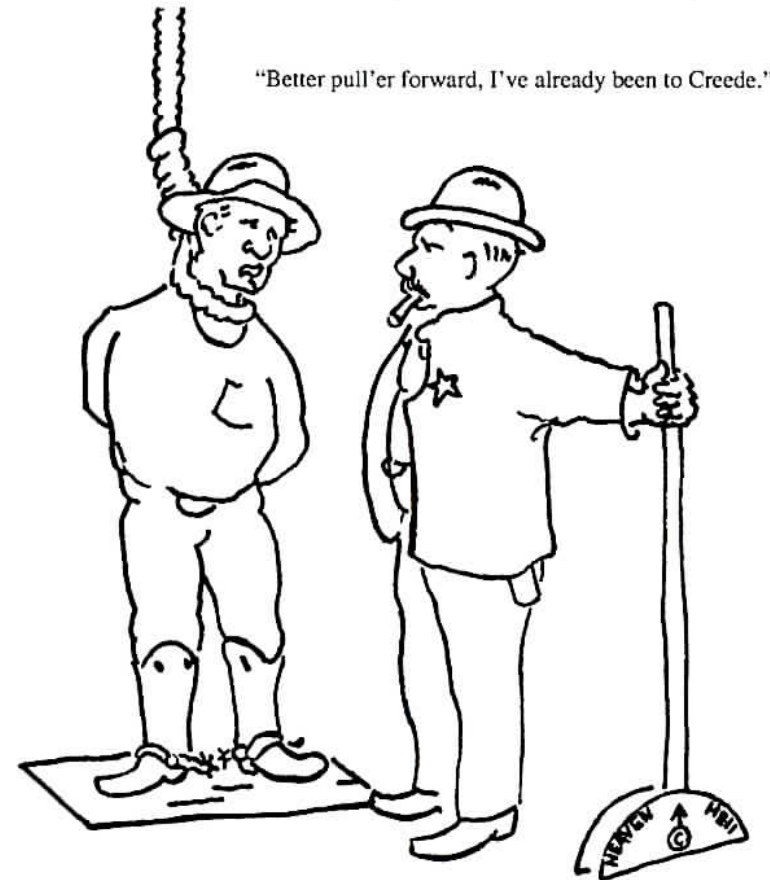
"You, sir, are nothing but a whoremonger, you have been before me twice on this same count and I should let that mob have you."
Harry was fumbling with his billfold.
"You can't buy me off, young man." he roared at the pale and shaking Harry.
Harry dropped his billfold, retrieved it and fished out a snapshot from one side.
"I just wanted to show you this picture, this is my wife and my little girl, please your honor, she'll leave me if she hears about this."
"You should have thought of them before you..." Judge Fellows started to lecture him when the doors were breached and the lynch mob overpowered the law officers, Judge Fellows disappeared, and the prisoners were seized.
Cast and crew then adjourned to the nearest bar where drinks were on the house and Harry learned he was victim #6 of the notorious "Creede Running Crew."
Illustration by Joel Tankersley; its own caption, "Better pull'er forward, I've already been to Creede," is printed under the drawing and is given here as its figure caption rather than left inside the story text, where it originally interrupted the sentence about Judge Fellows banging his gavel. Archie "Spud" Fellows is the full-time moonshiner of "Hellions and Moonshiners" and appears again in "Who Upset the Thundermug," Chapter IV, in the photograph captioned in "I'll Drink to That." The book does not name Harry's surname or Mel's, and this "Mel" is not connected here to any other Mel on the site.
Let's Hear it for the Ladies
With so many feminist groups seeking equality for women the male faction is becoming increasingly beleaguered and rightly so. As youngsters we made heroes of our Fathers and generally took our Mothers for granted. They were the ones who soothed our hurts, darned our socks, patched our trousers and put nutritious meals on the table in good times or bad. As I look back on our childhood I can't help but wonder how our Mothers survived.
An especially rough time was in 1933 when the Davis brothers were working a promising lead-silver prospect near the little town of St. Elmo, down Chalk Creek from Tincup Pass. Our Father was Mineral County Treasurer at the time and was helping out with supplies. On one trip he drove his family from Creede to spend some time with Aunt Caroline and her brood who had settled in what had been a bunkhouse of a bankrupt mining company. The building had a large cook stove and little else. For the most part it was open to the elements other than the roof which was tin covered and didn't leak.
The men, Frank, Woodruff, and Arthur, hiked to the diggin's each day where they were driving a tunnel with single jacks and hand steel. They carried a rifle along with explosives and were always on the lookout for wild game. The women and older boys took care of all camp chores and the ever present wash tub with scrub board rested on blocks of wood on a porch. Every spare minute of Aunt Caroline, cousin Rosebud and Mom Jo was spent on the washboard keeping clean clothes on the lines for the entire crew of 6 adults and 7 children.
We had only been there a few days when Uncle Frank borrowed a mountain sheep from a small herd of the Collegiate range. He usually settled for a deer, but the sheep was available, in a reasonable distance from camp, and he dropped it with a single round from his .25-.20 Winchester.
There were several people in the area. One lady lived in St. Elmo who was called Princess and was supposed to be a descendant of a prominent European family. Another old fellow lived in a cabin further up the creek and owned a mine near the pass. We also saw a vehicle each day traveling to the Mary Murphy Mine where leasers were shipping a little ore.
Someone reported poaching by the Creede rabble to the Game Warden in Salida who promptly fired up his Model A sedan and came to apprehend the culprits. The carcass was well hidden but the heart and liver were in a two gallon bucket with offset ears and bale in the kitchen when the warden arrived. Aunt Caroline saw his badge and plopped herself on the bucket. There was a scarcity of chairs in our living arrangement. We rested or ate on powder boxes or benches but a wired up chair was available and Mom Jo directed the stranger to it as she poured a cup of coffee for him. He inquired about the men, the mine, Creede town and our general well being as Aunt Caroline smiled and answered from her low perch on the bucket. He had another cup of coffee with Caroline becoming increasingly uncomfortable, but still smiling and rock solid on the bucket. I have since wondered if the fellow thought it was our thundermug.
Eventually he left the bunkhouse, made a tour of the premises then returned to thank the ladies. Aunt Caroline was still on the bucket and didn't move until the sounds of his car died in his dust trail. She had to be helped to her feet, but the dear lady had saved the day and our evening meal.
"Frank," "Woodruff," and "Arthur" are, per family knowledge, John Franklin Davis, Albert Woodruff Davis ("Uncle Woody"), and Arthur M. Davis, John's uncles. "Mom Jo" is Alice Josephine Davis, John's mother. "Our Father" was William T. Jackson, called "County Treasurer Bill Jackson" in "Echoes from the Thundermug." "Cousin Rosebud" is not otherwise identified on this site; "Echoes from the Thundermug" names an "Aunt Rosebud" in a different story, and it is not confirmed to be the same person. St. Elmo, Colorado, and "Aunt Caroline" do not appear elsewhere on this site under those names.
Triple X Shale Pit Academics
There was nearly always a job for a willing hand around Creede in the late '30s. Ranch hands were earning $30 per month with board and the retail stores would sometimes hire a young fellow for 35¢ per hour. The best and highest paying jobs for students were part-time employment with city maintenance and county road crews.
I was among several of the huskier boys who had both summer time jobs and weekend work with Mineral County under the supervision of Kearney Higgs. The oldsters at this time were Fred "Soapy" Birdsey, Art Neal, Witt Thomas, Lee Love, Fred Ast and, occasionally, John La Font. We did much rock work on wash-outs along the narrow grades, replaced wooden culverts and shoveled gravel into dump trucks hauling loads to a maintainer operated by Frank Powell.
We were good workers, liked the feel of four dollars a day and tried to outdo each other at every task. Kearney was proud of us. I relished the work in the gravel pits above all because of the banter that went on between the oldsters as we ate lunch on a warm day. We would gather on one side of the pit where wind wouldn't disturb us and revel in the warmth of the sun on winter days. I arranged to be near Witt and Soapy as their conversations were usually the spiciest and most humorous.
Creede had a brothel of sorts at the time. An old veteran who had operated minor league whorehouses in different locales opened a cafe by Soapy's pool hall and barber shop with two long legged waitresses and a sheepherder's tent roped up at the rear of the Elk's Hall for customers who wanted something more than a chicken fried steak. Soapy's coal bin and woodshed were within 30 feet of the tent so he knew what was going on and he had a list of the patrons in his memory bank.
Within a few weeks several of the miners, one rancher and two influential citizens were sporting evidence of a social disease. Soapy was telling Witt about one of them, a rough cowboy.
"Lucas didn't know what the hell was wrong with him until it nearly fell off...told me he went to take a leak and it hurt so bad he jerked a fence post right out of the ground. Felt sorry for Herman, hell, he never fools around but he got drunk and George got him fixed up with the red headed one...his wife was going to leave him, but they got things patched up...he'll damn sure never go back...not even for a cup of coffee."
He turned his attention to me. "I see you squiring Tenbock's oldest daughter around...better be careful...you get funny with that little girl and that big dutchman will change your voice."
"Did your ladies from Alamosa get up to see you and Snoosie last pay-day?"
"Yeah, they finally made it. They were on the galloping goose (a rattle trap bus of the day) and it lost a wheel near Masonic Park...Sam had to bring them on up to Snoosie's place...his wife was fit to be tied...told him not to haul any dammed hookers in their car again."
"I notice Snoosie always has a little cute one, can't you talk him into swapping with you?"
"Well...the way I see it...I'm getting a helluva lot more for my money."
"You've been around Milt a lot in the timber and hauling logs, is he all the man he claims to be?"
Witt had to think about that for awhile. He had a rather high pitched drawl that sounded like it came from his nose.
"We were waiting for old Tingley to get out of the way so we could unload at the Amethyst and Milt came walking up beside me. He took a leak so close it splattered on my boots and I can tell you this, he had more in front of his thumb than I have behind mine and I'm pretty well equipped."
The crew roared at that exchange and it even brought a chuckle from Kearney sitting on a running board of one of the trucks.
Another day they drifted back a few years.
"Do you remember when Willy was playing around with Myrtle, she used a window shade to tell him when the coast was clear?"
Witt had his hat tipped down near his eyes and was half asleep, he snorted and nodded.
"Myrtle got her signals mixed up one day and Willy come visiting when Ralph was home...guess it surprised all of them, but Willy was always quick on the trigger. He told Ralph he needed some help at the sawmill and wondered if he would take the sawyer's job...hell, Ralph's no sawyer, he can hardly get up town and back, but it puffed him up like an old toad...he told Willy he'd think about it. Walt lives right beside them and sees Willy slipping in when Ralph's at the beer parlor...I wouldn't wonder but what old Walt pays a visit now and then too."
Raunchy old birds? Sure they were, but we loved every one of them. They looked after us and they made it known if we were going to get a man's pay we were going to do a man's work. We picked up the slack when they tired and we took the dusty side when the wind was blowing. They appreciated the smart alec kids from Creede town and they taught us a lot.
The contents page shortens this title to "XXX Shale Pit Academics"; the body heading, given here, spells it out as "Triple X." The same county road crew, minus the barroom-talk names below, appears in "Echoes from the Thundermug," in "Toils and Foibles of the Depression Kid," which spells "LaFont" as one word where this book spells it "La Font." Lucas, Herman, George, Tenbock, Snoosie, Milt, Willy, Myrtle, Ralph and Walt are named nowhere else on this site and are not indexed here as a matter of course, since the story trades in their reputations rather than their histories.
Aspen Short Cuts
We were on our way to Seepage Creek where the northern flights of ducks found open water and lush feeding grounds by warm springs on the long autumn journey to the Gulf of Mexico. We could nearly always bag a few mallards or teal here and occasionally a canvas-back that made prime eating when baked with apple slices and sweet cream. We even dropped a goose on one trip, but it glided to a crash landing where a coyote was closer and made off with it.
We had passed seven mile bridge and were nearing Fir Creek grade when Dad spotted a small herd of deer in a clearing surrounded by aspen trees north of the road. We coasted to a stop to watch them feed. There were four does and one small buck nosing their way in browse. As we watched, a doe near the rear jerked it's head up and flashed it's tail to warn the others that they were in danger. They bounded into a strip of trees appearing in the upper edge of another clearing minus the buck. We had barely heard the report of the rifle, but there was little doubt about the disposition of the buck deer though it was well beyond any legal hunting season.
Poaching, or borrowing as we liked to call it, was common practice for many in the area. For some families venison and cotton-tail rabbit were the only meats decorating the dinner table. We didn't want to draw attention to the borrower if a warden or deputy was in the area so we continued on our own hunting trip.
We turned off the main road near Tom Powell's ranch and followed a narrow, rutted road that followed a low mesa near Seepage Creek then turned west in a dip below Lower Seepage Lake. With Dad and his pump shotgun out of sight below the dam I took a route through the timber to emerge near the upper end of the lake where several mallards took off in noisy flight before I could get a shot. They swung to the far side as if to gain altitude and go upstream to Santa Maria Reservoir then turned again and flew directly over Dad. I saw two drop before I heard the reports and by the time I returned to the car Dad had retrieved his greenheads. We bagged two more stragglers along the creek and headed home to pick and clean them before dark.
As we neared Kid Gulch, in return, a red Diamond T pickup was just pulling onto the highway ahead of us from the side road leading to the park were we had seen the deer feeding. It was heavily loaded with dry aspen logs and we thought it likely the wood covered the carcass of the freshly killed deer. We recognized the truck and we were well acquainted with the driver, a partner in a mining lease that wasn't pulling in many dollars.
We let him get ahead of us, followed for a couple of miles then began honking. With each blast of the horn a long arm would stretch from the driver's side and wave us by. This went on nearly to the Broadhead Ranch before Woody tired of the game, stopped his truck, and came storming back to us to inquire, "What the hell's going on Bill?"
Dad said, "We thought you should know that all the sap is running out of your wood."
Woody turned to see a small red puddle under the end gate of his pickup and more red fluid dripping to enlarge it. He put his hand on Dad's arm and sheepishly asked, "If you'll stop your honking and let me get to town I'll give you a hind quarter of that wood?"
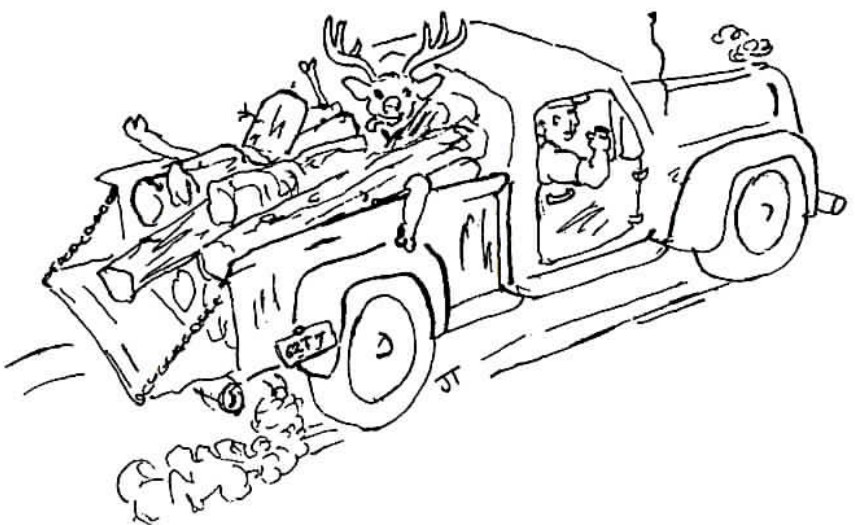
"The park were we had seen the deer feeding" is printed as written, "were" for "where." This "Woody" is not identified further; the book gives him no surname, and nothing here connects him to Woodrow Weaver, whose burro is called "Woody" in "Bearly Heroes," Chapter III, below. "Dad" is William T. Jackson.
They Only Tickle When You Swallow
It was a normal beginning of a summer day in the kitchen of Loraine Wills at the Lake Cliff guest ranch. I had just restocked the woodbox, Grover McDaniels was trading barbs with "Lo...rain...y" as he called her in his Texas drawl, and Billy was cutting slabs from a cured ham he had just taken from a window cooler on the shaded side of the sprawling ranch house.
Loraine had laid the ham slabs in a large cast iron skillet, poured Grover a cup of coffee and ordered me away from the stove. I usually obeyed her without question as she was a force to reckon with when she had her dander up, but as the skillet began to sizzle I saw the slabs come to life and I couldn't take my eyes from them. Little snow-white maggots, disturbed by the heat, were crawling over the upper sides.
Refrigerators hadn't entered our lives and window coolers or spring sheds protected perishables, to a certain extent. Blow flies were a constant problem however, and in this case had found a hole in the screen.
Placing a hand over my mouth Loraine commanded: "Billy, come here please." Grover was still struggling with his shoes as Loraine pointed at the skillet. Billy never at a loss for words said, "I'll have mine well done, but I expect Grover will want his squirming a little."
As Billy held Grover's attention Loraine disposed of ham, occupants and skillet in the garbage pit. Later, Grover ate his scrambled eggs without a question about the ham he had smelled frying.
In August of a later year I was at the Lane ranch when a couple of fellows came driving in with a small buck deer in the trunk of a 1937 Plymouth coupe. They were fishing in upper Shallow Creek when a small herd of deer crossed near them, Al always carried a pistol and when the buck appeared he took a quick shot at it's head. Wonder of wonders it dropped on the spot and spoiled their fishing trip.
I helped them skin and quarter it. Then, after disposing of incriminating evidence, we hung the meat in a large root cellar. After two weeks of aging Art came from Creede and we carried the quarters to a cabin to finish carving and divide the free venison.
It resembled the ham at Wills' ranch, only more so. Maggots were well entrenched in the ribs and neck with the hind quarters carrying fly blow. As we cleaned it and cut the worst of the rot from choice cuts Art warned me, "Damn you, don't you tell a soul about this or no one will eat it."
Several days later I saw Al and he told me that was the best venison he had ever eaten and he planned on getting another next August. I couldn't vouch for the taste. I like wild meat, but I passed that well tenderized venison for potatoes and gravy.
Loraine and Billy Wills of the Lake Cliff Ranch appear in "Echoes from the Thundermug," in "Black Drought Basics." The "Lane ranch" belongs, per family knowledge, to the family of Charles Lane. "Art" here is given no surname and is not confirmed to be a specific person documented elsewhere on this site.
Smooth as Silk A'Goin' or A'Comin'
I returned from work one evening to find my bride all hunched over with a death grip on the sink. She looked as pale and shaky as Wylie Turnquist when he learned his girlfriend had flunked the rabbit test.
I figured she had either met the Overnight Express driver, who travels like a bat out of hell on our narrow road, or she had lost a footrace with one of the whiteface bulls in the west 40.
As it turned out it was far worse, in her estimation. She had been using more water than on a normal day and had gone up hill to check the depth of water in our culvert-type storage sump. There she found a mouse, hairless and bloated, floating in silent repose. She had spent the remainder of the day retching, choking, gagging and dragging herself around.
In 1953, I left the Phoenix property to lease the Holy Moses group of claims from Allen Hosselkus, Alex Duncan and Ralph Ellithorpe. I installed a water tank in First Gulch with an outlet near the road in East Willow Creek Canyon. From the tank we drew drill water, compressor coolant and drinking water. It became less than potable after a couple of months, not putrid but with what could be called a distinctive taste and odor.
William "Scooter" Jackson, who was helping me sink a winze in #2 Tunnel, had long since quit drinking from the overflow pipe as had the crew from the Outlet Mine. Pete Walker, our ore hauler, and I continued to drink our fill each day and filled our canteens from this icy cold, snow melt and remarked to each other that the pipe must be rusting to cause the peculiar taste.
After we mucked out and drilled the floor of the winze Scooter would leave me to tamp explosives as he did maintenance work outside the portal. He usually hauled a barrel or two of water for the next day's use among other duties. On this day I had timed the fuses leading to the primers lit them with the flame of a carbide lamp and climbed ladders to reach tunnel level. I walked a safe distance from the hoist station to count the reports.
Satisfied there had been no misfires I walked the additional half mile to sunlight and fresh air. I had just hung up my diggers when Scooter came in the dry room with a board in his hands. He handed it to me and I turned it to the light where I could see the barely identifiable remains of a mouse and chipmunk spread-eagled and beginning to smell.
"I had time to clean the water tank," he advised me, "and here's what has been fouling up the water."
I wasn't very proud of old Scooter as I lay stretched out on the waste dump trying to turn myself inside out.
A friend once told me of the smoothness of a drink he had concocted, Old Crow whiskey and Cranapple Juice. I tried it, but as Pete Walker will attest, no drink approaches the smoothness of First Gulch ice water laced with mouse fur.
This is a variant of "Smooth as a Biscuit" in "Echoes from the Thundermug," told there with differences kept exactly as printed in each: the Echoes version names Les Turnipseed in the opening comparison, and this one names a different man, Wylie Turnquist, in a different predicament, so the two are not the same story; Echoes says "UPS lady" where this book says "Overnight Express driver"; Echoes says "Thirty years ago" where this book gives the date as 1953 (Echoes' "Stealing Ain't As Easy As It Was In Time," in Creede Boyhood, Part One, says the Holy Moses lease came two years before a 1954 larceny, which would put the lease in 1952, a year off from the date given here); and Echoes names "the crew from the Phoenix Mine" where this book names "the crew from the Outlet Mine." This book alone names William "Scooter" Jackson, John's brother, in the story. Wylie Turnquist is not the same person as Newt Turnquist of Union Supply Company, who appears elsewhere in "Echoes from the Thundermug"; nothing ties the two Turnquists together. Allen "A.J." Hosselkus, Alex Duncan and Pete "Ralph" Walker are documented elsewhere on this site; Ralph Ellithorpe is named only here.