"Who Upset the Thunder Mug": Chapter IV
Chapter IV runs from printed page 29 through page 39 and holds the last eight stories: bar characters, marital quarrels, a hunting-camp radio joke, two Minnesota boys on the road to Creede, and a closing essay on flatulence that the author calls a "fitting finale to this publication." Three more pages follow the last story and are not listed in the table of contents: a photograph and verse headed "One More Clean Shirt for Old Robert" (p. 40), a photograph and verse for Victor Miller and Noel Oates, and the back cover with a paragraph about the author. All three are transcribed at the end of this page.
I'll Drink to That (Or Anything Else)
A young fellow in a newspaper office penned a memo to his superior that my articles were mainly about alcohol and drinking. He was right and I apologize for spending an inordinate amount of time writing about drunks, but like our beloved Will Rogers who never met a man he didn't like, I seldom met a drunk I didn't like. In mining you face a certain amount of danger as soon as you enter the hole. We depended on a narrow strand of cable spooling from small tugger hoists to lower us safely in winzes and shafts as we stood on the rims of the buckets and, again, to pull us safely to the haulage tunnel at the end of our shift. We lit our fuse to the primers and dynamite with either our carbide lamps or a length of fuse notched to spit fire every inch. When lighting as many as 50 ends hanging from holes in a shrink stope and allowing 5 seconds for blasting interval there was little time to get the hell out of there when the last fuse hissed with flame and smoke. With seven hours behind you holding a tight cinch on your pucker string it was a great relief to gather in a local bar with fellow miners and down a boilermaker or two to unwind. Laughter is one of our most pleasing sounds and there is much laughter in bars. There are characters who wouldn't give you the time of day until they wet their whistle with 86 proof then would astound us with knowledge and tales from other camps. Frustrated singers, actors, orators and dancers lived a few hours of their fantasies during our gatherings of drinking and camaraderie.
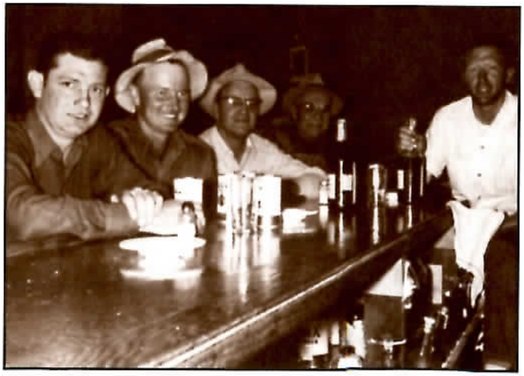
Bartender - Ed Hargraves
"Bottom's up, here's mud in your eye,
and pour us another, your turn to buy."
Women, as rule, don't make good two fisted drinkers. Ruby, a tall, skinny redhead came as close as any to joining our fraternity. The old girl could slug it down like a pro and had the courtesy to excuse herself before kneeling over to sleep it off. She had long fingernails and the constant clicking of her nails on the glasses irritated the hell out of one of our elders. Unc Hood would begin glaring at her after the second drink and retire to a corner table until she left or passed out. We liked Ruby. Most of the females would begin blubbering about a worthless husband or unconcerned boyfriend after three or four drinks, but Ruby had no inner turmoil. She could sing bawdy songs and rip off a joke with the best of the males. We were beginning to think she had all the necessary credentials. Then one night she miscalculated her capacity and puked all over the bar. She withdrew her application and shortly thereafter moved the California.
During one summer we were joined by an elderly gentleman who had leased a barber shop and was a regular at the bar after working hours. Winston liked to be addressed by his first name, but he referred to us as "Mister Jackson" or "Mister Hutchinson" or Mister whoever he was talking to. He was a very learned man, loved poetry and could recite with a flair normally reserved for someone on stage. As time went on Winston began spending more time at the bar than at his shop and business dropped off. He asked me if his haircuts were not suitable or if his patrons were going to the valley barbers. I told him the problem was he might be drinking too much. "Mister Jackson, I resent that statement. I have never drank too much, I invariably pass out before I have had my fill."
Another evening, as I slid onto a barstool beside him he looked sorrowfully at me and whispered, "I shall not be able to drink with you tonight, Mister Jackson." I was afraid I had offended him and asked if he was mad at me.
"Oh no, not at all, sir, but I believe I am either dead or very near death's door."
"Come on, Winston, you look pretty chipper to me." I responded.
"Mister Jackson, I recently read where the last act of an expiring body is to purge itself of all wastes, liquid or solid and I fear I have done both without moving from my stool."
By the aroma I felt he was right and I left.
The photograph and its couplet fill the lower half of printed page 29, below the opening paragraph. The caption names five men and does not name the bar. Raymond Ball is named beside Hank Slaght in the Amethyst crew photograph in "Please Go to Hell, John Jackson" and appears as "Ray Ball" in a 1940 photograph caption in the "Memories" section of "Echoes from the Thundermug." Pete Walker "who hauled our ore" is in Echoes, and Chapter II of this book gives his name as Ralph "Pete" Walker. Archie "Spud" Fellows is the full-time moonshiner of "Hellions and Moonshiners." An Ed Hargraves is named in Echoes, in "Talking to Yourself OK, But Don't Start Believing It," as a man who talks to himself; that page gives no occupation, and no other page gives him one. Lucky Keene is not named anywhere else on the site. "Unc Hood" matches Clyde "Unc" Hood, the railroad engineer with the old army overcoat, who is described in Echoes in "A View from the Barroom Floor" and captioned in "Memories" as "R.R. Engineer, Gentle Spirit." Ruby and Winston are not named anywhere else on the site, and the story does not say which Creede bar this was. "Moved the California" and "Women, as rule" are as printed.
Let Me Put It Another Way
Any young rooster can chase a pullet across the barnyard, but it takes an old cock to really make a hen ruffle her feathers.
A couple attended a dance in Creede. They were a good looking pair, danced well and were enjoying the evening to the fullest until Elmer came up missing. His wife asked me if I had seen him. I told her I had, indeed, seen him without adding any pertinent details except that I was sure he would return. She said she was going home, she was tired and sleepy, and if I saw him again to tell him where she had gone.
When she arrived home she found Elmer in bed with a young lass who liked the feel of different sheets. Bathed in the light of a 100 watt bulb Elmer rose, looked first at his wife, then at his bed partner and cried, "Oh my God, I was so drunk I though it was you, honest honey." She didn't believe him.
I was socializing with a splendid group in the Elk's bar one dance night. I was with both locals and old friends who had been away for years in other states. With all the toasts and rounds to the departed and those in danger of departing, I became severely overloaded and began feeling my way around. A perturbed husband and Inez arrived at the same time. I told her that due to my condition I wasn't seeing well, but I knew her dimensions to the very centimeter and was trying to find her so she could take me home. She believed me not at all and the husband believed me even less.
In view of those two incidents, I would advise every young male to try, with all his heart and soul, to get along with his Mother. She will be the last female he will know who will listen to his side of the story.
The epigraph under the title is printed on its own line, as it is here. The book gives Elmer no surname and does not name his wife or the woman in the bed. "I though it was you" and "Elk's bar" are as printed. Inez is Inez Mae Schriver, John's wife. The closing advice is repeated, in slightly different words, in the last paragraph of "I Didn't Hear It 'Til It Was Already Passed," below.
Records Were Made To Be Broken
If we pass 50 years of age without a string of successes we can be fairly certain we will never be listed in "Who's Who" or the Guinness Book of Records. If we pass 65 years of age without a single success we should accept the fact we are doomed to obscurity. I begged for recognition when I was mucking out tons upon tons of blasted rock followed by setting up a Leyner "Wiggle Tail" drill to riddle the face with holes and blast out another smoking pile of rock. Fame didn't come until the day I got loop-legged drunk and ran over several 55 gallon barrels behind Tomkin's Hardware Store. A couple of crushed barrels got hung up on the chassis of the 1948 Chevrolet truck and veered me into a large snowbank further along the route home. As I struggled with the dilemma I was recognized by 317 of the 364 residents of Creede, Colorado. The town marshal, the principal of the grade school, the new Preacher of the Community Church and my bride were in the audience.
I drank more than my digestive tract could safely handle during those years of adjusting to a new and strange lifestyle. Marriage had problems that I was unable to solve with a pair of fists or a swearing, furniture throwing tantrum. The little gal from Kansas was a good scrapper and had both temper and stubbornness to match her teutonic ancestors. We lived, briefly, in a one room cabin with a lumpy bed, a wood cookstove, outside water and a two holer 30 yards to the east. There was never a complaint over living conditions, but there was hell to pay if I came home with a load of barley corn under my belt. I had a good head of hair then with a wave in the front. She would grab me by the forelocks, drop my head to where she could connect with her other hand and draw blood from my nose. I couldn't believe she would get that riled up so early in our marriage. For a measure of defense I had my hair cut flat-top, a style I have worn since though she has lost her timing and much of the force behind her punches.
Before I get into other things I should mention that my bride had a traditional wedding shower by a group of ladies in Creede. The shower was held in what had served as the Red Cross Hall and training quarters for aspiring boxers. I thought it a fitting setting. I was summoned to help in cutting a large cake at the height of the ceremony. I was standing, self-consciously, to one side when an elderly matron, a family friend, sidled up to me and whispered, "The first baby only takes six months, Johnny, all the rest will take nine months." The poor lady went to her reward still wondering.
I had a friend in our United States Army who held a record of sorts in joint tenancy with his wife. Shortly after they were married he was called up for military duty and then shipped to the Pacific Theater of War. He was gone for 21 months. Three months after his return to the home fires his wife presented him with a normal weight male heir. It was either the longest or the shortest human gestation period on record though I can't remember if either claimed the honors.
I also knew a lady who gave birth nearly two years after her husband died. It was presumed the cold weather of Creede held the deceased's sperm immobile until she got too near the pot bellied stove in a beer parlor...or another location just as warm.
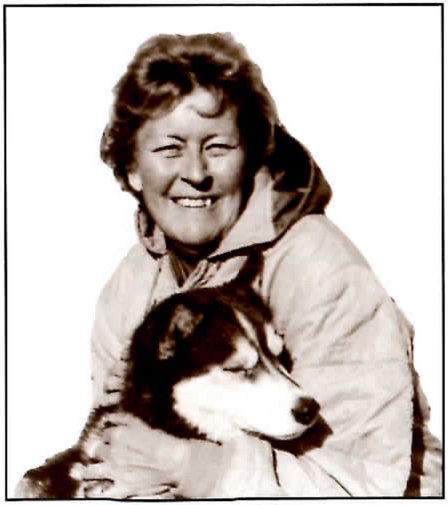
Life has no meaning without a love or a pal
and I have had both in this smiling gal.
Our cup runneth over, each day so fulfilling
and another tomorrow if the good Lord is willing.
I believe science must be baffled by the records being set in this generation. If they don't slack off with genetic engineering the baby will be born before the gentleman can even tip his hat and when there ain't no fun in it people will soon lose interest.
The photograph of Inez and Skeeter fills the lower part of printed page 32, between "immobile" (the last word of the text on that page) and "until" (the first word on page 33), so the sentence about the pot bellied stove runs across it. It is set here after the paragraph that contains the break, so the paragraph reads whole. "My bride" and "the little gal from Kansas" are Inez, whose page records her birth in Melrose, Kansas. Echoes has a husky named Skeeter who works the ranch and goes prospecting with John, in "Dog a Big Help on Prospecting Expedition" and "Anything's Better Than Being Alone." The marshal and the barrels turn up in two other places with different details. Echoes, in "Sweet Beetles," has John "pushing 55-gallon barrels through snow banks with a Chevrolet truck" until Marshal Bill Kolisch turns him over to his bride, and "The Price of Glory" has a single barrel wrapped around the front axle and pushed seven blocks. This version puts the barrels behind Tomkin's Hardware, dates the truck to 1948, and names no marshal. Echoes spells the store "Tomkins Hardware Co." in "Stealing Ain't as Easy as It Was in Times Past." The bridal shower in the old Red Cross Hall is told again in Echoes, in "Wedding Reminds Us of Our Own," where the matron's remark ("The first baby only takes 6 months, but all the others will take nine") is followed by "We fooled her" and Gavin Skinner brings John from the Rainbow Bar; here it is addressed to "Johnny" and ends with the lady "still wondering." The Red Cross Hall as the boxers' training quarters is in "Once Around the Thunder Mug," "Lessons from a Barber's Chair." John's wedding itself is told in Chapter III, in "Wedding Bells and Chesapeake Retrievers." "Teutonic" is as printed. The matron and the two friends in the anecdotes that follow are not named.
You Read It Here First
One of life's greatest ironies is to struggle so hard to reach maturity only to find that it is occupied by old people.
There are two sides to every question and then there's the ladies side...which doesn't fit endways or sideways.
Ignorance is a valid excuse whereas stupidity straddles a narrow line both in social acceptance or legal matters. I don't believe, in good conscience, we could hang a man for being ignorant; however, I have seen stupid men the noose would fit well. There are many congressmen who would plead ignorance if called in for appraisal by a higher authority. I believe a higher authority would dispatch them to a much lower authority and rightfully so.
We think we have seen and heard everything vile and revolting then our nation brings forth a new rock group or pseudo entertainers with their brains located between their rectums and genitals where, steeped in cocaine or other drugs, they cast a spell on the young and continue to devalue every facet of human life.
One of my first goals was to reach an age where I could legally drink alcoholic beverages then the bars raised the price of whiskey to 35¢ a shot. It took no less than 8 shots to get brave enough to pick a fight with my wife. That amounted to two dollars and eighty cents which was a great deal of money to pay to get the hell beat out of me.
I was chauffeuring a friend who was engaged in some sort of ritual with a young lady in the back seat. The rear view became more interesting than the front view whereupon our vehicle entered a ditch, became airborne for several feet before slewing sideways across the road to the other ditch where it righted itself and we continued with no more motoring difficulties. I was pleased to note that the figures in the back seat were not dislodged. This leads me to believe that a firm anchor will control the most wayward ship.
This story is a run of separate aphorisms and anecdotes; the first begins directly under the heading, as printed. The friend and the young lady in the last anecdote are not named.
Purse Your Lips Before You Blow
There are two kinds of fools in this world. Those who are born to be fools and those who work at it, Mrs. Jackson believes I am both.
If I live to be as old as Methuselah I will never understand women. My bride was trying to lead me to the backdoor of our home when I suddenly became violently ill. "Just look at you," she cried, "if you aren't a sorry sight, throwing up out here where the whole world can see you."
Not long after that, following another meeting of the Upper Willow Creek Mineralogical Society and Glee Club, I made it into the house and nearly to the bathroom before I parked my cookies and she still scolded me.
I had a good friend who was an alcoholic. He told me his wife drove him to drink. I, too, am an alcoholic, but unlike the experience of my friend, my wife tried to drive me from drink. I believe everyone will agree she was a poor driver.
At this late date the old girl seems unduly concerned with the amount of grey hair accumulating in my ears. We have chairs on opposite sides of a small stand that contains books as well as supporting a lamp. At least twice monthly I can see her peering over her bi-focals at my left ear. If I don't hurry outdoors she will have her little manicure scissors snipping away drawing blood.
I like that hair. If you have ever had a gnat or other small insect take up quarters in your ear drum you can appreciate the comfort a growth like that affords by giving you time to mash the culprit before it can start doing barrel rolls in the inner ear.
I was in a bar one night where a gentle person kept wanting to blow in my ear as he rolled his eyes in mind boggling revolutions. Fact is, he wanted to blow in everyone's ears so I wasn't singled out. There are a few of us left of that crew and we all seem to have hairy ears. I now wonder if that poor fellow had anything to do with it. Probably not, but there's a lot of body chemistry we know nothing about. Next time someone blows in your ear check it out for a few days and let me know if anything sprouts.
"Mrs. Jackson" and "my bride" are Inez. The "Upper Willow Creek Mineralogical Society" is the same jokingly named club Echoes places in the rear of Tomkin's Hardware, where its "first annual meeting" was also its last; in "Women Can Scare Strongest Man" Mother Bee McClure blasts it "to smithereens," and in "Mother Bee's Tantrum Put an End to Party" she disbands it and the "Tomkins Hardware Brotherhood of Mine and Mill Suppliers" together. "And Glee Club" is added only here.
Forest Blows a 10-4
Gene Wardell and I were driving a tunnel near a ranch owned by Forest Cadwell of Cathedral. It is an area of deep canyons, heavily forested with both spruce and aspen on either side of Spring Creek.
As a sideline to his ranching Forest had a clientele of hunters from the Fremont County and La Junta areas. Among the group was an old friend, Leo Lockhart, who arrived prior to opening of elk season with a pair of Walky Talkys, hand held radios, he had purchased thinking they would prove of value in keeping track of each other in the wilderness.
They were in upper Spring Creek with Forest at a high vantage point where he was supposed to meet Leo before hunting another basin. They had been bantering back and forth with the radios and Leo was within a hundred yards of Forest when a single engine airplane passed over Cascade Mountain.
Forest pushed the button and said, "Hello little airplane, how's the weather up there?"
Leo heard it clearly and seized the opportunity. He stuffed the radio he carried under his jacket and disguising his voice, answered, "This is NC one...double zero...four...four...nine, who am I talking to?"
Forest nearly jumped out of his skin. It took him a moment to recover, but he again pressed the button and looking at the plane directly overhead added, "My name's Forest Cadwell and I'm hunting elk on the mountain just under you."
Leo continued his side of the conversation, "Well, I don't see you, but good luck hunting, over and out."
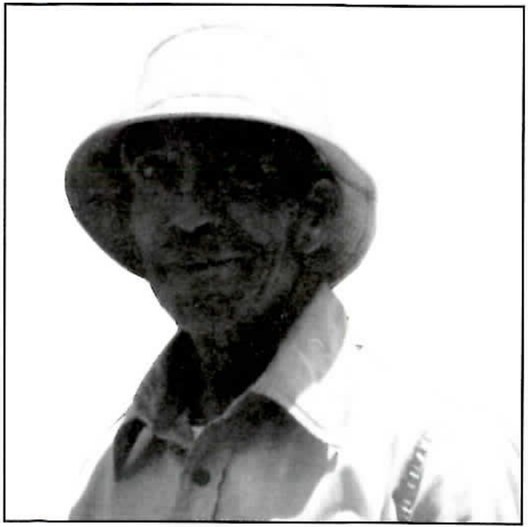
My friend talks to airplanes, he says they talk back
I tried it myself, but I don't have the knack.
So we coddle old Forest, he's on the right track
when he talks to himself some darned fool answers back.
Leo waited several minutes then went huffing and puffing to Forest's location where he found him beside himself with excitement.
"Hey, Leo, did you see the airplane that just went by?"
"Yeah, I heard it then I saw it as it went over San Luis, what about it?"
"I talked to the pilot," Forest responded.
"Hell you did! That was a long way to holler."
"I didn't holler, I talked to him on this radio."
Forest then quoted their conversation word for word.
"Aw hell, Forest, there's no way you could have talked to the pilot, these radios aren't on the same frequency as airplanes."
"I don't know a damned thing about frequencies, but I talked to that pilot, he even told me where he was going."
Leo shook his head.
Forest repeated the radio phenomenon to everyone who came in visiting and hunting. It was near the last of the season and Forest was again rehashing his contact with the pilot when Leo covered his mouth with one side of his jacket and chimed in, "This is NC one...double zero...four...four...nine," and doubled up in laughter. Forest couldn't believe it.
"You no good flimsy excuse for a hunter Lockhart, you've let me make a darned fool of myself all season."
"If I didn't like your wife so much I'd kill you right here and now."
That was nearly 30 years ago and they are still friends, but Forest hasn't played with a Walky Talky since.
The photograph and couplet fill the middle of printed page 35, between "over and out" and "Leo waited"; they are set in the same place here. The caption is a title, not a name, and the book does not say whom the photograph shows. The verse is about Forest, so the picture may be of him, but that is an inference. Cadwell's ranch on Spring Creek at Cathedral, with its cabins of summer guests, is described in "Echoes from the Thundermug," in "Sore Toe a Lesson to Prospector," and "Forest and Curt Cadwell" are named in "Dog Is the Dogies' Best Friend, as Well as Master's." Gene Wardell is named in many Echoes columns; in "Advice for Bea Jean" he and John prospected the Mineral Creek headwaters and staked claims. Leo Lockhart is not named elsewhere on the site. The radio call sign is printed with ellipses and no spaces, as here.
Well! I Wiped It Off On My Apron
The great depression of the '30's was on creating hardship nation-wide when two Minnesota youths learned from a friend of a friend in Colorado that a mining company in the little town of Creede was hiring. They had no money and no transportation, but they were adventurous, used to hard work, and had no qualms about starting a journey to a new life.
They caught rides, when available, in every manner of vehicle, but mostly they walked. They tried to arrive at small towns or ranches by nightfall for shelter and a chance to exchange labor for meals and lodging. It worked well and they were nearing a halfway point when they detoured from the main road to a farm in Nebraska.
They approached a middle aged man herding several Holstein cows to a corral and helped him thread them through a gate before introducing themselves. After the initial greetings, Ikie and Bob told the gentleman they were headed for Colorado and would do chores in return for a bed for the night and a couple of meals. Their offer was taken with no hesitation and the farmer outlined work for them. Bob followed him with pails to several stalls for the milking phase as Ikie fed the other animals before starting in on a woodpile with a double-bitted axe.
They reveled in their stroke of good luck. The evening meal had everything they had been missing for nearly a month and they slept in frame beds with quilts over and under.
The farmer woke them early. Once again Bob helped with milking as Ikie took over the other chores. He finished before the milkers and gathered up an armload of wood to deposit in the woodbox of the kitchen where the farmer's wife had a cup of freshly perked coffee waiting on the table. She was a hefty, buxom woman and appeared capable of handling any job connected with farming. A pancake griddle was well greased beside two large cast iron skillets in which she had spread thick slices of home-cured bacon. As she turned the bacon and ladled pancake batter on the griddle, a toddler, just able to walk, appeared in the bedroom doorway. He was clad in a pansy flour sack diaper that swayed merrily, side to side, as he waddled over to grasp his mother around one leg. Ikie said he should have known the diaper was loaded.
The cook took note of her offspring and just as she reached down to pat him, a long, firm turd from the previous night's production slipped from one side of the diaper and clunked on the floor. With no hint of embarrassment or pause in conversation, she worked the spatula under the offender and flipped it into the woodbox. Ikie couldn't believe his eyes!
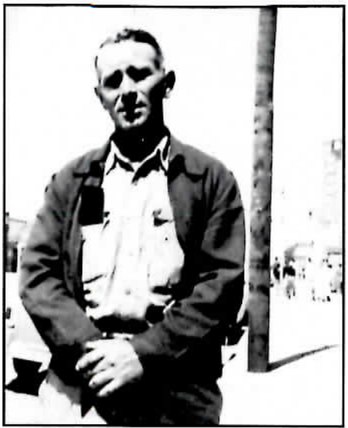
The depression was on andhe needed a job,
hiked from Minnesota with his good friend, Bob
hired on as a mucker at three dollars a day
and soon became foreman
at a higher rate of pay.
As soon as the farmer and Bob cleared the kitchen door Ikie grabbed Bob by the shoulder.
"I think I hear a car coming Bob, if we hurry we can catch it."
Bob looked at Ikie like he thought he had lost his marbles. "I'm not going to miss a meal like this, besides if a car was coming we could see the dust." he replied.
As Bob walked over to a wash basin and began scrubbing his hands Ikie excused himself, said he wasn't feeling well and he would be on his way. "I'll see you on down the road." he advised Bob.
When Bob caught up with him Ikie told him of the double duty of the spatula and that was the reason he left so hurriedly. For the next two miles, between retchings, Bob alternately cursed Ikie and the loose boweled kid.
On printed page 37 the photograph and its verse sit at the right of the text, beside the kitchen scene, with the paragraphs wrapped around them; they are set here after the paragraph that ends "Ikie couldn't believe his eyes!" The story never says that Ikie is "I. D." Crawford. The caption does: its verse tells the same journey from Minnesota with a friend named Bob, so the book treats them as one man. "Andhe" is printed that way in the caption. Isaac D. Crawford is the superintendent and top miner of the Amethyst crew in "Please Go to Hell, John Jackson" and is a supervisor in Echoes; the "Ikie" nickname and the friend Bob are not found elsewhere on the site, and the farmer, his wife and the child are not named. Pansy flour-sack diapers also appear in Echoes, in "The Magic Age Is Five." The two closing quotations end in a period before "he replied" and "he advised Bob," as printed.
I Didn't Hear It 'Til It Was Already Passed
There is no sterile approach to the problem of flatulence or "genteel fahting" as it would be called in New England and I'm not totally convinced it is a problem. One can either stand with a self satisfied smirk on his face and fan the rear of his trousers or point an indignant finger at an innocent bystander while holding his nose with the other hand. This is a controversial topic, but we have never backed away from controversy and it will serve as fitting finale to this publication. I have used the masculine gender because my bride advises me that ladies do not suffer from generation of methane gas in their colons. If she is correct I would judge that 99.9 percent of women are not ladies. I was near a well dressed woman in a supermarket who produced an audible, as well as the unmistakable odor of colonic disturbance. She smiled and I tipped my cap in respect. I had to stifle a, "Bravo, Bravo!"
Cattle are being maligned as contributors to the expanding hole in the ozone layer and a warming of our climate. This is unfair to both ranchers and their herds. Humans expel more methane gas in one family picnic than I have ever smelled in a barnyard or pasture. I knew an old fellow named Clyde who always wore a knee length Army coat in his rounds of Creede. He could actually make it billow and lift his neck hair when he was fully charged. Those old birds used to sit on the bench at Soapy's Pool Hall and Barber Shop and see who could lift himself highest with a single burst.
I was on a job in Idaho. We were just backing out of a driveway in a Chevy Blazer when our Senior Geologist, Joe Kantor, ran out of our quarters and waved us to a stop. He stuck his head in the passenger side of the front seat with a topographic map in his hands to show us a new area we were to check. At that exact moment Denny Heyrman unloaded the product of three helpings of spaghetti that had been nine hours in fermentation. The blast reversed the arch of the springs on the vehicle and flattened two tires on his side. Mr. Kantor jerked his head backwards with such force he hit the top of the door and knocked himself unconscious. When David Jones and Denny Heyrman were "bursting with pride" it sounded like a concert of French Horns and Tubas.
On another job, this time in Colorado, I was following two geologists who had dined on Mexican food the previous night with both refried beans and fresh Pinto variety supporting the enchiladas. We were traveling at a good clip and every mile or so we could see either the head of Bob Hawkins hanging out the left side or Dave Jones with his head out the right side of the vehicle. A young lady from Massachusetts was my assistant. She noticed the strange behavior of the pair and asked me what kind of game they were playing. I told her they were checking the rock units and were looking for younger age intrusives in the precambrian rocks.
"Can they honestly identify the formations traveling so fast?"
I assured her they could.
"Gee," she went on, "it must take an awfully long time to become a real geologist."
I wanted to tell her, "Only as long as it takes Mexican food to reach the colon."
I had just returned to bed from an early morning bathroom visit when my bride severely violated our air space. I was clutching the bedding as tightly as I could to my neck and the mattress hoping for a brief respite to recover enough to open a window. My pulling on the covers awoke the dear lady whereupon she gasped several times and screamed, "Oh, ohhh, that is terrible," partially recovered she added, "if you ever do that again I'll go sleep on the couch."
Like I advised the male faction several pages back, "Better try to get along with your Mother, she'll be the last female you will meet who will listen to your side of the story."
This is the last story in the book's table of contents; the text ends at the top of printed page 39, which is otherwise blank. The same subject, with the same pool-hall contest and an old Creede fellow named Clyde in a long coat, is argued in "Echoes from the Thundermug," in "Eat Beef and Help the Ozone Layer." The Clyde here is very likely Clyde "Unc" Hood, the railroad engineer in the old army overcoat of "A View from the Barroom Floor," and the "Unc Hood" of the first story in this chapter; this story gives only "Clyde." Soapy's Pool Hall and Barber Shop is Fred "Soapy" Birdsey's shop, described in Echoes, in "The Magic Age Is Five," and in "Once Around the Thunder Mug," "Lessons from a Barber's Chair." Joe Kantor, Bob Hawkins, Dave Jones and Denny Heyrman are the party crowd of Echoes; the first three are named together at a pig roast in "RSVP," and Kantor is called "the geologist" in "Inez Hooks the Big One." The book does not say which mining company or year the Idaho job belongs to, and the young woman from Massachusetts is not named. "Genteel fahting," "generation of methane gas" and "David Jones" (against "Dave Jones" later) are as printed. The marriage advice in the last paragraph refers back to the end of "Let Me Put It Another Way," above.
One More Clean Shirt for Old Robert
The book's last three pages carry no story heading and are not listed in the table of contents. This one is printed as page 40. The heading here is the photograph's caption.
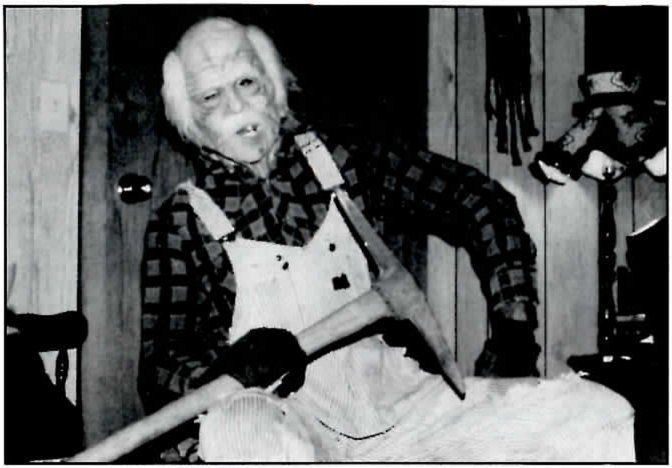
Sure I'm old and my lungs are scarred
but I'm headin' back to the lode
where tall pine trees have been standin' guard
and you live by the prospector's code
Clean up your diggin's, take only your share
and help those whose luck went astray
faith is the beacon that leads us there
and gives us the strength for each day.
The stanzas are printed as one unbroken verse in italics, with alternate lines indented; they are divided into two here at "code" / "Clean." The book does not say who "Old Robert" is or who is pictured. The face has the look of a mask or costume, but that is an impression from the page image, not something the book states.
Victor Miller and Noel Oates
This page and the back cover that follows are unnumbered. The heading here is the photograph's caption. The caption and couplet on this page are set in a sans-serif face unlike the rest of the book.
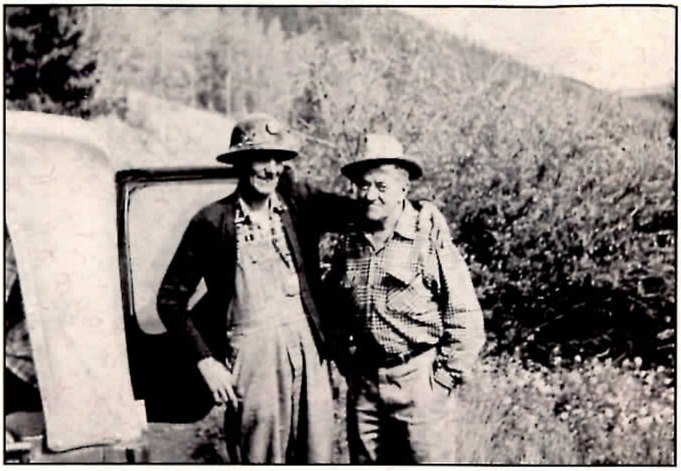
Vic was a mule-skinner in The Commodore Hole
where the ore was blasted by our good friend, Noel.
I'll tell you, lad, it's a black old hole
when the flame flickers low and goes out
yuh curse the devil and pray for your soul
as pack rats scurry about
Ain't nothin' good 'bout a hole in the ground
just takes yuh closer to hell
muckin' ore in a can and listen' for the sound
of the devil ringin' his bell
I've been there lad, yep, worked with the best
in the tunnels and shafts at Creede
Alvie and Erick, Noel and the rest
we called them the last of the breed
But they weren't the last and the list goes on
the pride of the next generation
taking the place of souls now long gone
all part of the good Lord's creation
The photograph does not say which man is which. A "Vic Miller" is listed among the skinners of Emperius Mining Company in "Echoes from the Thundermug," in "Mule Skinners of 40 Years Ago Were a Hardy Breed," which gives no first name; the match rests on the surname, the nickname "Vic" and the job. Echoes has Emperius Mining Company renovating the old Reynolds Tunnel, the Commodore 5 level, in the early 1940s ("Grown Up in Creede, Part One"). Noel Oates is not named elsewhere on the site, and nothing on the site connects him to the other Oateses in the Name Index. "Alvie" and "Erick" are given by first name only. Both names are on the site, as Alvie Wintz, in "Moves Keep 'Em Hopping," and as Erick W. Nelson in "Please Go to Hell, John Jackson," but the verse does not say these are the same men. "Listen' for the sound" is as printed.
About the Author
The back cover carries a portrait and a paragraph, with no heading and no caption. The heading here is editorial. The portrait is presumably the author, as is usual on a back cover, but the book does not say so.
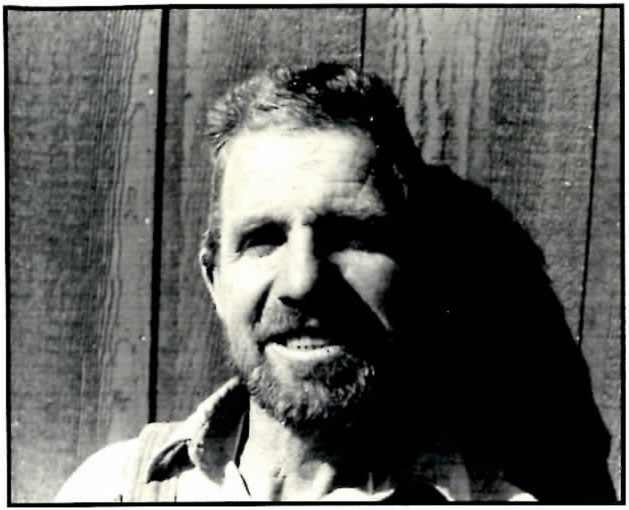
John Richard Jackson had a working career, less military service, spanning a half century. He ran the gamut in professions from "Garbage Man" to part time columnist for a weekly newspaper, but his love was mining. His first literary effort, Once Around The Thundermug, chronicled the humorous side of growing up in the mining town of Creede, Colorado. Who Upset the Thundermug, continues in the same vein only more so. He believes we take life too seriously, that we should take a moment to laugh at ourselves. After all, our neighbors laugh at us...why should they have all the fun?
The back-cover text spells both titles "Thundermug" as one word; the front cover and title page have "Thunder Mug." The comma after the second title is as printed. John's own page is John Richard Jackson.