Chapter I: From the Womb to the Real World
By John Richard Jackson, writing as "Thundermug"
Chapter I of John's 1993 book "Once Around the Thunder Mug," reproduced exactly as he wrote it. See the book's front matter for the full note on how this text is transcribed.
From the Womb to the Real World
They were gathered in a little white house on the mesa overlooking Creede from the west. Tommy Eden had painted the exterior and had papered the walls of two rooms in the spring. He had not been invited to join the group waiting for the newest addition to Bill Jackson's growing family. Mom Jo was praying for a beautiful little girl; Dad Bill was hoping the distress was only gas; Joel and Scooter were sure all the commotion would bring forth the puppy they had long wanted. Dr. Samuel McKibbin just wanted to get back and pull Nate Hyam's wisdom tooth. There was less money in the extraction but at this late stage in his practice it didn't really matter as long as he could close the door and clean his tools in peace and quiet.
Mom Jo was the second person to know her prayers weren't answered. Joey and Scooter gave up when they couldn't make me bark and returned to dragging a train of six milk cans across the kitchen floor. An uncle had made the train by punching holes in the center of the cans and threading a length of twine through them. Part of a lid had been turned up to form the smokestack. Dad Bill held out for two weeks before assuming the role of Father to whatever lay on his side of the bed seeking protection and nourishment. Misery loves company and many of his fellow miners were sharing his misery as squalling infants graced houses the length and breadth of the town to take over for the rocked up* boom day miners who were breathing their last in one room cabins.
Babies weren't planned in that slack period of Creede's mining history. They were blamed on late night fires or an especially potent run from Bill Tingley's still. They were received with all the enthusiasm generated for a case of seven year's itch or protruding hemorrhoids, 100 proof white lighting that could grow hair on a man's tongue had to be laced with an aphrodisiac.
My first solid memory was of a grizzled face so close to mine I could smell traces of Bull Durham tobacco as he talked and the pungent smell of powder smoke permeating his overalls from his day's labors in the Commodore Mine. "Well Josie, they shouldn't come any uglier than that but I sure as hell wouldn't try again." With such a greeting at so tender an age I shouldn't be blamed for the list of failures since.
Mom Jo had medical problems both before and after my birth forcing her to farm me out to the wife of "Packrat" Jackson (no relation) who had given birth near the same date and had a well functioning milk factory. With this arrangement I never lacked for nutrients and Mom Jo secretly hoped Mrs. Jackson might become confused and switch babies giving her the girl she longed for. Mom Jo was due for many disappointments, however, she would have her daughter many years later, she would be beautiful and well worth the long waiting period.
* "Rocked up" — Afflicted with silicosis, a lung disease
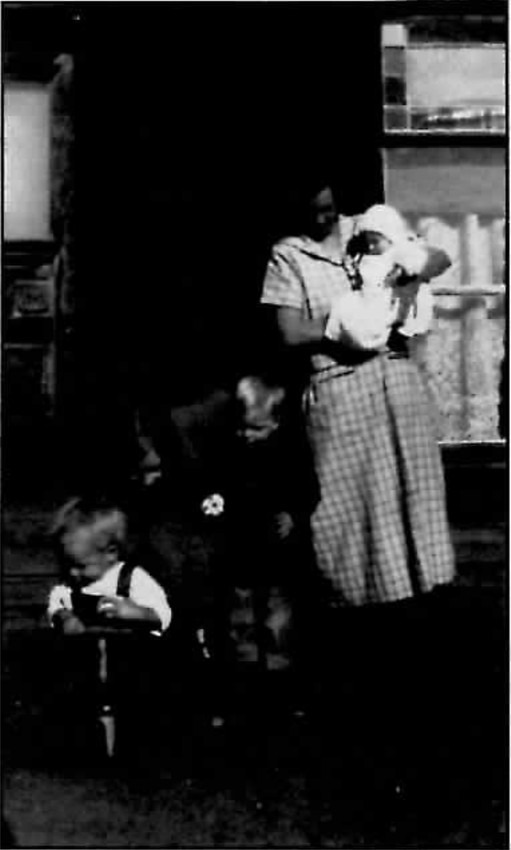
Adults don't give enough credit to the minds of infants, if they did they could forget all that baby talk and cuddling. I knew, though I couldn't yet walk, that if I could just stop crapping yellow and get rid of the fraying Pansy flour sack guarding my rear I could get out in the real world and contribute to the noises I could hear from our bedroom window. Brother Joel wore real underwear under real overalls which allowed him to venture from the house for long periods. Scooter still had accidents but could join Joey from time to time. My first goal in life was to get rid of the sack and safety pins and learn why it was light half the time and dark the other half. There were occasional trips in a Model T Ford to a ranch somewhere out there but I was so wrapped up I couldn't see anything.
Future Presidents of Capital Avenue
We grew, we grew and we soon forgot the first two years of non-production as our world expanded to the homes on either side of us. Ed and Eva Snow lived just thirty feet from the south side of our house and shared our drinking water which came from a well under our back porch. We were more affluent than the majority of Creedites who drew their water with dip buckets hanging from the end of a rope. We had a cast iron hand pump that, when primed, would force water twelve feet from the rocked in hole. A tinny taste would signal a decomposing body of mouse or squirrel was floating on surface to be fished out from a trap door.
Eva was a small, gentle lady who always had a filled cookie jar and a kind word for our newly acquired tomcat named Mutt. Ed Snow was a carpenter and prospector. He was not overly comfortable with the three Jackson boys and damned well uncomfortable with our tomcat. Mutt liked to dart in the Snow house and relieve himself in a flower box near a large east facing window. Mr. Snow strongly objected to his toilet habits and promised to tack old Mutt's hide to his picket fence.
Ed worked through the winter months in or near Creede to finance his prospecting trips to a mineralized area west of Monte Vista. He had a Model T Ford equipped with a haulage bed in the rear like the beds of horse drawn buggies. All spare time was spent in refurbishing both his prospecting gear and the Model T. One warm day Scooter and I were perched on the fenders offering advice as he put new brass reinforced bands in the transmission. He became more and more agitated as the bands refused to go where directed so he retired to his shop and came out with a broken coping saw he handed to Scooter indicating we should play with it at home. Model T transmission bands are adjustable for low, high and reverse gears. A ratchet lever to the left of the driver served to draw on the rear wheel brakes and disengage the transmission. When working on the truck Mr. Snow always engaged the lever and jacked up one rear wheel as an added precaution when checking tension on the bands. Unnoticed by Mr. Snow, Scooter and I had put rocks under and behind the jacked up wheel while he replaced the cover over the adjusting bolts. He peered over his glasses to be sure we were on our own porch far out of harm's reach. Satisfied we were only spectators, he placed his feet wide apart, grasped the crank and turned the cylinders over in one fast revolution. The engine fired and the reverse band, evidently too snug, took hold, transmitting power to the rear wheel where Scooter and I had carefully placed the rocks in our efforts to help.
With only a slight growl from the engine and shudder from the rear wheels, Mr. Snow's transportation started a trip over the hill all by itself. Life could get no better than this! Chug chug chug chug, the little four cylinder engine labored against the force of Ed's arched frame as he held tight to the bumper and the heels of his boots dug furrows in the ground in a vain effort to save his pride and joy. It was a short trip. A ditch less than a hundred yards away following the incline of the hill stopped the Ford suddenly and effectively threw Mr. Snow several feet further. We did not venture from the porch to offer assistance.
Contractions and Distractions
Mom Jo didn't know of the part her sons had played in the wreck of Mr. Snow's Ford, but she knew he had threatened to tack their hides right alongside the hide of our tomcat on his picket fence. With that warning she kept us playing to the north of the house where we could watch Mr. Matson file saws when he wasn't working his claim in Windy Gulch. Our Grandmother Jackson was traveling all the way from Bellingham, Washington to see us "live and in color," not stretched on someone's fence. We had heard many tales of this lady who emigrated from Sweden while still in her teens; of the long ocean voyage and detention at Ellis Island before she could travel on to Illinois for a reunion with relatives who had made the same journey at an earlier date.
We were disappointed. We expected a large, buxom woman who could swear like a trooper and swing a double bitted ax. This frail lady with the dark, sunken eyes in no way resembled the picture we had of our Grandmother, a pioneer who had crossed the Atlantic Ocean and lived through the privations of boom and bust mining camps. Selma Jackson would live only three more years.
In our childish dismay we remembered the broken coping saw Mr. Snow had given us. It didn't take long for two bright kids to learn that by whamming the slotted end into a piece of wood one could produce miniature elk hoof imprints. We retired to the steps of the front porch where Scooter got the first turn and, since he was bigger and tougher, decided we would get 11 whams apiece before turning the coping saw over to the next participant. Since Scooter was able to count, or so he said, he would tell me when it was my turn, also when his turn came again. After several turns it was obvious his elk were traveling further than mine. I began to think he couldn't count either. We had cluttered up a couple of steps with our marks and Scooter was counting his production with a five, six, nine, four, which was all Greek to me as I waited for that magic word "eleven."
About this time I got a terrible rolling in my stomach and gurgling in my bowels. It was some 50 yards to the toilet and I knew there was little time for a safe run but the next number Scooter rolled off his tongue was sure to be eleven. Another contraction hit and the situation was now becoming desperate just as good old Scooter handed me the tool. I managed to make one hoof mark before another contraction gave clear warning the 50 yard dash was out and Scooter was counting faster that I was whamming with my attention so divided. I concentrated totally on making hoof marks and let loose all holds, otherwise, "'til my shoes runneth over." The last I saw of old Scooter he was holding his nose and running to tell Mom Jo and Gram Jackson I had messed my britches. In spite of the smell and uncomfortable feeling I put hoof prints in the step until my elk were far ahead of Scooter's and I derived a measure of comfort in the knowledge Mom Jo would be unable to spank me in my present distress.
Bathrooms and Biffies
In that stage of our existence if someone had said, "hold my place I have to go the bathroom," we would have thought he was going all the way to Wagon Wheel Gap where, we had been told, the Bergeys had honest to God baths with constant flowing water piped from artesian hot springs. We had also heard that Charles Webber, who lived near the end of the mesa, had a toilet right off the kitchen in his large house where one could pull a chain and water flushed the deposit somewhere under the house. We felt this a very unsanitary setup and were content with our two holer. From our lofty heights we could see every shape and size of toilets perched on log stringers straddling the wooden flume directing Willow Creek's flow to the outskirts of town. We considered ourselves upper class living on the mesa though we could see the townsfolk had a definite advantage with the creek carrying their spoils to the river and never having to dig holes or move structures. During the winter there would be considerable buildup on the ice and it was a common sight in spring to see cakes of ice adorned with one or more piles of effluent and fluttering pages from Sears Roebuck catalogs floating merrily down the flume.
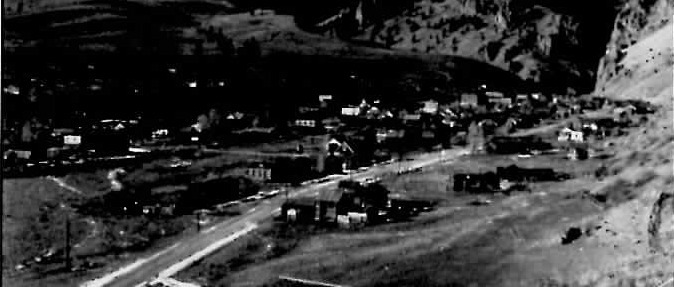
I once knew a town
where sheer cliffs looked down
on a people in need of solution
to rows of two holers
where overused molars
created malodorous pollution
The sounds of folks groaning
of belching and moaning
drifted with eye burning vapors
as neighbors dumped trash
over creek banks to splash
and winds scattered yesterday's papers
Infectious hepatitis
and gastro enteritis
passed with an early morning rally
to join Willow Creek's sand
thence the famed Rio Grande
to nourish the San Luis Valley
Now progress has brought
the answers long sought
the Valley no longer need worry
With a swirl and a suction
this daily production
is sped underground to a slurry
No more will we capture
solitude and enrapture
peering through cracks in the door
laying troubles to rest
on a throne with the best
dammit, that's what biffies were for
The venerable john was sometimes unfairly maligned. A girl with dubious morals sought treatment for a bladder problem from our good doctor. When he determined she had a venereal disease and told her the affliction was gonorrhea she gasped, "I just knew it! Our toilet seat is filthy and I'm sure that's where I picked it up." The old medic laughed and replied, "I suppose it's possible but it's a helluva place to diddle."
Our county judge, Homer Kendall, suffered a fatal heart seizure during his morning constitutional causing more than the ordinary problems for the coroner and mortician in examination and removal. They roundly cursed the small biffy which had absolutely nothing to do with the timing of Judge Kendall's departure.
There was excitement, too. Sometimes more excitement than our tender carcasses could bear. One summer day Scooter and I heard the door to the Jackson john slam closed. Dad Bill was at work and Mom Jo was several pages deep in a new novel the last time we were in the house so the odds favored brother Joey as the occupant of the throne. One thing we never lacked for in Creede was rocks, and rocking someone on the throne had become one of our favorite games as age improved our accuracy. Kerwhack! Scooter scored the first hit followed by two fast rocks from my grip.
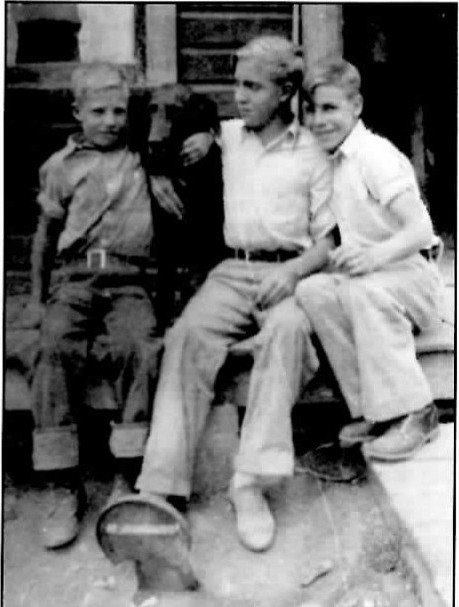
The trick was to lambaste the door with large rocks so the guest was afraid to open it then alternate with a fistful of small rocks hoping one or two would filter between the cracks and sting the trapped critter. We had acquired a dog by that time and he was dodging in and out between fusillades to see if we had a marmot cornered. There was much commotion in that confined space and a series of agonized screeches reverberating from nearby buildings which tended to fuel the fire.
We were throwing rocks with wild abandon when one sailed over our heads to ripple a board on the roof of the john. Another, even larger, rattled the boards on one side. We turned just as brother Joey whispered, "who's in it?" I looked at Scooter, he looked at me, just as startled, and we hightailed it for Cottontail Gulch. The last we saw of brother Joey he was still knocking chips from the door but we knew, as soon as he figured out Mom Jo was the target, he would either join us or pass us.
Sheriff Pollock and the Rattlesnake
Our world expanded greatly after the disagreement with Mr. Snow and the visit of our Grandmother Jackson. Lee and Verna Shillings had moved into the vacant house south of Snow's and were parents of two small boys. Raymond was a master rock thrower and was teaching Clarence the tricks of the trade. Rather than explore in that direction and have to dodge Raymond's barrages we trekked north to Aunt Caroline's where we could count on a slice of home made bread heavily laden with chokecherry or currant jelly.
Thus fortified and now a trio, with cousin Lee, we would go from there to bushes just above Gus Haigner's house and rock the tin roof until Gus came storming out shaking a fist and cursing the heathens who lived above him. With that chore out of the way we would wind through choke cherry bushes to the railroad tracks and make a dash for the lumber shed, a big barn like structure in lower Creede.
The lumber shed had two large doors enabling wagons to pass through delivering or removing lumber. We liked to race down the sweet smelling piles and swing from the 2 x 4 braces of the upper bins. Steve Pollock, an ex-lawman, who lived next to the shed would gently usher us out when he tired of the noise. On our last excursion there Steve opened the east door and called us to come down. We crawled from bin to bin to emerge where he was standing with a big stick in one hand and a pistol in the other. This scared us as Mr. Pollock had never before hinted of violence in removing us. He eased our fears by telling us he needed us a few minutes to do a job. This made us feel important and we couldn't wait to get started.
"Last evening a big old timber rattler came slithering in and hid out before I could get my gun, now Lee, I want you to go down to the far end, jump on the lumber and make a lot of noise, Johnny, you go to the other end and do the same." He looked us over, carefully, before he added, "Scooter, since you're the biggest, I want you to take this forked stick and when they scare that rattler out in the open you pin his head with the stick and I'll shoot him." We looked at each other just long enough to be sure we had heard him right then lit out for the hill and safety.
We gathered under a bush waiting for the shot that would signal the end of the timber rattler. It never came and Mr. Pollock never saw us in the lumber shed again.
Cousin Polly and Mud Pies
One of the penalties assessed on me for tasting the goodies in Aunt Caroline's kitchen was the burden of playing house with cousin Polly once or twice a week. I was too old for such nonsense but I loved the home made bread and cookies too much to rebel.
After she coached me for the umpteenth time in my role Polly would gather the ingredients for the pie she would bake me in her imaginary oven in her imaginary house while her imaginary husband was at work. I was supposed to wander out of sight and return just as the pie came out of the oven.
She had everything set out in order. A Hills Brothers coffee can half full of water, a tin cup full of fine dirt, rose hips, honey suckle and weeds. She would furiously mix the fine dirt and water into a consistency firm but pliable for the crust and press it into a Mason jar lid. Next came the other ingredients for the filling then it was slammed into the imaginary oven. At her signal I was to come plodding in from work, take off my boots and light up a smoke. By that time the pie would be done and it was placed by me to ooh and aah over and eat. The play acting was over when I received the finished product. If I hesitated in the least she would waggle a finger at me and scold, "I didn't slave over a hot stove all day for you to come home and turn up your nose at my cooking."
My slowness, I attribute, not to lead weight in my butt
but to cousin Polly's mud pies slowly sliding down by gut
Allen Sisters; We Don't Chew Our Tubakkur Twice
At this stage of our growth, Joey had learned to shoot a beanie flipper and we had begun to recognize the Allen sisters, Mabel and Olive, who drove their herd of milk cows from corrals at the outskirts of town directly past Mr. Snow's garage eventually arriving in lush pasture at the head of Slaughterhouse Gulch. There had actually been a slaughter house in the gulch to provide beef for the hardy miners and their families.
The Allen sisters were somewhat retarded and lived a solitary life caring for their widowed Mother. They were hard workers and earned enough from sales of eggs and milk to have the necessities of life. On their daily trips herding the cows to pasture they would bring their produce to customers on the mesa. The delivery, cash transaction and visiting usually left the girls a few hundred yards behind the cows but offered no problems as the herd grazed peacefully until they caught up. Peacefully, that is, until Joel Thomas Jackson began hiding behind Mr. Snow's garage to pelt them with rocks from his beanie flipper that had been engineered and produced by Uncle Woodruff Davis. The parts came from a forked willow limb, a used 30" x 3½" inner tube and leather pouch from an old boot. Uncle Woody presented the finished product to Joey without instructions for use.
We watched from the safety of the back porch the first two times Joey stampeded the herd then began helping him by gathering rocks of just the right size and passing them to him so he could get off more shots and a better average of scores. Mabel and Olive may have been simple folk but they knew the cows were being spooked and they were fairly certain it concerned evil spirits around Mr. Snow's garage. So, there we were, crouched at the north end of the building, snickering among ourselves as the bell on the lead cow sounded closer and closer. Joey waited until there were two cows in view then rose, drew the bands to full cock, and ricocheted a rock off the neck of the second figure that ended its flight on the rump of the first. Away they went, snorting and bellering for all they were worth. We were rolling on the ground in laughter when Joey looked up to see Mabel bearing down on our hiding place like a Kansas tornado. We ran. We ran all the way to Charlie Matson's woodshed, without looking back, where we lay in the grass and watched as Mabel stormed to the kitchen door of our house.
Mom Jo was totally unprepared for the outburst from this Allen girl. Mabel was so furious she nearly lost her chew as she yelled, "your boys chased my cows over the hill with their tails up over their backs." She was working her lower jaw in time with the tapping of her shoe and losing tobacco juice from the corner of her mouth. Mom Jo hadn't completely understood her and asked, "I'm sorry Mabel, could you tell me again just what the boys did?" Mabel straightened her frame and barked, "I don't chew my tubakkur twice, Josie Jackson!"
Mom Jo made our britches smoke with a leather belt later in the day and the Allen dairy herd settled into its old routine as Joey's beanie flipper was turned to ash in the kitchen stove. On the plus side we had added to our storehouse of slang. When anyone asked us to repeat words we firmly stated, "we don't chew our tubakkur twice."
Uncle Herb and Aunt Bernice et al
Dad Bill owned very little that wasn't an outright necessity. When a nine tube radio was introduced and marketed by Montgomery Ward & Company with a little green light on one side indicating when the tubes were warm enough for reception, he splurged. Next order of business was to string an aerial from our woodshed to Mr. Snow's garage. This brought in distant stations better than any set in town. Mom Jo was less pleased because it also brought in many unsavory characters to listen to heavy weight boxing contests with much swearing and drinking of home brew. Our favorite of the group was a good looking young man with slicked back, black hair. He was a butcher for A. H. Major who was introduced to us as "Uncle Herb." Later we associated a large, muscular woman, who smoked Lucky Strike cigarettes and swore like the boxing fans, with Uncle Herb. It naturally followed that she was our Aunt Bernice though she didn't tease us or box our ears.
During a bout with pneumonia Mom Jo was in care of Aunt Bernice who had just manufactured two banana whipped cream pies and was now doing up dishes in pans on the kitchen stove. We three boys were sitting on a bench at a respectful distance and Mom Jo was propped up on a cot that had been brought in to keep her close to heat. She had heard that Uncle Herb hadn't been feeling well and asked Bernice if he was any better.
"The son of a bitch has been playing around with that little whore old Guy Timmons brought in and if he doesn't straighten up I'm going to cut his water off." Mom Jo, in her efforts to hush up Bernice and motion us outdoors, went into a coughing spasm that accomplished both aims. Bernice had to mix her a glass of honey and whiskey and we hurried outdoors to practice the words that had been added to our growing vocabulary.
Several days later Dad Bill, with me in tow, stopped at Major's grocery for a serving of round steak. As he and Uncle Herb were chewing the fat I remembered how mad Aunt Bernice had been and felt I should warn him. I managed to get the whole tale out before Dad realized the turn in conversation. He was embarrassed as hell and cuffed me along side the head. Though I didn't talk plain, Uncle Herb understood every word and laughed heartily. As he put a handful of unshelled peanuts in my pocket he explained that the girl was his cousin. All these relatives were beginning to confuse me.
I had the false impression, for the first years of my life, that I was normal. On another expedition with Dad Bill we met a salesman Dad had known from his stint as clerk and butcher with Mr. Major. Dad and Terry Ferrell visited for several minutes then Terry pointed at me and asked, "is that one of your boys, Bill?" Dad laughed and answered, "well, he was caught in my trap but I believe the milkman was to blame." For years after the encounter with Mr. Ferrell I thought Frank Bruns was my father. He was the only milkman I knew.
I remember when relatives were visiting the Lane, Jackson and Davis families. They were rather distant both in lineage and environment having driven all the way from California in a 1928 Buick touring car.
Aunt Maude had just told Mom Jo how pretty she looked and "so young" to have three boys. She next asked how old we were. Before Mom Jo could answer Joey piped up, "I can tell you." He then rattled off our ages and finished with, "and we would have been older but we were sick a lot."
As Aunt Maude puzzled that one out she looked quizzically at me. Mom Jo patted my head and explained, "I had German measles when I was carrying Johnny." She nodded in understanding.
Chocolate Dipped Road Apples and Pugilists
The Colorado Fuel and Iron Corporation operated a fluorspar mine and mill complex at Wagon Wheel Gap, 11 miles southeast of Creede. There were company houses for workers with families and a large bunkhouse for single men. The mine was active several times when mining was in a slump in Creede affording work for the silver miners who chose to stay rather than tramp to other camps. Fluorspar was vitally needed in CF&I's steel making process.
Bill Jackson, along with Alex Duncan, Al Turnipseed, the Dooley brothers, Ambrose and Red, Billy Weaver, Lee Skinner and others worked both underground and in the mill to extract the ore and upgrade it to over 80% spar, a very heavy material. The bunkhouse was a two story affair with a flight of stairs at one end. Bill Jackson bunked in the upper story.
Lee Skinner and Bill Jackson were vying for the attentions of Adeline Officer, during one stint at "the Gap," with Lee gaining the upper hand. Lee had a date one Saturday night to take Adeline to a movie in Del Norte. He had bought a box of cherry chocolates for the event and laid them on a stand by the rear door as he bathed and shaved. Dad Bill and Billy Weaver carefully opened the cellophane outer wrapper, slid the box out far enough to tip the lid and remove the chocolates. Dad slipped out to the mule corral and gathered enough droppings to refill the box before sliding it back in the wrapper and sealing it. It was a professional job and Lee didn't suspect a thing.
Shortly after midnight the bunkhouse door burst open and a livid Lee Skinner vaulted the stairs to the upper story and made a beeline for Dad's bunk. Dad Bill had heard the commotion and tried to jerk his pants on before battle. He lacked time. He lacked time even to make any defense. The first punch sent him flying toward the stairs and the next right cross skated him to the bottom of the flight of stairs. By that time enough of the crew had been roused to tackle and hold Lee before he committed murder.
We were in the Princess Theatre in Del Norte enjoying soft music piped in on either side of the screen. We had arrived early to have our choice of seats. The lights were on and only a scattering were seated to see this Mae West film. As we shared a box of popcorn a girl and boy near the ages of the Jackson trio passed our row followed by a lady carrying a small girl, she, in turn, was followed by a large man wearing a gray sweater and matching Stetson hat. When the man was perhaps five feet from us Dad raised from his seat and said, "better find a seat, Mooneyes before I find one for you." The big fellow turned, looked directly at Dad and answered, "pull your glasses off, four eyes, I'm gonna nail you," then he turned to the lady, "hold it a minute Myrt, I'll have to whip some smart bastard before we can watch the show." Mom Jo had Dad by the hip pockets with both hands as we boys jumped up in our seats to watch the fight of the century. A frightened usher had summoned Johnny Mattern, the owner, from the projection room who arrived just as the would be combatants shook hands and laughed like a couple of kids. Thus was our introduction to Lee Skinner, the man who tried to kill our father in the bunkhouse of the Colorado Fuel and Iron Corporation.
Of Puffing and Puking
Every youngster in Creede was tempted to try the nicotine weed. Teamsters would offer us a chew from their plugs and our uncles incurred the wrath of Mom Jo by coaxing us to take a puff or two from a "roll your own." Charlie Matson, through no conscious effort of his own, cured me of the creeping addiction.
Mr. Matson was laboriously breathing his last share of Creede's high-altitude air in the weathered, clapboard house we could see from our kitchen window. He suffered from various ailments but the latest, failing heart and pneumonia, would combine to free him of a hard, lonely life and dispatch him to greener pastures where the Davis and Jackson kids, who resided on either side, no longer could chase Indians from his woodshed or disturb his evening rest.
Dad Bill cared for Charlie in his last days. He fed him, rubbed his sore muscles with liniment and scorched his chest with mustard plasters to relieve congestion. On this, his last night, Dad had bathed him in our old metal tub and remained for the death watch. "Charlie's got the rattle," he told Mom, "it won't be long now." Dad, Dottie Turnipseed or Gram Lane alternated in service and sometimes combined their care so none of the old timers would die alone.
There were so many leaving us at this time we were able to accept death though we didn't understand it and we didn't like to hear or talk about it. These old timers had shared stories with us and, like Charlie, had let us visit their "diggins," see the dynamite and primers that blasted the silver ore loose from waste rock, and handle the tools that callused their hands and stirred silica dust that scarred their lungs. We wanted them to live forever because they were the essence of Creede, Colorado and, surely with each death, part of Creede died, too.
So Charlie died, as expected, and personal effects of no value were consigned to the ash pile that had grown several feet from his South doorway. Such castoffs were treasure troves to us lads and, from the housecleaning, I retrieved a well used brown pipe with a stem nearly worn through where Charlie held it between his teeth. I remembered that his teeth were worn in an oval shape where the pipe was clasped.
Not only did I have a pipe but I had a felt lined snap case to protect it and down the hill, just off the railroad tracks, I had a chokecherry bush hideout to conceal this new found prize which was certainly on a par with a two bladed, leather punch jack knife.
After waiting a couple of days to be sure no one of authority knew or suspected I had my own Meerschaum smoker, I borrowed a brown, paper bag from Mom Jo's kitchen and trotted to the business section of Creede. I salvaged every cigarette and cigar butt from Phillips Beer Parlor to Soapy's Barber Shop and Pool Hall across to the depot and down to Claude Larson's garage, stuffing the bag with a combination of tobaccos that would last through the winter.
On returning to the chokecherry bush hideaway, I dumped the works in a pile and began the tedious job of separating tobacco from the paper, carefully saving the foil rings that encircled the most expensive cigars.
With the last shred of tobacco dropped in the sack and a fistful of kitchen matches I had stolen from a box near the courthouse wood-coal heater laid out on a rock, I tamped a charge in the bowl the way I had seen Charlie prepare his pipe and fired it.
I used up half the matches before I could maintain a consistent smoke production. From then on I drew on the red glow like a pro. With the second pipeful I practiced a two-fingered grip with one finger curled under the bowl like Mr. Barnhart, the English gentleman who served as Mineral County Clerk.
Then I advanced to holding the pipe with my teeth and smoking it upside down like Tommy Eden, the little painter and paperhanger, who always expected wet weather and traveled the least distance with the most steps of anyone I knew.
With the third pipeful I began inhaling and after that I only remember the town revolving around me and the remains of a venison sandwich coupled with green speckles of several sweet pickles spattering the rock where the rest of the matches lay and gushing through the dry branches that made up the lower part of the hideout.
Mom Jo could smell tobacco smoke on us from 30 feet away, in a high wind and skunk season. She took one look at me, as I staggered up, glassy eyed and pale complexioned, removed her shoe as she wrinkled her nose, then walloped hell out of me as I bent over with less resistance than a rag doll.
After wearing her arm out and tiring of standing in the path with one bare foot she wagged her right forefinger at me and warned, "your daddy will use the bullet belt on you when he gets home." She could have saved her breath. I was sure I would join Charlie Matson long before Dad Bill came home from work.
The Bessy's Cabins Olympics
One of the first feats of note of a growing boy is to urinate further than the toes of his shoes. This progresses to picking targets for the stream, eventually to group "pissin' contests."
One of my favorite pastimes, after developing a fair degree of accuracy, was to stand between holes in our biffy and shoot down flies on a warm day. I felt as victorious as a World War I pilot shooting down a German Fokker when I switched holes in a flash and sent a blow fly spiraling to doom with one wing drenched. This caused no end of trouble with Mom Jo who would find puddles or wet spots on the seats after one of my successful forays.
There was rarely a time, after completing our chores, that the mesa elite and lower Creede boys didn't gather at some wayward spot for the day's top athletic event. We even hiked up West Willow Canyon and back on the very south end of Campbell Mountain to the Champion Mine where we crawled over a cliff to the great tram house perched 1200 feet above East Willow Creek Canyon floor. The four mile hike and perilous undertaking to get to the tram house was solely so we could brag to anyone who would listen that we had urinated no less than a thousand feet. We had to avoid updrafts.
In our team I usually ranked in the top three. I had more practice than the others. I used to stand several feet up on stairs that ran from the lower mesa roadway to an upper deck just below the Snow and Jackson houses when Webber's delivery wagon was due. It passed a little before 8:00 each morning on week days and I was always prepared to pivot and direct a blast at the top of the wagon. When I finally scored I not only hit the top of the wagon but the arm of George Webber, son of the elder Charles Webber. Word of my prowess went straight to the ears of Mom Jo who fairly made the seat of my trousers smoke.
On one of our hikes east we picked up Billy and Albert in lower Creede to make nearly a full squad as we trooped over the hill to Mr. Bessy's mine at the head of dumpground gulch. As we were to learn, this day, the size of the nozzle has no bearing on the distance between the competitor and the end of his stream.
Les drew a line with the toe of his boot and we lined up. My first salvo was a beauty, a full two feet past Bobby's who was older and bigger. There was laughter along the line as one fell short, another equaled Bobby's and Les swore he had beat my best mark. Then, from near the end, a cheer went up and Albert said, "migawd, did you see that." Billy, in his first contest ever, had put the lot of us to shame. We couldn't believe it and gathered near him to watch his second effort of equal distance. Les summed it up best. "Jeezus crist, his peter isn't as long as his belly button and he can piss 20 feet."
The original manuscript includes a photograph here, captioned "And still champion." and credited to Gordon Duncan — a studio photograph of a bare infant, continuing the chapter's joke about championship distance. It isn't reproduced on this page.
Of Conflagrations and Confrontations
With wood and coal stoves the only source of heat for homes and businesses and makeshift electrical wiring in most of the homes, fires were a common occurrence in Creede during our youth.
The wail of the siren made our skin crawl but fires ranked next in excitement only to car wrecks and we attended each one as we would a theatre show, sitting far enough from the action so as not to hinder the volunteer firemen but close enough to hear the crackle of the timbers and feel the heat.
Old timers told of a house fire involving an old shack where a fellow by the name of Deefie Moss had taken residence. It had started in the flue and was well along by the time neighbors saw the flames. Men were busy on the pumper as others directed the single hose. It was wintertime and when someone began chopping a hole in the roof Deefie came storming out in his long handles yelling, "for God's sake, boys, don't put it out, it's the first time I've been warm in weeks."
Another of equal disinterest concerned a hoist man at one of the local mines. Ed had staggered home after a drinking bout up town, built a roaring fire, and crawled into bed fully clothed. Smoke billowing out from the eaves alerted a close neighbor and again the volunteers came to the rescue, rushing in with a loaded hose aimed at the source of the smoke. Old Ed, still very well inebriated, rolled over in bed, surveyed the situation and barked, "careful where you point that hose, you sons of bitches, there's a chicken in that pot on the stove." With a fair warning given he pulled the covers over his head and went back to sleep.
The most spectacular fire of our era destroyed the mercantile block, jumped across the street and also gutted the Heinz building. The mercantile block housed a pharmacy, liquor store, Webber's Mercantile Store, a barber shop and the theatre. The fire was believed to have started in the pharmacy and a curious happenstance of this conflagration is that the entire stock of Johanna Neef's liquor store was salvaged but not an article of clothing, barber's towel or movie reel were saved from the other establishments.
Mom Jo drove Grandmother Lane and the three Jackson boys up back street to locate Dad Bill and set him down to bacon and eggs after an all night shift on the fire line. As we approached the concrete jail house we saw a man entangled in a tractor drawn road grader feebly waving one arm. "Oh, my God, that's Billy and he's hurt," screamed Mom Jo. Grandma perceived the situation with more clarity and answered, "hurt hell, he's drunk."
Our Forest Ranger and Game Warden turned firefighter staggered home to a furious wife who swatted him across the face with a skillet. He returned to the warmth of the fire sporting two black eyes and a gory nose.
Never had a liquor establishment provided the streets and alleys with so many drunks in a single night and never had the children of Creede been treated with such a debacle and source of tales for years to come.
Someone, as the fire progressed and became totally out of control, suggested that explosives be used to check the advance of the flames. By the grace of God the entire block was burning before dynamite and primers could be found or that snockered conglomeration would have spread both ash and flesh over the entire town.
When it was all over and pulses checked of the bodies strewn hither and yon it seemed impossible there could be no fatalities or serious injuries. Other than for headaches and ruptured domestic relations the glorious firefighters emerged unscathed.