Chapter II: Of Bagpipes, Coasting and Firemen
By John Richard Jackson, writing as "Thundermug"
Chapter II of John's 1993 book "Once Around the Thunder Mug," reproduced exactly as he wrote it. See the book's front matter for the full note on how this text is transcribed.
Of Bagpipes, Coasting and Firemen
Our mesa platoon was fast gaining strength. Alex Duncan, who had just lost his beloved "Odie," moved to a house across the gulch from Frank Davis. We now had Gordon, Cloy, Hurtha and James to swell our ranks and add muscle for encounters with the rabble in urban Creede.
Alex Duncan was a pure, unadulterated Scotsman complete with bagpipes. Before his first move to Creede Alex had his family in company quarters in Wagon Wheel Gap where he was employed by The Colorado Fuel and Iron Corporation in its operation of a fluorspar mine. While at "the Gap" he imbibed a little too much of fermented spirits with fellow workers one evening and unpacked his bagpipes for a short march in the dark of night. Dogs howled at the unearthly tones as Alex blew dust from fabric and pipes, mothers gathered children indoors and a milk cow, three houses distant, cleared a high board fence and forded Goose Creek before she was headed off. It was rumored she had also aborted her calf. The Highlander never again played his bagpipes in Wagon Wheel Gap.
The steep road, winding upward from Gene Thom's house to the cemetery, became our coasting path in winter. A wide turn at the Duncan house afforded space for sleds and a warming fire on the frigid nights when temperatures might drop to 40° below zero. There was an uneasy truce between the urban hoodlums and the mesa elite during coasting season as it took a combined effort to pack the track, keep firewood handy and hoist scores of buckets of water from a well midway between the road and Barnett's house. The water was combined with snow to build bone jarring jumps, a process that could take several nights. Mr. Barnett didn't like these jumps at all and poured no less than two buckets of hot coals on them, daily, after a bad spill one day on his way to town.
Anyone having the misfortune to die in winter received an extra half mile ride in a detour that included the lower mesa road and two tight switchbacks before reconnecting with the proper route above the Davis house. We felt this a minor inconvenience for the thrill it offered all parties.
I'm not sure our winter work was a factor but an ex-fire chief, who was being transported on Creede's brand new fire truck to the cemetery, was dumped unceremoniously just above the second switchback. Rough box, casket and contents were restored in proper order on the vehicle and rounded the upper curve safely though the firemen, in charge of the proceeding, appeared to have been fortified by a recent run from Bill Tingley's still.
Bernie, Harry and the Blond Bomber
The longest lasting and most durable friendship of any pair in Creede belonged to Harry Larson and Bernard Soward. Harry and Bernie were two fisted drinking men in the '30's while doing various jobs around the camp and leasing ground in the "Big Six" tunnel of the Silver Horde Lode in Sunnyside. Through a strange turn of fate they pointed a drill in the right direction and made a rich discovery of silver ore.
This news was received with mixed emotions by close relatives. The idea of the mining enterprise was to keep them out of sight and free of the trouble they were prone to propagate, with only the faintest hope of it being successful. Their wives were especially fearful of the change the sudden good fortune might bring about in this pair.
Harry, heretofore, had always come out second best in his exchanges with Mary and she wanted to keep it that way. Bernie, on the other hand, had no fear of his "Blond Bomber" as he called her. With a deep gruff voice and his rolling walk left over from a tour with the Navy, he looked and sounded like he could handle a grizzly bear with ease.
They needn't have worried, success didn't spoil these pals in the least. They paid outstanding bills, plunked down cash for their bottled goods and continued to drill and blast tons of ore for the smelter at Leadville. They were even receiving minimal recognition as pillars of the community when Bernie pushed his luck too far.
Harry had stopped to pick up his partner in the '30 Chevy truck they used for transportation to the mine. Waking Bernie on his way to the kitchen, he started a fire in the wood-coal range and prepared the coffee pot for brewing as Bernie roused himself from bed.
Once on his feet and nearly awake, Bernie drug the thundermug from under the foot of the bed as he groused at Harry, scratched himself and vented gas, generated during the night, through his long handled underwear and in the direction of the "Blond Bomber's" head, as was his ritual before urinating. Engrossed, as he was, in his first worthwhile activity of the day, he was unaware of a stirring in the bed. Harry, who by now had drawn up a chair to listen in comfort to the groans, belches and other sounds emanating from the other end of Bernie, kept his eyes and ears tuned for a rumble from the coffee pot and the curling rise of steam signaling the elixir, that would prepare them for the rigors of the day, was ready. He, too, was unaware of imminent catastrophe.
Bernie's nickname for his wife was well conceived. The initial stirring in the bed erupted into a full scale storm of flailing arms and legs that, in its pent up fury, reduced him to a battered hulk and crowned him with the thundermug as a final act of defiance.
Harry wasn't to be spared. Before Bernie capitulated he yelled a warning to Harry, "run, for God's sake, run." And Harry ran. He was sprinting for the safety of the truck when the thundermug clipped his curly hair and slid nearly to Ivan Weaver's home.
Grant Matzen and the Law of Physics
Grant Matzen lived across the street from the Stone Blacksmith Shop with his wife, Esther, and three children, Billy, Norma and Mildred. We got acquainted with them through the courtship of our Chesapeake retriever and their female of the same breed. Norma and Mildred were normal kids we could get along with, however they had a cousin from the Valley, Hendricks "Heinie" Leonard, who spent school vacations with his Aunt Esther and teamed with Billy Matzen to cause more problems than the entire lot of mesa heathens.
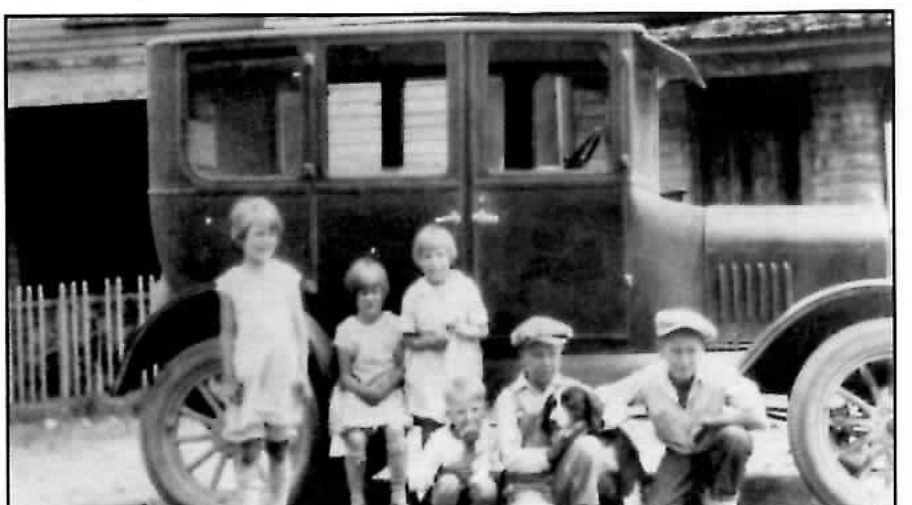
To get away from the hell raising kids Grant would pick up Noel "Bo" Roberts and Lee Shillings for a run through Center, Saguache and, sometimes, Bonanza on a little drinking spree. John Van Buskirk, well known in the Creede camp, had a barber shop in Center. Grant always made it a point to visit his old friend, John.
On one such trip Grant was badly in need of a shave. They stopped several car lengths from the barber shop, walked back, and sat on a bench in the sun as John finished a haircut and shave for a local. When he was finished Grant hollered, "hey Van Buskirk, I'll trade you a pint of whiskey for a shave." John yelled back, "get your lazy old butt in here, you've got a deal."
Grant Matzen received the best shave he had ever enjoyed in his life. He got up from the chair, looked at himself in the mirror, and, with his companions, walked out the door and headed for his car. John was cleaning his razor in the lavatory and it took a minute to register that Grant had left and he didn't have his pay. He ran to the door and yelled, "hey Grant, you forgot to give me my whiskey!" Grant yelled back, "you'll have to come to Creede to get it, John, I came down here to get my shave."
John never forgot. Years later he moved his barber pole to Creede and set up shop north of the post office. Grant Matzen was on night shift at the Amethyst Mine and would drop in daily just before noon to visit with John and have a gurgle or two of John's liquor he kept in a drawer near the towels. John waited nearly a year then bought a pint of cheap whiskey, dumped a quarter of the liquid down his sink, and mixed a generous portion of Croton Oil, a powerful physic, with it.
Next time Grant came in he went straight for the drawer explaining to John he was in a hurry, had to take Esther somewhere, so would just have a drink and go. The bottle wasn't in the drawer. John said, "you're out of luck, Matzen, I'm fresh out." Grant kept prowling as he growled, "you don't lie worth a damn Van, you've never been without a drink." About that time he found the pint under some dirty towels and shoved it right up to John's face. "Hah, nearly full, too, the extra work should be worth two shots." With that he sloshed his tonsils thoroughly. "Jeezus crist, this tastes awful, what did you change brands for?" John replied, "well, the price was right and it has some new ingredients."
Grant was missing for several days. When he next climbed the three steps to the open door he pointed a wavering finger at John and advised, "you bastard, as soon as I'm well enough to hold a gun I'm going to blast you to hell, Van Buskirk."
The Wild and Untamed
The character who provided us with the most exciting stories was a fellow we knew as "Tex." Tex was our idea of a real cowboy. Tall, broad shouldered, skin like an old weathered boot and hands so callused the palms looked like they were covered with large fish scales.
Tex lived in a small shack at the foot of the mesa south of the Haigner house. He was a teamster during this period and hauled mine props from Dry Gulch to the Last Chance Mine. Tanana Cimarron, as he sometimes called himself, was the only cowboy we knew who could roll a cigarette with one hand. We marveled at this feat and the chattering stopped, with all eyes glued to his hands, as he pulled the sack of tobacco and papers from his shirt pocket. He would grip one side near the top with his teeth and pull with his fingers to open the sack then deftly extract a paper, cradle it between his fingers and dribble out just the right amount of tobacco, then a twist and a lick finished the job other than lighting a match with a thumb nail. As a finale he would have one of us hold out an arm for him to blow a smoke ring around.
The story we liked best concerned the time he was a cowpuncher in Texas and would ride into Mexico to visit the cantinas and a beautiful Senorita who danced and sang with eyes only for the tall gringo. She was in love with Tex but her Mexican boyfriend and relatives disapproved. On one of his visits they decided to chase the big "Yankee" back to Texas once and for all. A terrific fight ensued. Cimarron was more than holding his own when one of the group slashed his belly open with a razor sharp knife. Holding his entrails with one hand he somehow managed to exit the cantina and vault onto his black stallion, the horse no one but Tex could approach, let alone ride. With the reins in one hand and his entrails in the other he galloped into the black of night, through arroyos and mesquite, across rivers and mountains in tortuous flight, finally crossing the border into Texas. He was still 40 miles from a doctor and he found it increasingly hard to control his entrails, in that large hand, rocking in the saddle of the great black stallion. He knew he had to close the wound or he would never make it to help. At last he came to a barbed wire fence and knew there was no choice but to nip a strand of the wire, shove the entrails into place, and sew himself up.
So there we sat, Walter Workman, David Manning, Lee Davis, Scooter and I, spellbound by this tale hoping it would never end and there was Tex by the coal oil lamp, tipped back on the hind legs of his chair, rolling another cigarette with one hand delaying the finish for the full impact of this daring act to register on our faces.
Just as we would start to ask for the gory details he would blow a smoke ring and continue the story. He grabbed the wire cutters he always carried on the great black stallion, chose a length of wire with the fewest barbs and cut it cleanly, he then found a piece of driftwood to bite on, bared his midriff, and wired the hole in his belly closed. As one we would beg Tex to show us the scar but Tanana Cimarron felt the sight of it would make us have nightmares or worse.
Cowboys and Gentlemen
Our association with Tanana Cimarron made us all want to be cowboys. We had burros from time to time that sheepherders left in our care when sheep were brought in from the range and John Albert Dabney let us ride a steer he was fattening in a corral by their home in Creede. We were thrown and stomped by all and we were sure it was because we lacked cowboy apparel. If we just had pointy toe boots and spurs and chaps and gauntlet gloves and shirts with flap button pockets and a red bandanna with a bone choker we would be able to ride with the best of 'em.
David Manning and Walter Workman had boots, Bobby Oates had gauntlet gloves, Lee Davis had a ragged pair of chaps and they could ride longer and better than the rest of us. That proved that all it took to be a cowboy was the proper equipment.
We had a gentleman rider of that era who, while not a cowboy, commanded the respect of adults and kids alike when he put a beautiful bay horse through its paces wearing his cavalry outfit complete from leggings to campaign hat. The Cathcarts, Charles and Annie, also had milk cows that pastured where mill tailing dams now reside. Charles couldn't understand the contrariness of his cows on certain days when they refused to release milk to his massaging fingers. On those days you could be sure a group of rag tag kids had been riding hell out of them. With a piece of rope from the halter as reins and a switch to make them buck we could picture each as a great black stallion.
The greatest event of our young lives was the spring drive of the co-op herd from the stock pens of Wason Ranch where cattle were unloaded from railroad cars and driven to high range on Clear and Spring Creeks via Seepage Canyon. Try as they might Bruce and Ethel Manning could never stop David from joining the drive and he was the envy of all us towheads as he worked the stragglers in line in choking dust with his bandanna over his nose and mouth on a real, live, honest to goodness horse with saddle and bridle provided by either the Dabneys or Shirley Wills.
Grandparents, the Building Blocks
I never pictured my Granddad Lane as a cowboy though he rode everything cantankerous or gentle. A tall, handsome man he was more at home behind a team of horses than astride one. We took some wild rides returning to the homestead after delivering wood or mine props to Creede. Lower Creede residents knew that Granddad had spent too much time in Phillips Beer Parlor when they saw a wild eyed youngster holding tight to the spring seat and an equally wild eyed oldster slapping the reins at a pair of galloping horses churning dust and scaring dogs into howling flight as they pulled a clattering wagon down main street.
Granddad was full of wisdom though some of it took several years to register with me. I once asked him why a favorite Aunt and Uncle didn't have children. She was so kind and giving to us heathens I felt they should have children of their own. "Well, Johnny, you never want to make a brood mare out of a good riding horse," he replied. I thought he hadn't understood my question but I didn't press him on the subject.
The foundation for a child's life is firmly set if he or she has grandparents for one of the building blocks and a ranch owned by the grandparents for another. From this start any chosen goal can and should be reached. Those of us, so firmly entrenched, have only ourselves to blame if we become sidetracked along the way.
We had a firm foundation to grow on. Charles L. Lane, our Mother's stepfather, had a 160 acre homestead that embraced the mouths of Sawmill and Gardnier gulches running to the county road on Moonshine Mesa. Granddad Lane had a
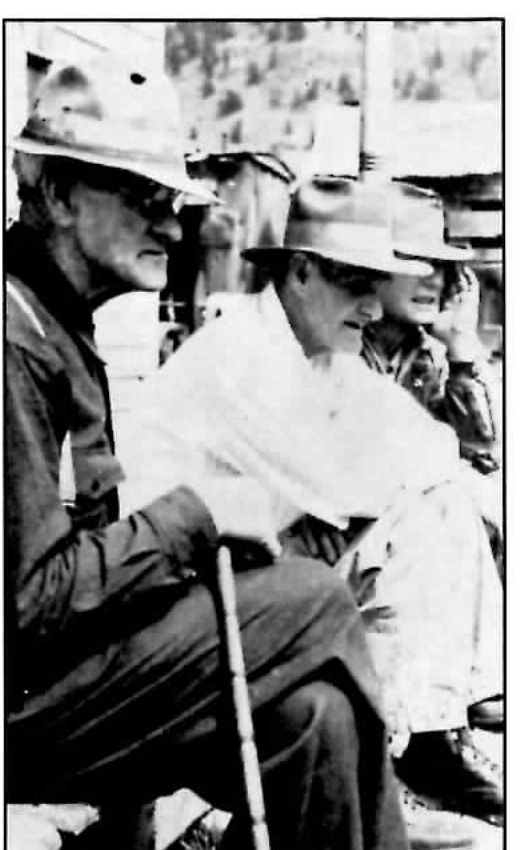
wood and mine prop business as his main source of income. He raised oats and barley for his teams and milk cows. Grandmother Lane raised chickens, rabbits, guineas and, for a brief period, turkeys and geese. Coyotes developed a taste for goose and turkey, Buck, the part Airedale had grown too lame to chase them away. Grandmother Lane was also a practical nurse and brought the first cry of life from most of the youngsters born in Creede in the interval 1920-1940.
Mom Jo welcomed the end of school year as much or more than her boys. With the final ring of the school bell each May I was farmed out to Granddad and Grandma for the summer. I relished the change and felt I was an integral part of Granddad's wood business, besides that, I loved the smells from Grandma's kitchen. Fresh baked bread, rhubarb and apple pies with hot goo boiling up on the crusts were daily fare plus her stocks of jams, jellies and preserves in the root cellar.
Three cows provided milk and I had become a milker. They had two Holsteins named Blanche and Pet, and a Guernsey we called Georgie. From the pails of white beverage Grandma produced butter, buttermilk and cottage cheese. A milk house covered the outlet of a spring which kept the dairy products cool and sometimes aged a deer or elk carcass before butchering.
We weren't dumb kids and we knew that to keep the milk flowing it was necessary to take the cows to visit a bull yearly. When Gram would tell Granddad "old Pet has been bulling a couple of days" we knew we would have a diversion
from our chores to drive old Pet three miles, including a river crossing, to the Broadhead Ranch where the romancing took place.
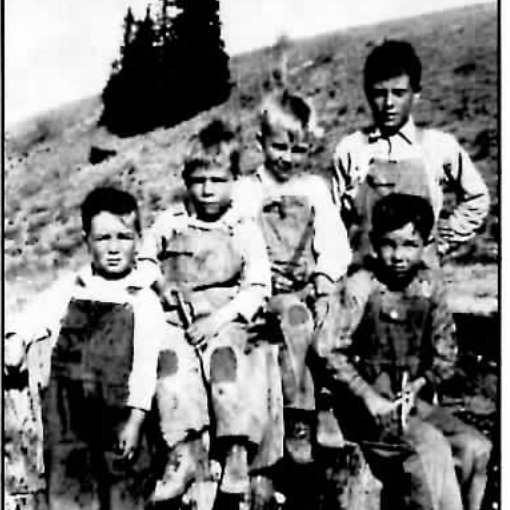
Raymond Lane, Charlotte and I made up the procession. Raymond, riding bareback on one of the horses used for both skidding logs and pulling wagons would lead with Charlotte and I following until we made the river crossing. Once across the Rio Grande love conquered all and we were hard pressed to keep up and open barbed wire gates to the Broadhead corrals.
On one such visit we met Ellis Clampett, Mrs. Broadhead's new hired hand. Ellis took over introducing the bull to old Pet as we crawled over the pole fence by the barn to visit with Mrs. Broadhead at the ranch house. A ditch ran in front of the house with a small footbridge over it and fish were nearly always visible from the footbridge fanning their tails to hold against the flow of water. Mrs. Broadhead let us get our fill of watching the somewhat tame trout before inviting us into the kitchen where after the formalities she would set out glasses of milk and a plate of biscuits with hand churned butter beside it. Cholesterol was unheard of then and we packed the biscuits with a coating of butter that would make a physician cringe today. It was easy to love this squat, gentle lady with the low voice and slight Dutch accent.
On another visit Mrs. Broadhead let us fish in the lake on the north side of the road. With a string of trout for supper Raymond and I headed past the corrals on the long walk back, Ellis was perched on a one legged stool, his forehead mashing his floppy hat against the flank of a reddish brown cow drawing milk from her plumbing system with hands that had had much practice. We detoured to visit a few minutes in a fairly one sided conversation. Ellis would utter a few words then appear to doze off though his hands continued their rhythmic massage of the teats, another exchange of words and he slipped off again with his hands dropping to the pail. The old cow, thinking her duty done, lumbered off upsetting both the pail and Ellis. He got to his feet, chased her around the corral a couple of times uttering choice words about her ancestors, then finished the milking task. Raymond and I couldn't wait to get home to tell about this cowboy that went to sleep milking a cow.
Shortly after this Rufus Mann acquired a Holstein bull and our trips were shortened by a half mile but we still had to make a river crossing, ofttimes by hanging onto the cow's tail.
Birthday Cakes and Pucker Power
You won't find this entered in the Guinness Book of Records but there is little doubt that Charlotte Lane and I hold the record for pushing and pulling a one horse buggy the most miles over rocky and rutted dirt roads. No four legged equine stirred up as much dust as our four feet did in our travels from the Lane ranch to Swinehart's ranch to the east and the Barber and McKay spreads to the west.
We had been working on a pot of lima beans and cabbage for two days when Charlotte Lane and I were invited to Howard Barber's ranch where he and Pearl were hosting a birthday dinner for their son in law, Bob Bennett. We walked the mile and a half from the Lane ranch, went through the proper greetings and were seated on a rough wood bench before a platter of fried chicken, mounds of mashed potatoes, milk gravy and fresh baked oven rolls. On a butcher's block rested the largest rectangular cake I had ever seen, loaded with white icing, and decorated with mouth watering pink icing.
Lima beans and cabbage combined have a tendency to generate gas in the intestinal tract. Before I had stripped two drumsticks of meat I could feel the methane building up. I ate faster, with one eye on the cake, hoping the others would get their fill and let Bob blow out the candles so we could get to the serious part of the meal. Howard was wound up in a hunting story and barely picking at his food, Pearl was dishing up seconds and thirds while my methane generator, fueled by the lima beans and cabbage, was near out of control. I puckered until I was completely puckered out and the safety valve finally blew. It sounded like an off key clarinet interrupting a violin solo muted only slightly by the wood bench. I looked left and right hoping the blame would fall on Martha or little Freddie and I would still get my share of the cake but Howard zeroed in on me with the first note and was roaring with laughter. Pearl tried to console me with, "slips don't count Johnny," as I ran through the door. I didn't stop until I was in the darkness of the milkhouse where I, alternately, cried and cursed the lima beans and cabbage that cost me the best slab of the best cake to ever grace a table on Moonshine Mesa.
Most ranchers lambed in February and calved in April but Granddad Lane always lambed in June. Granddad's grain would be at an enticing height in June when the herds of sheep bound for high range feeding grounds were driven by. Granddad would wait 'til several sheep had penetrated the barbed wire fence surrounding the grain field then with his 30-30 Winchester cradled in one arm and Charlotte, myself and old Buck, the mongrel dog, trailing we would walk from the ranch house to the fence line where we would weed out the old ewes, select two or three lambs, then with the help of old Buck, Charlotte and I would drive them to the sheep corral that ran from the chicken coop to the wood yard. Granddad stood with one foot on the lower wire of the fence nonchalantly chewing tobacco as the herders furiously drove the rest of the herd to safer territory. None questioned the authority of this tall man with the long barreled rifle. All in all it was a better exchange for the herders than when Granddad was away and Grandma unlimbered the rifle to fire warning shots among both sheep herders and sheep to protect the grain.
In time the herders became familiar with this part of the drive and made an extra effort to keep the sheep along the river and away from the green fields but until that time our menu included lamb chops quite frequently.
Lessons From a Barber's Chair
The first haircut I remember was in the Heinz building. It was a two story, brick structure with a barber shop in the south end at ground level. Eugene Thom, who would become our town marshal, did the honors. Gene was a patient man and the only barber who diligently tried to keep the cuttings from going down my neck.
When we were old enough to make the trip alone we chose Fred "Soapy" Birdsey's shop at the lower end of the BPO Elks building. Soapy had two pool tables in the rear and a nightly poker game. We learned more about life in our visits to Soapy's than could ever be taught in a classroom or the Red Cross Hall where the boxers trained.
What a thrill it was to be allowed to sit on the waiting bench near the cloth covered table as Judge Homer Kendall, Walt Wilson, Gus Swanson, Roy Phillips and Soapy shuffled the deck and zipped cards around. If Soapy was on a winning streak we might have to wait several hands before he returned to the barber's chair. Every subject of national interest was discussed here and the skeletons of every closet in Creede bared. I learned far more about my heritage in such sessions than I learned from my parents.
Soapy took us from the hobo jungles of Chicago to the boom town of Creede; Gus Swanson took us even further. From Sweden, across the Atlantic, to the United States of America. Gus had been a weight lifting champion and could pick up a 75# anvil by the horn with his right hand and hold it at arm's length. In America he was just another immigrant content to live out his life in Creede as a miner.
We learned the bawdy side, too. The poker players sometimes forgot we were within earshot and discussed matters our mothers would rather had been reserved for 50 or more years.
At one session where Soapy was raking in pots left and right, with a run of good luck, and we were patiently waiting he asked Walter about his kibitzing with a certain widow that day. "I saw you and Mae huddled up like you were planning a surprise party." Walt hemmed and hawed, twitched one shoulder, and offered, "well, there wasn't anything better for either of us to do so I propositioned her." The cards went around twice before Soapy asked, "what was the verdict?" "Why the old bat told me" (his voice rising to mock hers), "'I'm so sorry, Walter, but I'm flowing this week.' Hell, she hasn't flowed for forty years." They all burst out laughing and so did we though the punch line was lost on us.
After a long apprenticeship Soapy let us shoot pool by ourselves with a stern warning that a tear in the fabric would cost us a dollar an inch. A dollar was a third of a miner's daily pay and equal to two haircuts. We were careful.
We were in the pool hall when a young pool shark challenged Soapy. It was nip and tuck for several games with the young fellow boasting a two game lead and a bunch of disappointed youngsters afraid Soapy would lose his day's earnings. The young fellow was getting pretty cocky, made a few trick shots, then offered to put up $5.00 for a final game and let Soapy break. We were really scared then but our barber broke the triangle and ran every ball to a pocket in the best exhibition we had seen. The pool shark had met the master.
Bill Tingley — Sawmiller and Moonshiner
Our favorite sawmiller and moonshiner, William Tingley, kept Scooter and me in western magazines. He lived in a one room cabin in lower Creede during winter, but as soon as weather permitted he returned to his sawmill and mash tubs.
We knew within a day or two when Bill would have a magazine for us. He usually put the reading material on a stool just inside the front door, but if he had been on a bender the magazines could be anywhere. On one visit Scooter and I found him rolled up in his covers, fully clothed, with the cabin so smoky we could hardly see. We found one of his quilts smoldering and soaked it with a tin dipper and a water bucket. He had evidently been drunk several days and had been pulling ashes from the stove with his arms until the pile tumbled against his bed kindling several hot spots. Bill woke up as we were rustling around and roared, "gitchur damn books and git outta here, can't you see I'm sick." Eventually his cabin burned to the ground, luckily he had left for his mill.
Bill had a terrible hernia on the right side of his belly near his groin that periodically strangled a length of intestine. He could work the gut back within the abdomen wall if it wasn't bloated, on those occasions he called on Dad Bill to take him to a doctor. This invariably happened at mealtime and Mom Jo would set another place. Bill always declined to join us but insisted Dad finish his meal before driving him to Del Norte.
We liked Mr. Tingley very much but we didn't like to see him at lunch or supper. He would sit near my chair in a worn, buttonless sheepskin coat and belch loudly followed by gurgles and groans as he shifted the padding of towels and a wool shirt on the hernia and his fingers worked with his entrails. I could never finish my meal in that atmosphere and would excuse myself. Scooter would soon join me. Bill would then look over our plates and tell Mom, "Josie, if them boys ain't gonna finish their supper slop it on one plate and I'll eat it." Food wasn't wasted around the French-Canadian Bill Tingley.
We were at Gram Lane's with our dog, a large Chesapeake retriever. Gram had just brought out leftover pancakes for Scrappy who expected such treats at least once weekly. She was nearly to the dog when old Bill came past Witt Thomas' corral and saw the pancakes in her hand. "Migawd Maude, don't feed those good griddle cakes to that worthless damn dog, give 'em here, I ain't had my breakfast yet." So Bill went waddling home with his griddle cakes clutched in a grubby hand as Scrappy cocked his head at Gram Lane and tried to reason with his loss.
The only time we were comfortable with Mr. Tingley and food was during fried fish picnics, outdoors, with other old timers. There were stories galore and we would sit near Bill to watch him strip trout. He insisted his fish be cooked with heads attached. He would first suck the eyes from the sockets followed by a nip of the meaty portion on top of the head then the front started in on the right side of his mouth and a meatless skeleton emerged on the left. It was a show we never tired of watching.
Kilowatts and Yankee Ingenuity
These were the years when a Pelton Wheel powered the generator providing 75 kilowatts of power to the town of Creede. We were fascinated by this apparatus that spun the generator via a long flat belt from hub to hub. This whirring, clapping belt also produced static electricity around its oval perimeter. Our town electrician, Ivan Weaver, would have us little shavers hold hands as he would lead us up the walkway by the belt and explain the intricacies of the progression of power from the wheel to the lamp bulbs in our homes. Holding the hand of the leader in our interconnected group he would wave and point for emphasis then hold his free hand over the belt. A sharp tingle would pass through our line as his hand entered the static field and never failed to scare the pee out of Robert. We always had to wait for his pants to dry before returning home from the "light plant" in North Creede.
A citizen, just out of the city limits, suffered without electricity for years or so the council thought. Ivan marveled at the sudden onset of darkness in the house as he was driving by one night. He kept closer watch after that as coal oil lamps took time to fully extinguish the flame and flickered for several seconds. When there no longer was doubt electrical current had found its way to at least one room Ivan made a daylight inspection and found Garret had laid the first underground power cable in Creede and had wired his house. The line ran up a pole and spliced in by insulators almost invisible from the road. The electrician was appreciative of Yankee ingenuity and let the power flow.
Ivan wasn't nearly as appreciative of Uncle Woody's ingenuity in our home. Money was as scarce as hen's teeth during those years and each family tried to conserve electricity and stay within the minimum fee. Woody solved our problem by bypassing the meter for periods of days and even learned how to roll the kilowatt hours back. He became over exuberant on one rollback and when our meter was read Ivan informed Mom Jo the city owed us 90 cents. He also advised Mom he would have to bring Woody's name before the council if it happened again.
I was a student of electricity and an inventor of sorts at an early age. While the folks were busy entertaining John and Lena Slater one night I stacked books and shoeboxes to a level with an open copper socket where a screw-type plug could be inserted. I placed a table knife on my construction, pointed directly at the inner connection, and rammed it home with a stick of kindling wood. Before total darkness set in I saw the knife shoot like a bullet across the room, followed by smoke and fire. After Dad Bill and John had replaced a fuse and determined the source of the trouble, more fire came from the seat of my britches, Dad wasn't at all impressed by the curled, serrated blade I had produced that could peel an apple with a single stroke.
The summers spent with Granddad Lane served to bring home the magnificence of Ben Franklin's ingenuity as we read or romped in the vapors of coal oil lamps in the ranch house and cabin. Trips to the biffy at night seemed much safer illuminated by one candle power secured in an open-sided, reflecting coffee can that singed the wings of moths attracted by the flame.
Long Green and Short Stuff
We were going to Missouri to visit our Grandfather Davis who looked forward to our arrival with all the enthusiasm of a convict on death row about to take the last walk.
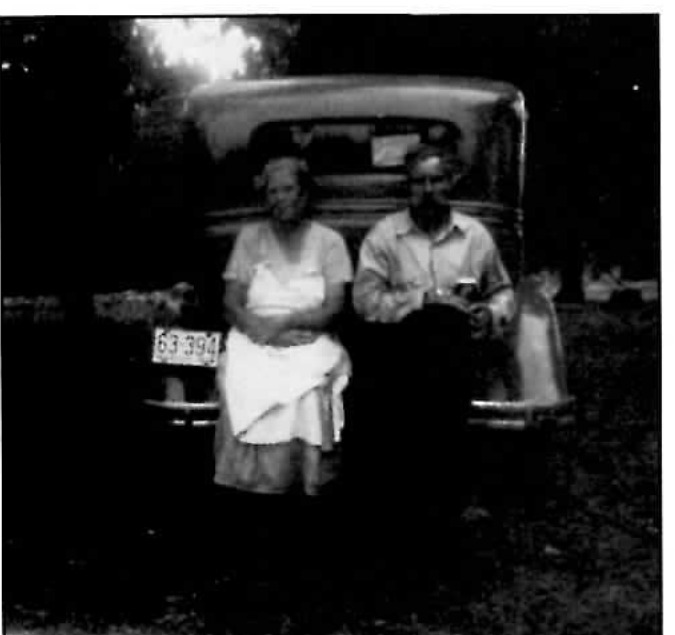
Mom Jo, sat in the front seat looking prim and pretty, anxious to show off her trio of boys. Dad Bill made last minute checks of the moving parts hoping the engine would fall out or a gully washer would hit sparing him the tortures of being cooped up in a '34 Ford with his sons and heirs for the long journey. Joel, Scooter and I were cocked and primed for this adventure. Our slingshots and a can of rocks of just the right size were hidden under a jacket in case there were no rocks in Missouri, a state full of poisonous snakes, alligators, tarantulas and long green tobacco.
Brother Joey may have flunked English but he could read a road map. After turning umpteen 90 degree section corners we wound up in Oklahoma where the roads were even worse than those in Kansas. The sand was several inches deep forcing Dad Bill to constantly shift gears to keep momentum. He cursed the God forsaken country that broiled grasshoppers and wind whipped them into the radiator causing the engine to heat and he prayed for a valid excuse to turn back. The very next shift to a lower gear the gearshift lever came completely out of the transmission. At the sound of cursing we gathered around his neck where we could see oil dripping from the lever and foaming from the opening in the transmission.
We continued in low gear to a single pump gas stop where a weather beaten old fellow, with more mechanical experience than Dad Bill, succeeded in working the lever into the proper position so the keeper would slide in. Joey told him the story of how we had come all the way from Colorado and got lost as Scooter and I tried to knock a grasshopper from the glass bowl, on his gas pump, with our slingshots. He looked immensely relieved when we boarded the four door to resume our journey.
We bombarded Dad with questions as miles of sun scorched earth passed behind us. A lone jackrabbit leaped in front of the car hoping to end his misery under the wheels but succeeded in only getting bumped and rolled to the ditch where he appeared to be motioning us back for a second chance. The first words of protest from Mom Jo came as we held our arms out the rear windows trying to catch grasshoppers which also brought in clouds of dust.
Missouri was like an oasis after the sand traps of Oklahoma and Kansas. Water ran in streams boasting crawdads and perch, a persimmon tree treated us to ripening fruit and a stocky old fellow with a handlebar mustache welcomed us to a farmhouse shaded in trees just off the road between Southwest City and Noel. We had been briefed repeatedly, during the trip, on behavior and greeting our Grandfather. Mom Jo wanted initial impressions to be rewarding for all concerned, Dad Bill was a realist. He was prepared for the worst and we rarely gave him cause to be otherwise.
After the first day Grandfather Davis began absenting himself for longer and longer periods of time until Mom Jo packed our belongings in the car for the return trip. He returned to bid us good-bye with few reminders of his new found grandsons to plague his thoughts at night. We had been banned forever from Alexander brothers because we had knocked down a year's growth of long green tobacco drying in the rafters of a barn we found overpopulated with mice and rats. We had ruined Aunt Mary's new galvanized wash tub killing a tarantula, that had become trapped in it, with an overhead barrage of rocks. We had seen Mr. Thompson relieve himself in his garden and take a stick to push the feces against fast growing cabbage and we had wasted a whole day hiding by Dovy Magee's house after she had been bitten by a copperhead snake and was supposed to die. She recovered without learning of our disappointment.
We were traveling via a new route, hopefully, shorter and with better roads. Dad had entrusted Joey with the role of navigator and Scooter and I were hanging out the windows shooting up the last of our supply of rocks at mailboxes and jackrabbits. East of Wichita, on a lonely stretch of road, we approached a car with one wing of the hood laying over the other. Two rough looking characters were flagging us down. Dad had been undersheriff to Bill Orthen for several years and carried his .45 revolver on all trips. He laid it on the seat by Mom as he got out and told her to keep an eye on them. Dad wasn't at all mechanical minded but when one of the men asked if he would look at their engine and try to figure out why it quit he dutifully stuck his head under the hood and began fingering the wiring. As one of the pair bent down with Dad and began pointing at various parts the other raised a tire iron over his head and prepared to clobber him. Mom Jo was a timid soul but she grabbed the six shooter with both hands, stuck it out the window and yelled, "Billy, look out!" The gun was waving over half an acre and in all likelihood she would have hit Dad had she pulled the trigger. The thugs saw she had the real thing and scattered into roadside shrubbery as we hollered, "kill 'em, Mom, kill 'em." Dad Bill vaulted the short distance and grabbed the gun just as Mom faded from consciousness.
We had been to Missouri. We had been in three states other than Colorado which made us world travelers. We brought back a small turtle that, if it bit you, would not release its hold 'til it thundered, so they said in Kansas where we found it on the road. We had a dried up tarantula leg and, best of all, we had the near shooting adventure in Kansas that got better and better each time we told it. Fame had come to the Jackson boys.