"Who Upset the Thunder Mug": Chapter I
Chapter I runs from printed page 1 through page 4 and holds three stories: the family tale that gives the book its title, a wood-hauling trip with the author's step-grandfather, and a summer job at the Creede reduction mill. The book prints the chapter heading as a numeral alone.
Who Upset the Thundermug
There is no mystery in Who Upset the Thundermug. My maternal grandparents, with their family, had moved to a two story house on Kerber Creek near the mining town of Bonanza where Lynn and two sons were employed in a saw-mill, Maude was cooking at a boarding house and Rose, the eldest daughter, was caring for the three youngest at home. A local cowboy had taken a shine to Rose and had begun stopping in at regular intervals. He was a handsome fellow and it soon blossomed into a full scale romance.
He was visiting one day when my future mother, Josephine Davis, was reading in an upstairs bedroom. Josephine believed in Princes and Princesses and she was sure the affair would advance to kissing, right on the lips, and perhaps that very day. She was squirming for a better view between the cracks in the floor when her bare feet made contact with a nearly full thundermug or "Chamber Vessel" as it was sometimes called. The vessel overturned and the contents began cascading between cracks directly over Rose and her boyfriend.
The cowboy jerked off his chaps and tried to shield Rose from the urine bath, but she was already on her way up the stairs to commit murder.
Thus was the end of the first romance for Rose Davis but the upstairs thundermug was emptied first thing in the morning thereafter and Josephine received kitchen duties that occupied her time for many weeks to come.
The story gives no surnames for the grandparents and no date. Read with the family pages on this site, "Maude" is Anna Maud Woodruff, John's maternal grandmother, and "Lynn" is her first husband, Robert Abraham Lincoln Davis, called "Lynn Davis" in "Please Go to Hell." "Josephine" is Alice Josephine Davis, John's mother, "Mom Jo." "Rose" fits Edna Rosamond Davis, the elder of the two Davis daughters, who per family account went by Rose; her later married name is still unconfirmed. The household as told also fits the six Davis children: two older sons at the sawmill with their father, Rose as eldest daughter, and Josephine and her two younger brothers as "the three youngest." That last match is an inference from the family's structure, not something the story says. The site has no record placing the family on Kerber Creek near Bonanza; the 1910 census has them at Florissant, and their son Robert Lincoln died in Creede in 1918. Maude cooking at a boarding house agrees with the account in "Please Go to Hell" that she ran boarding houses in lumber camps and mining communities before the family came to Creede.
Granddad and the Jayhawker
The first thing a young man must decide for himself is if his hands grasp a shovel handle better than his brain grasps trigonometry. I wasn't a scholar and the decision came easy for me. Some jobs were less than satisfactory, but there was a lesson in even the most menial of labor that would serve me well in later years.
My step-grandfather showed me that silence can earn respect one day while delivering firewood. It took nearly a full week to gather a load. We spent two days cutting and skidding spruce logs from a broad hillside between Gardnier and Sawmill Gulches along skid trails the horses knew by heart and seldom needed any directions to work their loads around obstacles. It took at least three days to saw the logs into blocks with a two-man saw, then came the job I loved most, splitting the blocks to size. I had a good eye for the easiest cleavage and could gain ground on Granddad who had a crippled arm that hindered him swinging an axe.
A message had been delivered by a neighbor that summer residents at Idlewild, on the road to Spar City, needed a load of fireplace wood. This was mile further than a trip to Creede but Granddad charged the same and the trips to the west were my favorites because we passed Comstock-Kinney Point of Rocks where Mr. Comstock operated a small store. Granddad always fished a dime from his deep leather purse for me on our way home which translated to ten long licorice sticks in the spring or a sack of cherries in late summer.
We had an especially large load as the rutted road from the ranch to the highway would shake it down to a compact mass. I loved every part of the deliveries from the smell of the horses and rattle of the doubletree to the clink of steel rims on rocks. When Granddad wanted a fresh chew he would pass the reins to me and let me have a brief fling at being a teamster. It took around two hours to reach the section line fence at Idlewild where we stopped to rest the horses before the climb to the two cabins resting in trees where a spring trickled from a canyon of Snowshoe Mountain.
I always marveled at the ease with which Granddad worked his team to back the wagon within inches of a woodshed. I tried it once and jack-knifed the tongue nearly turning the rig over. I was stacking the split pieces in a neat row as Granddad threw them from the wagon. A rather portly gentleman came striding from the larger of the cabins, ignored Granddad's, "Good morning, Sir." and stood at the rear where he could look in the wagon box.
"How much did you say you charged for a load of wood?"
"Ten dollars." Granddad replied.
"Looks more like an $8 load to me, I can't pay $10 for a load that size."
Granddad didn't raise his voice as he ordered, "Throw it back on, Johnny, we'll take it to Mrs. McKay's on our way home." I started throwing with all my strength hoping at least one piece would bounce and hit this fellow with the wool trousers and fancy shoes. There would be no stopping at the Comstock store and no licorice sticks this trip.
"Just a minute, young fellow, I'm sorry Mr. Lane, I guess I really didn't see how much wood you had there."
Granddad didn't say a word so I threw a couple more pieces out.
"Tell you what, Mr. Lane, let the boy finish stacking while you and I have a drink and get acquainted."
When they came back to the wagon Granddad was putting bills in his purse as the gentleman handed me a quarter and thanked me for stacking his wood in such neat rows.
I giggled every time I thought of that tourist thinking he could hornswoggle my Granddad. As we neared Comstock-Kinney with the horses in a trot Granddad slapped me on my knee and said, "Better not spend all of that on licorice or I'll never get you out of the toilet."
The story names "Mr. Lane," and calls him John's step-grandfather, which identifies "Granddad" as Charles Lane, who married Anna Maud in 1920. The ranch and gulches match the homestead John describes in "Once Around the Thunder Mug," Chapter II, "Grandparents, the Building Blocks," where the Lane place embraces the mouths of Sawmill and Gardnier gulches and the firewood and mine-prop business is described. That page also names "the Barber and McKay spreads to the west"; the story does not say whether Mrs. McKay belonged to the McKay ranch there. In "Echoes from the Thundermug," "Never Bet a Cinch" has John borrowing a dime from Granddad, a coin John counts there as "ten licorice sticks or two packages of Blackjack gum," and another firewood haul from the Lane ranch is told in "Short Stuff." John's description of Granddad's arm is quoted as printed.
The Con Boss Conned
Years after the trip with my Granddad, an assayer, and his helper made a useful contribution to my education that I remember when I begin to take myself too seriously.
Bill Anderson, mill superintendent for Emperius Mining Company, hired me one summer for cleanup work in and around the reduction mill at the south end of Creede. During the course of my duties I shoveled silver concentrates when the regular laborer failed to show. It was a foul smelling job requiring more muscle than brains as we loaded the heavy mud from a bin to a truck and in turn from the truck to a boxcar on a railroad siding near the depot. It was hard for Mr. Anderson to get steady help for the job so when he asked me if I wanted to take it on full time with Lynn "Key" LeZotte I jumped at the chance. I would get to drive a truck as well as earn $4.00 per shift. I would have returned half the pay just to get to drive the truck.
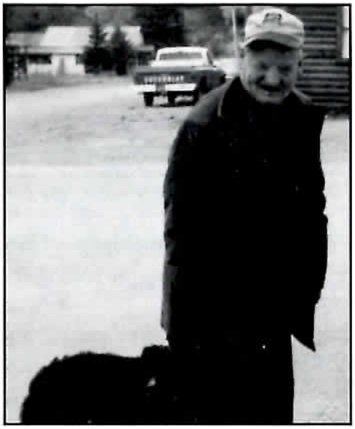
The Tommyknocker's pal and my good friend a life of hard work, beginning to end.
Key and I made a fine team. A childhood illness left him physically deformed and he stuttered but there was no better worker in Creede. We worked together again after World War II in the Amethyst Mine where Key always left a half sandwich for the Tommyknockers near our working place. He told me "If you f-f-f-feed the Tommyknockers, J-J-Johnny, they'll never b-b-b-bother you." He must have been right. The Tommyknockers never bothered us.
During the summer of concentrates hauling Key took over the wheelbarrow we used to transport the loads from the truck to the ends of the boxcars. He felt that was too much strain on a youngster's back, but when he was suffering from "lumbago" he would consent to me being engineer and complimented me when I stacked the loads nearly as tight as his own.
In little over a month we had things down to a routine and one evening I was hailed from a window in the laboratory. "Come on up, Johnny, we need to talk to you."
I fairly ran up the stairs as it was a treat to get to see all the equipment in the assay room and the little silver beads from the crucibles. "Johnny, you've been doing a helluva good job on the concentrates and we're going to promote you to con boss."
As Bryan let that soak in John Gulzow brought in the sampling tools.
"Every time you load out a car and the bulkheads are in place you can take this bucket and cross sample both ends for us to assay."
John then showed me how to use the tools and further advised, "Bring the bucket to the lab and make out this form specifying the railroad car number, number of samples and be sure to sign your name on the form with the title Con Boss."
I was on cloud nine. Less than two months on the job and I was a shifter of sorts. The added job was no great burden and I made sure Bryan and John noticed how I cleaned the tools so there would be no contamination with the next samples. One day, as Key waited for me with a large chew of tobacco in his jaw, he asked me why I was doing Bryan's and John's job with the sampling. I told him it was now my job that I was Con Boss.
He laughed, "You're n-n-n-not my b-b-boss J-J-Johnny."
At the same time Carl Hogue hauled ore from the Amethyst Mine for Creede Transportation Company. The firm also owned the truck I drove. We were walking out of the garage after gassing up the trucks and I was so proud of myself I just had to tell Carl that Bryan and John had promoted me to Con Boss.
He grinned, slapped me on the back and said, "You're moving right up the ladder, Kid, if bullshit was money you'd be a millionaire."
I may have been conned but it was one of the more pleasant lessons along the route I had chosen.
The story names two men in the laboratory, "Bryan" and "John Gulzow," presumably the assayer and his helper. Bryan is never given a surname, and the book does not say whether the two men were related. This is a different Lynn from the grandfather "Lynn" of the first story. Key's own tribute in "Echoes from the Thundermug," "Lynn Meets the She Ghost," covers the same ground from the other end of his life: the childhood illness, the years loading ore and concentrate for Emperius Mining Co., and the author's promise to "always leave a sandwich for the Tommyknockers." He is also named in "Moves Keep 'Em Hopping." The book's Acknowledgements spell his surname "Lezotte"; this story prints "LeZotte." John's description of Key's illness and the spelling of his stutter are reproduced exactly as printed.
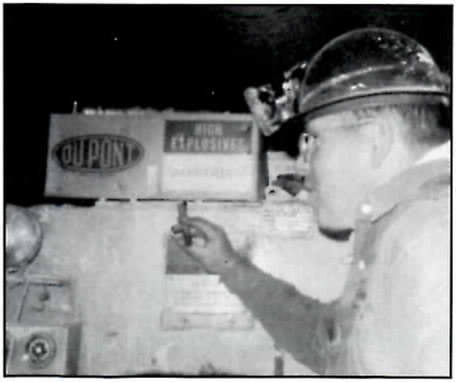
A dangerous load
for the tunnel crew
but our motorman
will see it through.
Monte Jay Larson is the second of the two friends to whom John dedicates the book in the Acknowledgements. He is not named elsewhere on this site. The book does not date the photograph or say which mine it was taken in.