"Who Upset the Thunder Mug": Chapter II
Chapter II runs from printed page 5 through page 18. It opens with a long poem about the Amethyst Mine crew, follows with ten underground stories from John's years mining at Creede, and ends with two full-page photographs, printed pages 17 and 18, that the table of contents does not list.
The Amethyst Crew
My gawd, pard, that rock was hard
but we broke 'er deep and clean
the shifter's sass, the dust, the gas
the worst I've ever seen
We'll wash it down when we hit town
in Tucker's Bar and Grill
they'll swear the smell is straight from hell
when we come off the hill
The driver slows, looks down his nose
as we scramble with our gear
and form a line to a neon sign
that flashes "cold draft beer"
Pug's at the bar and Tuck's not far
as we shuffle through the door
to take the stools of other fools
passed out around the floor
The great white ape with mouth agape
has staggered from the rear
a parrot's screech stops Bernie's speech
it's cage beside a mirror
A dog gone mad bursts from a pad
a monkey on it's back
the white ape's pet, his passions met
leaps up and scratches Jack
Our ex-marine sounds gruff and mean
the jungle sounds remind
he learned to kill on Bougainville
it still torments his mind
We yell to Pete, "your time to treat"
he orders, "pour a round"
"a toast to you and the filthiest crew
the devil ever found"
"A shot and beer for our engineer"
old Paul has come in late
he strains his eyes to recognize
each worthless reprobate
The stopes, the drifts, the black hole shifts
forgotten for a night
and folks will hear out lusty cheer
as Woody stands to fight
The lights grow dim, Hank's face is grim
we struggle hard to hear
the name, the age, the final page
not one will shed a tear
So long ago, the fables grow
as one by one we wander
to ash and grave, no souls to save
we've all been called down yonder
Just one more day to earn our pay
and one more night to revel
another toast to the Happy Thought Ghost
and we'll go to meet the devil
Now here we toil, far 'neath the soil
to mine old Satan's gold
we eat his tripe, our only gripe
the beer is never cold.
The poem runs across two pages, breaking after "as Woody stands to fight" (p. 5) and resuming at "The lights grow dim" (p. 6). Three slips are kept as printed: "it's cage," "on it's back," and "hear out lusty cheer." The same poem appears in "Echoes from the Thundermug," at the end of "Miners After World War II: A Unique Breed," where John introduces it with a prose account of Tucker's Bar and Grill, the "great white ape," and the Amethyst Mine crew of the late 1940s. The two versions differ. The Echoes version has no stanza beginning "The stopes, the drifts, the black hole shifts"; it puts "Just one more day to earn our pay" before "So long ago, the fables grow," where this book has them the other way round; its version of that stanza reads "And one more toast to the Last Chance ghost before we meet the devil" where this book has "another toast to the Happy Thought Ghost / and we'll go to meet the devil"; and it reads "Migawd pard" and "eyes agape" where this book reads "My gawd, pard" and "mouth agape." John's memoir "Please Go to Hell" has its own roster of the Amethyst Mine crew in "Dedication and The Amethyst Crew '1947.'"
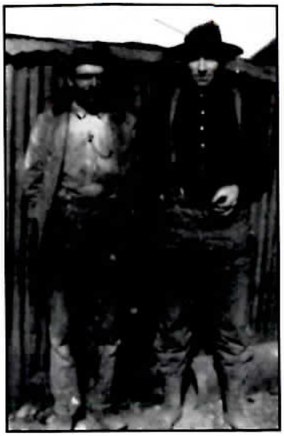
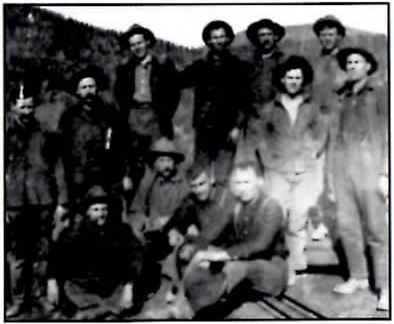
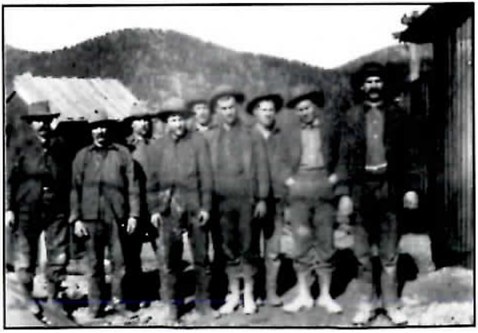
The Amethyst Mine
1890's crew
When the Roll is Called Up Yonder
Cunningham – "Here"
Gratton – "Here"
McGilvery – "Here"
Parkinson – "Here"
Reardon – "Here"
Regan – "Here"
Schultz – "Here"
Matson – "Here"
Stone – "Here"
The book prints one caption beside the three photographs, followed by the roll call, and does not say which men appear in which photograph or which surname belongs to which face. The caption dates the pictures to the 1890s; the poem gives no year of its own, and its setting is the postwar crew described in Echoes. Four of the nine surnames (Cunningham, Gratton, McGilvery and Matson) are also borne by men named elsewhere on this site. The book does not connect any of them to this roll.
And This Ain't No Bullshit
We are deep in the bowels of the Earth. I have just mucked out, laid a set of rail and set up the pneumatic drill, called a Leyner, on column and arm that will chatter in 18 holes to blast another pile of smoking rock. It is lunch time. With my hardboil hat resting on a nail keg and a carbide lamp providing illumination I flip open my pie can and pour a cup of coffee. Red Branson has started a story. He looks in my direction and advises, "Now listen up, Pard, 'cause this here ain't no bullshit."
Thirty years later I will remember that moment when Pat Madill, our helicopter pilot in minerals exploration, works his way into a story of exploration in Indonesia. "Fairy tales begin with...ONCE UPON A TIME...but real stories will always begin with...THIS HERE AIN'T NO BULLSHIT," he cautions us. Red and Pat had never met and Pat had never worked in a mine, but worker slang is universal and when a muscled fellow with sweat matted hair looks you in the eye and states, "Now listen up, Pard, 'cause this here ain't no bullshit" you had better listen and you had better believe it.
We will start our stories with, "This here ain't no bullshit, but once upon a time..." and leave the rest to your judgement. So...pull up a powder box, pour a cup of coffee and we'll let Red finish his story.
"They was seven of us young'uns to start with and our Pappy drug us from Oklahoma into Texas workin' the oil fields...I was a roustabout 'til I come on 18 years then I went on the pipeline crew...six of us laid 3 miles of pipe in one shift more 'n any crew before or since...pipe was so hot in that Texas sun yuh could see smoke comin' off your hands when yuh grabbed aholt of a joint...made muh hands tough as steel..looky here." With that he grabbed a large nail from a box, placed the head end in the palm of his right hand and rammed the pointed end through a 1" board he was using as a back rest. Nobody said a word so he rammed another through even further. I got up, moved my hat, and pulled two rail spikes from the keg. I walked over to some 6" x 6" ties leaning against the rib and rammed the first spike halfway into a tie with my left hand then really laid it on with my right hand and buried the second spike. Red looked at me like a bull at a bastard calf, slammed his lunch pail shut, and stormed off down the drift. Shortly after we could hear his tram car being loaded at one of the chutes.
Old Bill was laughing like a madman and slapping his knee. "How the hell did you do that?" he asked. What Red didn't know and I never told him was that the ties had been leaning in that same place for well over a year. The foul air and low humidity combined to make them as soft as balsam wood though they looked like they had just come from the mill.
Red didn't stay with us long but he touched my heart because he could neither read or write. He proved capable in all chores and worked with passion, but he just didn't like being underground. He drew me aside at the end of his first shift and asked if I would fill in his time ticket. It was embarrassing for both of us as he continued that none of his family had time for much schooling. That was one of many times I realized just how lucky I am to have had the opportunity for quality education in a town that cared and parents who stressed the necessity of a good education.
Neither Red Branson, "Old Bill," nor Pat Madill is named elsewhere on this site, and the book gives none of them a further identification. Red Branson and the Melvin "Red" Johnson of "Red the Medicine Man," later in this chapter, carry different surnames in the book, and nothing connects them.
"The Swede" Creede's Top Miner
Sometimes we get so busy patting ourselves on the back we tend to forget the real souls of merit, the trusting people who overlooked our mistakes and molded us into productive workers and citizens.
Erick W. Nelson was one of the finest miners to enter a tunnel or shaft in the Creede District. I have admired no man more than "the Swede" who rose from miner and leaser to become General Manager of Emperius Mining Company. He and my Father had been friends since childhood and I felt that friendship saved me from being fired several times when I taxed his patience. I was having problems pulling my rounds in a tight cross-cut before Erick was elevated to the top position. In desperation I drilled a sheep nose cut and overloaded the holes with explosives. I pulled the 5 feet, but I ruined two steel plats, shredded my air-hose and knocked out several lengths of pipe. I was unable to get it cleaned up and repaired before he made his inspection. Not a word was spoken, but I knew the pink slip only needed his signature.
Because of Erick I was treated to one of the most awesome sights I have ever seen in a mine. All water used in the several levels of mining came from a spring between the Last Chance and Happy Thought Mines. The water was piped to the Last Chance shaft and through connected workings to the Amethyst Mine.
I was driving dual inclines from a cross-cut and was just spraggin' up to drill when Erick came by. He replaced the carbide in his lamp and asked if I would help him on the water line. Every miner on level 5 was running out of water and he thought some moss or debris might have plugged the line. We took my pipe wrenches and started up 2 shaft checking every pipe joint as we climbed the rickety ladder. We arrived on the 150' level under the Sloan Tunnel, worked our way around a small cave-in, then scaled timbers to get past a larger cave, then up through a hole and onto level 2 of the Last Chance. I marveled at the way this old fellow, plagued by silicosis and rheumatics, found his way around and appeared to love every minute of his return to former haunts. We still had no water flow and continued south following the well rusted line. Erick was on his knees looking for a union to crack when I noticed a light ahead and told him someone else was on the level. He looked up, blew through his bushy moustache and said, "If that's a light, it darned sure isn't a carbide lamp." We began walking toward it and it became nearly overpowering, engulfing the entire drift.
If I hadn't been in the company of this seemingly fearless Swede I would have turned tail and ran. I'm not sure, but what Erick would have been stepping on my heels. We went on....slowly....and there we were, right at what had been #2 station of the Last Chance shaft with the sun shining down a wide open hole. At some time in the night an unknown factor had cleaned the shaft of all timbers, landings and pipe, dropping the debris to create a massive jam near level 5. We had arrived at the most opportune time to have the living hell scared out of us, just as the sun was directly overhead illuminating the gaping hole. Truly the light at the end of the tunnel.
The Swede took me on several trips through old workings where they mined by candle light and he learned to single jack with the best in the trade. He never forgot a thing and the knowledge gained in those early years served him and his crews well for the rest of his mining career.
This is Erick W. Nelson, whom "Please Go to Hell" also calls General Manager and "one of the very finest individuals I have known." A sketch there, "Quirks of the Trade," describes his "bushy moustache" and the habit of blowing up through it when he was riled, which is what he does in this story. "Echoes from the Thundermug" calls him "Erick 'Swede' Nelson," superintendent, in "Jackson Recalls Building of Ore Bins," where John's father, Bill, is his foreman. The poem that opens this chapter toasts "the Happy Thought Ghost"; the Echoes version toasts "the Last Chance ghost." Both mines are named in this story.
A "Runner" in 66 Raise
I liked everything about mining. Every smell, every sound and the excitement of seeing, firsthand, the minerals and crystals exposed with each blast while following a vein emplaced atom by atom through a complex hydro-thermal system that charged itself from a low level, mineral rich intrusive and dumped its load at an elevated level where lessening of pressure and lowering of temperature provided optimum conditions for deposition. There are other modes and models of mineral deposition, but the long term multi-phase, hydro-thermal system that filled fault fissures in the young volcanics of the Creede area provided the most spectacular crystal growths and mineral assemblages of any mining district I have had the privilege of actively mining in or visiting.
Hard rock mining attracts persons from every walk of life. At various times in Creede camp we had artists, cowboys, dentist, lawyers, farmers, barbers and even educators trying their luck at drilling and blasting paydirt. There were some who would panic at the first roar of a drill or run for cover with the first hiss and spurt of a flame from a fuse. We had Howard Midkiff who came from Illinois in the '30's to mine silver ore and drove his partners crazy with his "all the time in the world" igniting of fuse from primed holes. Howard would scratch his privates, wipe his nose, have a sip of coffee as he drifted from fuse to fuse to insure the correct interval between blasts and always reached a safe area before the first concussion.
Premature explosions were a rarity. We frequently tested sections of fuse and found both white and orange types to be accurately produced. White fuse burned at the rate of 60 seconds to the foot while orange fuse was 15 seconds faster. We used orange fuse in drill holes and white fuse mainly for blasting hangups and pasting large boulders. The only premature explosion during my mining career took the life of Reuben Wesander and severely injured Tommy Thompson in an incline from a vertical raise. Reuben was in the face igniting the notched fuse that made up their round as Tommy waited several feet lower. The blast knocked Tommy from a stull where he fell an additional 80 feet. Subsequent blasts sent rock cascading down on him but he somehow kept his head covered and managed to keep from being buried. There were four unlit fuse on a later inspection which indicated there had been a "runner." So called because the fuse burned faster than normal.
I have never been afraid of explosives, but I have always handled them carefully and developed a keen respect for the power in a small stick of dynamite. While working from the 850 level of a winze near the Last Chance claim I was to receive several boxes of gelatin dynamite via a can (sump bucket) lowered from an upper level. I was waiting some 10 feet from the bottom when I heard a strange whistling noise then a terrific thud just before being pelted by several 8 inch sticks of dynamite. The fellow loading the boxes had slipped one under the bale of the can and on the first rotation in lowering it fell nearly 300 feet. It was a little unnerving when I thought about it, but there was no time for fear in any event.
Another time, in the same winze, our hoistman had to lower Hank Slaght and me to the 850 level when he lost pressure to the pneumatic hoist. We had over 40 holes smoking a short distance from the winze and the first blast knocked out the flames of our lamps just as we touched bottom. We rasped them back into life with the flints mounted on reflectors and started for the ladder beside the hoisting compartment. In the brief instant before the next concussion buffeted us I saw that Hank was laughing then his overalls billowed like a balloon and we were again in darkness. He was still laughing when we clambered onto a safe landing in the manway.
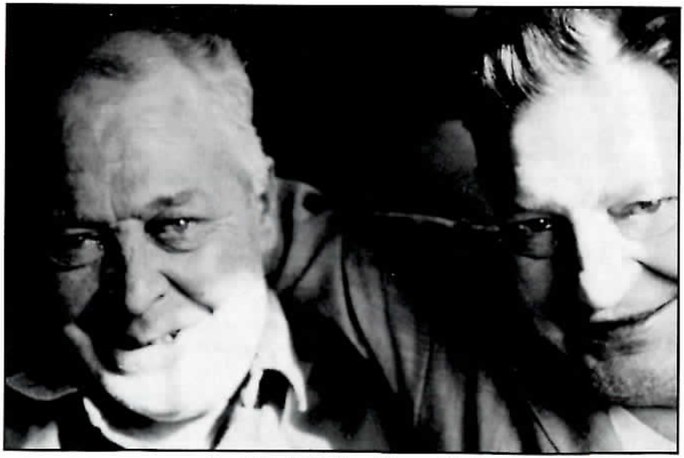
"Are you hiring or firing?" They questioned the day shift boss,
"I can use you both in the west drift sump as soon as you get off the sauce."
The title names 66 Raise; the story itself never says where the explosion happened. The fatal blast is the same accident told from other angles elsewhere on this site. In "Echoes from the Thundermug," "Name in Society Page Prompts Memory of Partners," John calls the man who died "Reuben 'Whitey' Wesander" and says Tommy Thompson was later "retrieved from inside a chute near tunnel level where he had been thrown by the force of the blast," while here Tommy is knocked from a stull and falls another 80 feet. The two accounts are kept as printed. The same Echoes page tells a different runaway hoist drop, with Gavin Skinner rather than Hank Slaght, and Echoes' "Miners After World War II" puts Wesander and Thompson in 63 raise. This story's opening paragraph on how the Creede veins formed covers the same ground, in different words, as a passage in "Please Go to Hell," "The Greenhorn." "Once Around the Thunder Mug" names "Henry 'Hank' Slaght" as the miner the foreman sent to frame and place square sets in its "Origin of Title."
Mr. Lehman Draws a Joker
During the lean years before economic conditions sparked a rush for more and more tonnage a new hand was placed with a seasoned miner for several weeks to get the feel of working underground. If he proved reliable and could cope with the hazards he would be allowed to handle explosives and start moving up in his apprenticeship.
My old friend, Dick Lehman, was driving a raise in what was called the West Drift and was asked to take a muscular young fellow as a nipper until he could be put tramming. I.D. Crawford, our foreman, told Dick the boy had worked around mines near Picher, Oklahoma but he was sure he wasn't old enough to have much experience.
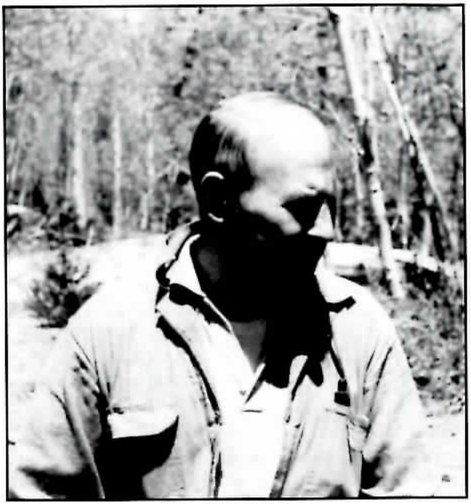
His partner yelled, "Is it caving in?"
"Only to surface," he replied with a grin.
Dick was pleased with his new partner. He picked up the primers with no show of fear and, when underground, carried a 50# box of DuPont powder from the magazine to a hole near the raise. They had to shovel muck off the bulkhead first then cut hitches in the rock for the heels of timbers that would span the void and provide a drilling platform. Hammer and moils were the tools for chipping the hitches and the lad had a good eye and swing. He appeared eager to join in every phase of the process of blasting rock.
They were ready to drill. Two planks were nailed to the stulls and a 6" x 6" timber rested against the footwall for added safety. Dick had his steel propped against the end furthest from the drill and a divided box of jack-bits secured on the bulkhead. He advised his partner, "All you need to do now is take the steel when I hand it to you, give me the next length, then change the bit on the starter, just rap it clockwise and it will spin off."
With the last of the instructions Dick eased the throttle to first notch which fed air to the leg and raised drill, steel and bit to hard rock. We used Ingersol-Rand 58 stopers exclusively. They weighed over a hundred pounds and with three exhaust ports fanning from the off side made one helluva lot of noise. With the bit in tight contact with rock Dick clicked the throttle to full power and cuttings of rhyolite began flying as he opened the water valve to keep dust down and cool the bit. The next thing he was aware of Martin had both arms around his legs, his hat was somewhere in the hole and he was yelling at the top of his lungs. Dick shut the drill off.
"Oh my God, oh my God," he yelled, "is it caving in Mr. Lehman?"
"Of course it isn't caving in." Dick responded, "What in hell is wrong with you?"
"Please, Mr. Lehman, just get me out of here." Martin was still shaking as Dick retrieved his hat and lamp from the muck below the bulkhead then held a hand on his legs as they slowly made their way down the ladder.
That was Martin's first and last shift in the mines of Creede and I have often wondered what stirring tales he had to tell his children if he became a family man on a farm somewhere in the midwest.
On the printed page (p. 11) the photograph sits beside the paragraph beginning "Dick was pleased," with the text wrapped around it; it is set here just before that paragraph. Dick Lehman is also named in "Please Go to Hell" as one of the Amethyst Mine's leasers in 1947, in "Dedication and The Amethyst Crew '1947,'" which also describes I.D. Crawford, here the foreman. The story does not say whether "Martin" is the young man's given name or his surname.
Forget About My Hat Let's Get Outta Here
Two young fellows from Kentucky hired on at the Amethyst Mine. Glen Archer placed them with Freddie Bridsey for their first week on 7 level where Freddie coached them in hooking buckets (switching from empty buckets to loaded buckets for hoisting from pockets) and tramming from stopes where the ore was stored. There are frequent jams in the chutes when large rock become lodged and Freddie had shown one of the boys how to put plasters (mud and dynamite) in the best location to break the rock and loosen the hangups. They were on their own.
The slender, dark haired, lad chose to work with the buckets and his partner began tramming and dumping ore from a tunnel car into a hole that supplied the ore to be hoisted. A large rock slid from a bulkhead over a stope chute and effectively plugged it. No problem, the Kentucky youth fashioned a plaster with mud, placed a stick of dynamite with primer securely in it, and slapped it on the boulder exactly as Freddie has shown him. He went the other direction and placed a "FIRE IN THE HOLE" sign across the drift then lit the fuse as he retraced his steps. Two minutes is a long wait when you are deep in a mine and nervous. He waited for an interminably long time, or so he thought, decided he had a misfire and walked back to check. He was just at the edge of the chute when a terrific concussion lifted him off his feet and sent his miner's hat spiraling down the drift to the hoisting skids where it clattered downward from side to side and ended up at the feet of the other newcomer. He had heard the explosion and now, with a shattered hardboil blown to him, he was sure his buddy was scattered to hell. He clambered up the manway, skirted the jump hole, and found his friend on hands and knees looking for his carbide lamp. They found the lamp, climbed ladders to 5 level, and ran the remaining mile to the portal. I never saw either again, but Glen told me they collected their pay and left town without changing or paying for board and room
The last sentence has no closing period in the printed book. "Freddie Bridsey" is printed this way; "Echoes from the Thundermug" and "Please Go to Hell" both spell the surname "Birdsey," and Echoes names a Freddie Birdsey tramming and hooking buckets in the Amethyst Mine.
George and the Glory Hole
A fellow from Utah who had worked briefly in a uranium mine was hired as a trammer on 9 level of the vein Les Turnipseed and I were working at a lower level. The shifter liked his attitude and ambition and promoted him to driving 9 level drift. He wasn't a miner by far but worked hard and was tickled pink to learn he had advanced 65 feet his first month. He told Les and me how well he had done and said he was shooting for 100 feet the next tape-up. Les tipped his head back as if figuring and said, "If you made 65 feet you must be getting pretty close to the big cave."
The kid looked startled and asked,"What's the big cave?"
Les answered, "It's just a helluva big hole a couple of drifts have run into, guess they've lost several miners in it."
I picked up the tale then and told George I thought there were just two miners they hadn't found and since the drifts were bulkheaded off no more had gone into it.
Dick Lehman was our shifter at that time and the next tour of the working faces he found his new miner with a heavy rope tied around his waist anchored to a heavy slusher bucket several feet behind him. He was drilling and when he turned the throttle off Dick asked him why the hell he had himself tied to the bucket?
George blurted out, "Why didn't you tell me about the big cave, I never would have taken this job if I had known about it?"
"I don't even know about any big cave, what are you talking about?"
After the young fellow explained about the conversation with us Dick advised him, "Don't ever believe a word those bastards tell you."
The book never gives this "George" a surname; he is a newcomer from Utah, not the Kentuckian George Hatfield of "The Big Kentuckian" later in this chapter.
Is There a Doctor in the Hole?
Rarely a day passed, in the hole, that someone wasn't nursing a mashed toe or finger or both. A young fellow in the upper Amethyst workings was tramming from a producing stope to a holding raise of the 150 level. His chute had plugged and he was poking at the hang-up with a bar in his right hand as his left hand clutched the side of the tram car. The hang-up broke loose with a gush that sent one sharp slab glancing off the bar to impact with his left hand. He knew it was a bad wound when he took his glove off and he ran to get a miner who had just come out of the stope. Billy could see the hand was a bloody mess and told Benny he would get him outside where he could be driven to town. Benny told him he had to go back and find his glove.
"Look, Benny, you don't need that damned glove, you're hurt bad and I'm going to get you out."
"Yes, I do need it,' Benny responded, "my finger's in it."
And it was. The slab had neatly severed the finger but only partly sliced the pouch of the glove.
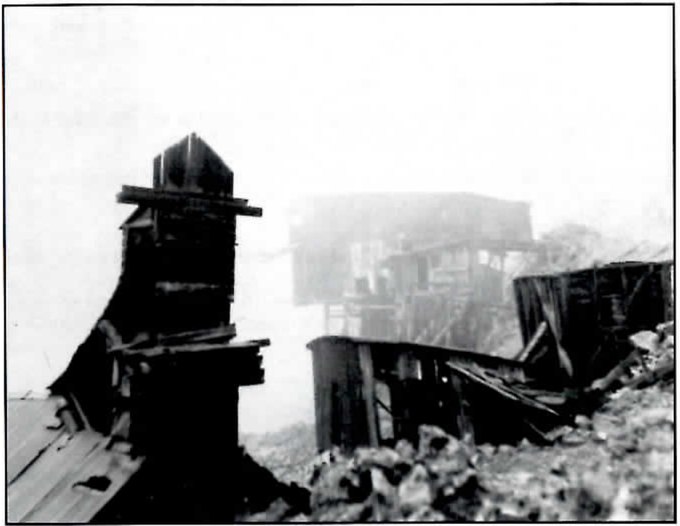
Let the fog roll in, we've served out time
ghosts of the boom days, coated with rime
lonely sentinels, still standing guard
o'er your final words, "Tap 'er light Pard."
The photograph and its verse have no title or caption naming the mine. The stray single quotation mark after "need it" in Benny's line is as printed.
Red the Medicine Man
Melvin "Red" Johnson and Shorty Dunkel were running a short stope near a winze where I worked. As Red was drilling a rock fell and mashed the big toe of his left foot. He took his boot off and found the wound worse than he had first thought. The nail was gone, bone was visible and it was beginning to bleed heavily. Glen archer drove him to town and offered to find someone to take him on to Del Norte and a doctor before he returned to his shifter's duties Red declined, said he would get a neighbor to help get it cleaned up and he would be fine. When I got off shift I met Red near the post office wearing his house slippers with a large hole cut in the top of the left one and a mangled toe protruding. He had a fifth of bourbon and stopped to give me a shot but first poured a healthy drink over the injured toe. He was back in his stope in less than a week which attests to both his durability and the curative powers of good bourbon.
"Glen archer" is printed with a lowercase "a," and the sentence has no punctuation after "duties"; both are kept as printed. Melvin "Red" Johnson and Shorty Dunkel are paired the same way in "Please Go to Hell," "The Amethyst Crew '1947,'" and in Echoes' "Miners After World War II."
Fire in the Hole and All Over
Walter Waldo had an interesting mishap in the upper Amethyst where Benny lost his finger. Walter was filling shaft buckets to be hoisted to the Sloan level from a lower drift. This required pushing empty buckets on a wooden framed tram car to small chutes to be loaded with ore then returned to the bottom of the winze to be hoisted and emptied at the upper level. Tram buckets are waist high to a normal sized man. When working the chute to load a bucket a man's genitals are often near and at times hanging over the rim as he steps up to slam a chute board down to stop the flow of ore. Walter was in just such a position when a heavy specimen of carbonate lead and silver ore rolled over the bottom board and severely flattened his reproductive organ against cold steel. It didn't only flatten his pecker it mangled it nearly as badly as Red Johnson's left big toe. Walter managed to scale the ladders to the Sloan Tunnel and from there painfully made his way to the portal and the blacksmith shop where Martin Wagner and Art Davis were sharpening steel. When properly apprised of the location and severity of the wound, Art said he would dress it as best he could so the ride to town would be less painful. Martin had the first aid kit ready by the time Walter worked his overalls and long handles down to expose the source of his pain, as Art remarked, "Mi'gawd, that looks like something a dog chewed on for a couple of days and couldn't swallow."
That wasn't to be the last of Mr. Waldo's humiliation. Art Davis poured a generous dose of iodine on the lacerated appendage and the pair of them were hard pressed to hold Walter for further ministrations. I worked with a miner for several years who suffered the same misfortune as Mr. Waldo; however, the wound to his tallywhacker resulted in an abnormality upon healing that proved beneficial to his social life thereafter. The luck of the Irish.
The book gives "Art Davis" no further identification. "Echoes from the Thundermug" names a mine superintendent, Art Davis, who per family knowledge is no relation to John's uncle Arthur M. Davis. Whether the Art Davis of this story is that superintendent is not stated.
The Big Kentuckian
George Hatfield and his growing family traveled west from Kentucky and ended up in Creede. I worked with George, but never learned what prompted him to seek work in the hard rock mines of Colorado. He was a member of the feuding "Hatfield and McCoys" and he never talked about that part of his life either.
When he was first hired he spent several weeks mucking (shoveling) ore from drifts "tunnels on veins" and tramming the loaded cars to form a train for the mule-skinners or pushing the cars to draw-holes where the ore passed to a lower level. Erick Nelson liked the big Kentuckian and always stopped to visit with him while he was sampling veins in the various workings. After he was adjusted to the altitude and surroundings Erick asked him how he liked his work. "Well, Mr. Nelson," George replied, "In another couple of weeks I reckon I'll be able to eat hay and shit a'walkin'."
George, James Ott and I were starting a new stope on a high grade silver vein near what was called "The West Drift." I had a terrible hangover one day, had emptied my stomach several times while trying to carry my weight. It was lunch time and I felt improved enough to try a cup of coffee and a few bites of a sandwich. I arrived at our station just as George and Zero opened their pie-cans.
"Yuh looked purty sick when yuh came in Johnny, feelin' better now?" George asked.
I told him I thought I might live.
"I saw yuh puking down the drift, reminded me of a time I was eatin' grits an' molasses, looked at my plate an' saw a half a beetle with one wing still flutterin', knew I'd already swallered the other half, I was near as sick as you sounded."
I could hear them laughing as I parked my cookies further down a side drift.
Pete Morowski, a former truck driver, hired on during the time I was stoping with George and he proved to be an amiable fellow. Bill Mathews, a mule-skinner, had quit to return to Texas and Pete took over his job. He told us he was a drinking man, liked good whiskey, and hadn't met a man who could drink him under the table. His stories grew with each telling until George invited him to join a few of the locals for a weekend party. They had just come off shift and Pete said, "I'll get us headed off, by golly." He went into the liquor store and returned with a pint of bourbon, unscrewed the lid and handed it to George. George took a hefty slug, handed the bottle to Uncle Bud who tipped it up for two fast gurgles and he, in turn, passed it to Zero. Zero finished it and gave the empty to Pete.
There are times when words fail a man. Pete looked at the three of them, who still appeared to be dry, then at his empty bottle. He turned his collar up around his ears and walked out of sight around the corner as George told Uncle Bud and Zero, "Well, if he expected to get a drink, too, he should have bought a quart."
George's beetle story is told again, in different words, in "Echoes from the Thundermug," "Sweet Beetles," where the meal is rice and sorghum and the beetle's front half looks up from the bowl. The book's "George Hatfield" is the miner of "Please Go to Hell," in "The Hog Killin' and Pass the Chicken, Zero," where James "Zero" Ott and Zero's Uncle Bud are his companions, too. Bill Mathews is named as a muleskinner in Echoes' "Miners After World War II."
Two Photograph Pages
Printed pages 17 and 18 hold one full-page photograph each, with no story and no heading; the table of contents does not list them. The heading here is editorial, describing the content.
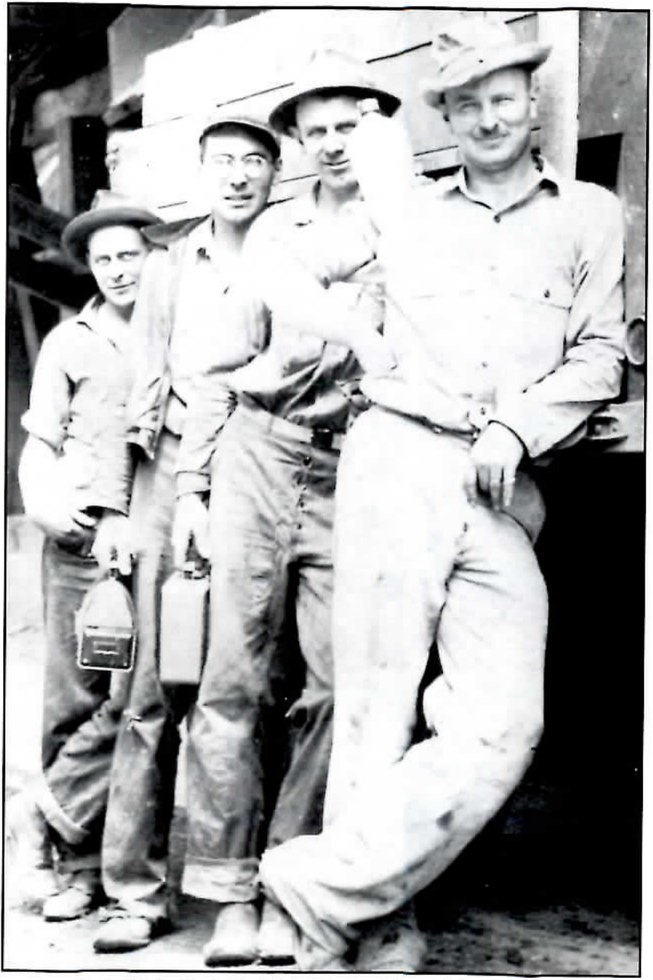
Come gather around me, I'll tell you how
they earned their pay by the sweat of their brow.
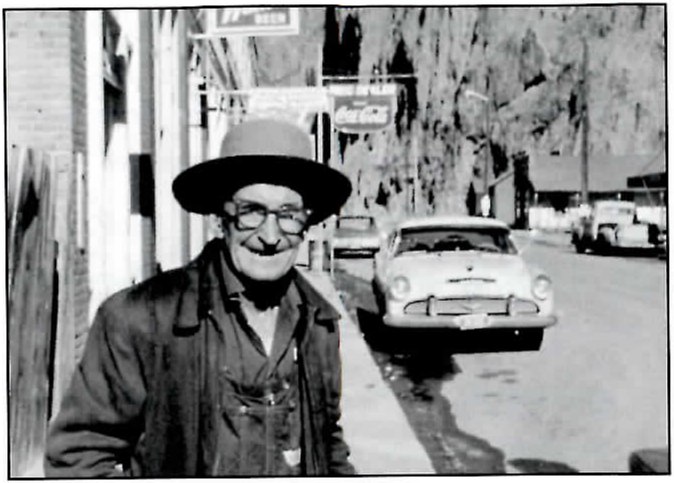
Ed was a miner and a poet as well
with many exciting stories to tell.
"Please Go to Hell" names Charles (Charlie) Slaght and Woody Wintz, and its "Dedication" poem closes with the two of them together; this caption calls him "Woodrow," which matches the full name the site's family research gives for Woody. The Name Index also records that the mine engineer Paul Davis, John's geology teacher, married Edith Wintz, a sister of Woody's. If the Paul Davis of this caption is that man, two of the four are brothers-in-law; the book does not say so. Ed McCargish was one of the Amethyst Mine's hoistmen, according to "Please Go to Hell." The two verses are printed on separate pages, one under each photograph.