"Who Upset the Thunder Mug"
By John Richard Jackson, writing as "Thundermug"
John Richard Jackson published this second collection of humorous stories in 1993, the copyright date printed in the book, and calls it a sequel to "Once Around the Thunder Mug." Most of its stories come from his years underground in the Creede mines, and it opens with the family story that gives the book its title. It is reproduced here, in sections, exactly as John wrote it, with his sister's blessing as his sole heir.
What follows is reproduced in John's own words, exactly as he wrote them: nothing edited, softened, or left out. It carries the same broad, joking, tall-tale narrator he uses throughout "Please Go to Hell" and "Once Around the Thunder Mug," a folksy small-town-goofball persona that was a deliberate comic choice, not a reflection of how he actually wrote or spoke. The scans were read twice by machine and the doubtful words checked against the page images. Where a slip appears below, it is a slip in the printed book itself (for example "The didn't know" for "They didn't know" in the Foreword, and "it's" for "its" in the poem on the first page), and it has been kept as printed. Numbers in parentheses are the book's own printed page numbers.
John signed his newspaper column and this and several later self-published books with the pen name "Thundermug." The cover and title page print the title as two words, "Thunder Mug"; the book's running text and its table of contents print it as one, "Thundermug." Both are kept as printed.
Contents
The book's own front matter, in full below:
- Acknowledgements (p. v)
- Foreword (p. vii)
- Introduction (p. ix)
The book's four chapters follow the table of contents as printed. The book gives its chapters numbers only, and lists the stories inside each one:
- Who Upset the Thundermug (p. 1)
- Granddad and the Jayhawker (p. 1)
- Con Boss Conned (p. 3)
- The Amethyst Crew Poem (p. 5)
- And This Ain't No Bullshit (p. 7)
- "The Swede"... Creede's Top Miner (p. 8)
- A "Runner" in 66 Raise (p. 9)
- Mr. Lehman Draws a Joker (p. 11)
- Forget About My Hat, Let's Get Outta Here (p. 12)
- George and the Glory Hole (p. 13)
- Is There a Doctor in the Hole? (p. 13)
- Red the Medicine Man (p. 15)
- Fire in the Hole and All Over (p. 15)
- The Big Kentuckian (p. 16)
- Never Let Your Mouth Overload Your Rectum (p. 19)
- 9 Bells For A Shower (p. 20)
- Rocky Mountain Fever (p. 21)
- A Wake For Herb (p. 22)
- Wedding Bells and Chesapeake Retrievers (p. 24)
- Revolutions and Bloodletting (p. 26)
- Why Dogs Shouldn't Chase Garbage Trucks (p. 27)
- A Hot Dog Story (p. 28)
- I'll Drink to That (Or Anything Else) (p. 29)
- Let Me Put It Another Way (p. 30)
- Records Were Made To Be Broken (p. 31)
- You Read It Here First (p. 33)
- Purse Your Lips Before You Blow (p. 33)
- Forest Blows a 10-4 (p. 34)
- Well! I Wiped It Off On My Apron (p. 36)
- I Didn't Hear It 'Til It Was Already Passed (p. 38)
The book's last two pages of verse and photographs, which the table of contents does not list, and the back cover follow the last story on the Chapter IV page.
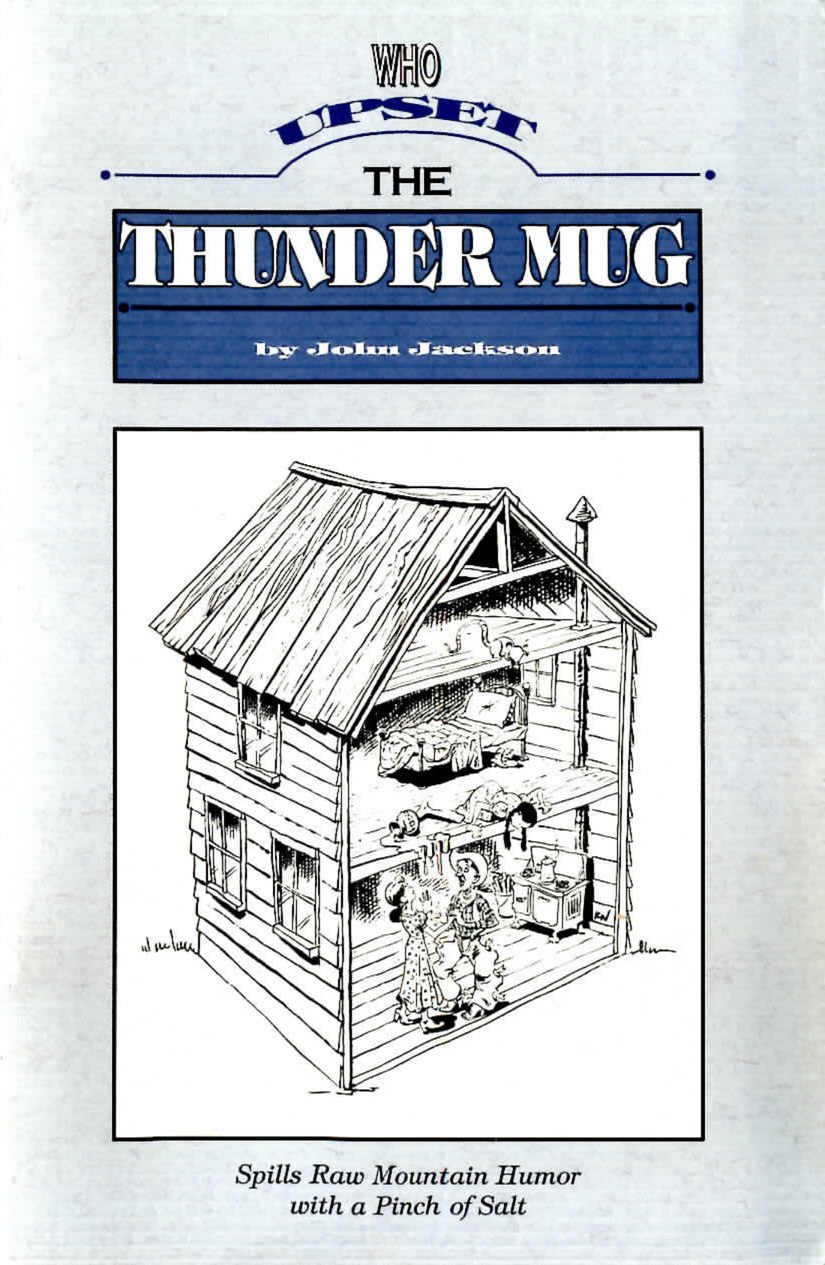
The cover drawing appears to show the scene told in the book's first story, "Who Upset the Thundermug," in Chapter I. The book itself does not say so.
Oh Lord, how I loved those lofty heights
where I followed the alteration
that turned hard rock soft from dissolved pyrites
in a subtle form of creation
There's a pluton buried beneath my feet
I smell it under Cascade Mountain
a seething mass that provided the heat
and the minerals to ascend like a fountain
Healing the breccia of a volcano's death throes
filling the cracks from it's spasms
providing the smells for a prospector's nose
as he works his way up rocky chasms
I've covered the ground where clear streams head
and panned gravel beds at their end
staked out my placer but found, instead
the gold was around the next bend
And now I know where the bonanza lies
the Lord led me to this great stope
a golden horizon that dazzles my eyes
in a sunrise with promise and hope
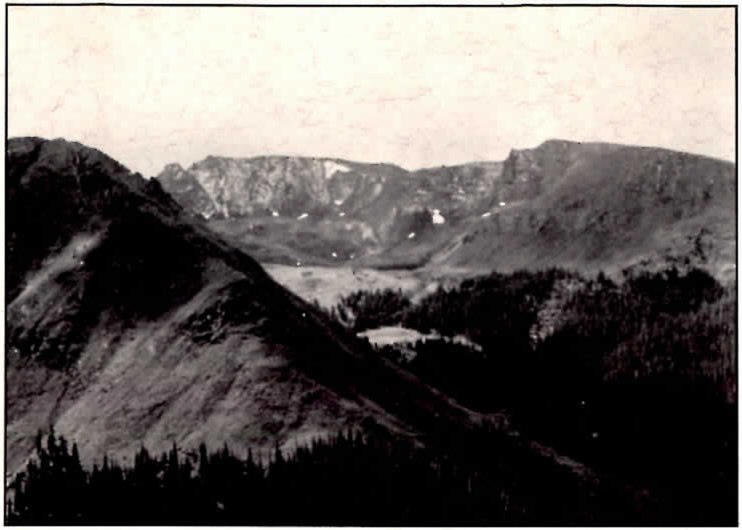
These lines and the unlabeled mountain photograph fill the first page after the front cover. The book gives them no title and no caption. "Cascade Mountain" is the mountain named in the second stanza; the book does not say whether the photograph shows it.
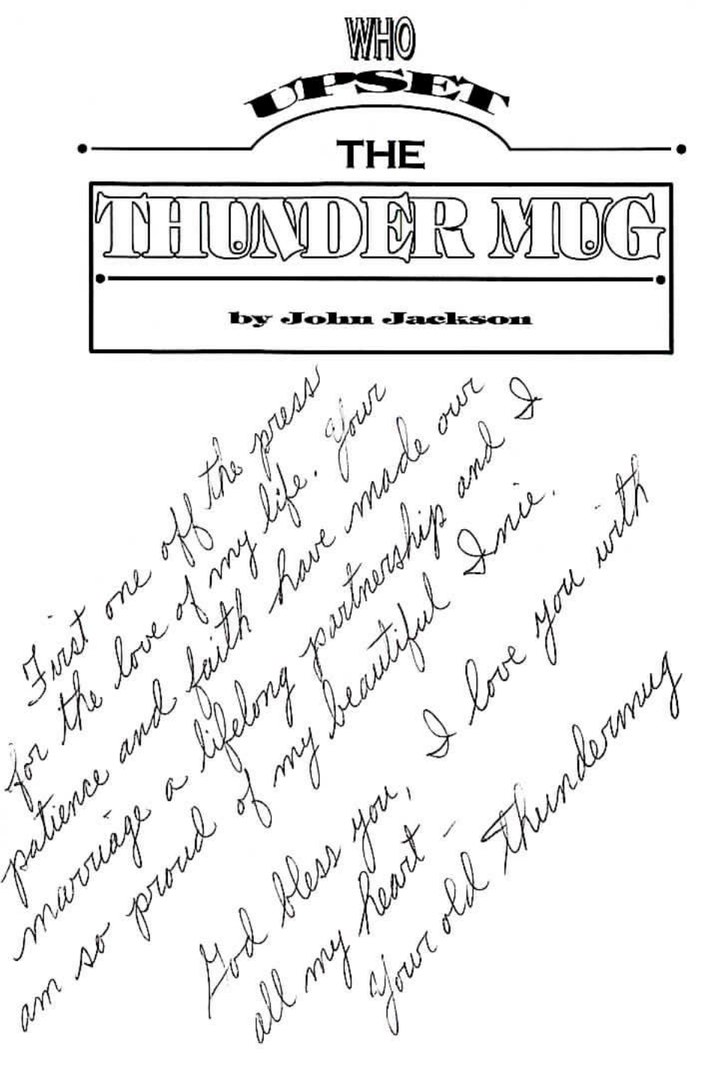
The inscription reads: "First one off the press for the love of my life. Your patience and faith have made our marriage a lifelong partnership and I am so proud of my beautiful Inie. God bless you, I love you with all my heart. Your old Thundermug." It is written to John's wife, Inez. "Inie" is the spelling of her nickname John uses throughout "Echoes from the Thundermug."
Copyright © 1993 by John Jackson. All rights reserved.
That single line is the whole of the copyright page (p. ii). The book names no printer or publisher.
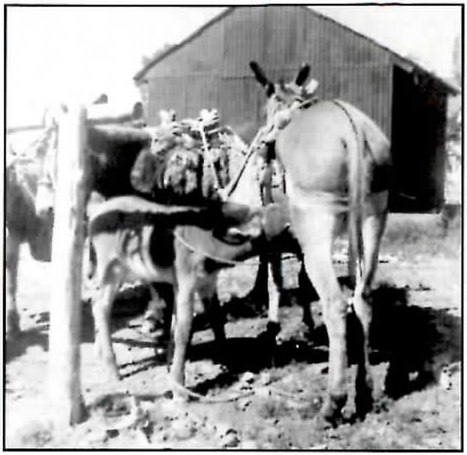
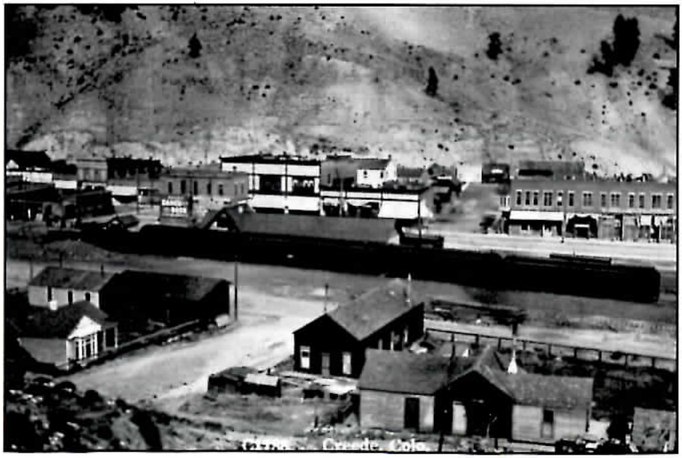
Sheep-herders burros waiting to load
the youngster says, "One more for the road."
Acknowledgements
In the first publication we gave credit to several persons who played a part in the effort through encouragement, contributions of photos and memories, or because of associations that improved and enriched the author's life.
With the possibility that Who Upset the Thundermug, a sequel to Once Around the Thundermug, may enter book-stores several of my friends have pleaded with me, "We like you, John Jackson, but please, please don't list our names in acknowledgements."
In respect to those dear friends I will dedicate Who Upset the Thundermug to my beloved sister, Pauline Roberta Jackson Bates, who was embarrassed unto tears so many times as I was trying to find myself. One of her most vivid embarrassments was the time the town Marshal found me before I could find myself. I fear this publication may be another embarrassment.
I would also like to dedicate this collection of humorous stories to my good friends and co-workers, Lynn "Key" Lezotte and Monte Jay Larson who left us several years ago. They were among our most productive citizens and inspired us all.
Special thanks to H. Heinie Leonard for critique and encouragement. To Gordon and Cloy Duncan who contributed several photographs.
"Lezotte" is spelled this way here and "LeZotte" in the story "The Con Boss Conned"; both are kept as printed. The book's photographs of Key and Monte Jay Larson appear on the Chapter I page, beside the stories where they are pictured.
"Once Around the Thunder Mug" carries its own Acknowledgements, in which John thanks Heinie and Vivian Leonard and Gordon and Cloy Duncan by name. See that page.
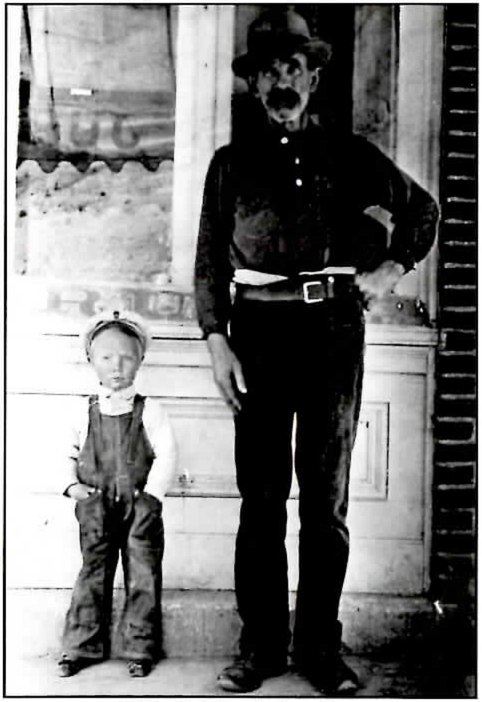
Famed Johnson Bar Miner
You mess with me and I'll stop your clock,
I once drove steel through solid rock.
This is the same photograph that appears in "Please Go to Hell," on the "Digging for the Truth" page, where the manuscript captions it "Claude & William T. Jackson Sr." and the handwriting on the original photograph names the boy as Claude, the youngest of William Sr.'s children. Here the son is "Rasty," spelled as printed. It may be a family nickname for Claude Cecil Jackson, but no other source on this site uses it, and the guess is not confirmed. "Famed Johnson Bar Miner" matches the expertise with a "Johnson Bar" that "Please Go to Hell" gives as the reason fellow miners called the elder William Jackson "old Bullprick."
Foreword
Who, among us, has not looked at the heavens
And pondered the questions; "Why am I here?"
"What is my purpose in life?"
We are here because our parents were instructed
To go forth and multiply. The didn't know their
Multiplication tables so they sat down in total
Frustration until one finally exclaimed "Well,
We better do something even if it's wrong."
Our purpose in life, therefore, must be to teach
Future parents the multiplication tables.
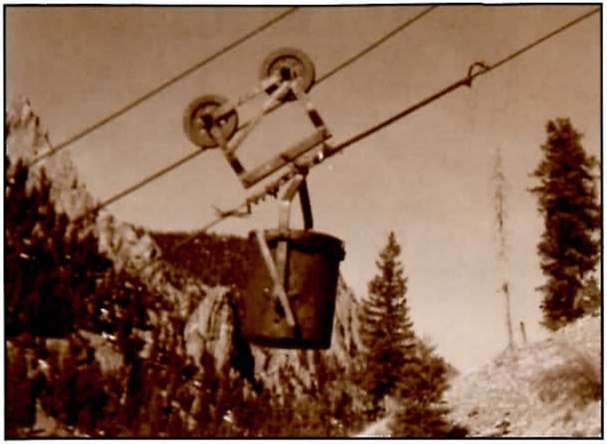
Grease the old bull-wheel and pour me a load
an ore wagon's waiting below on the road.
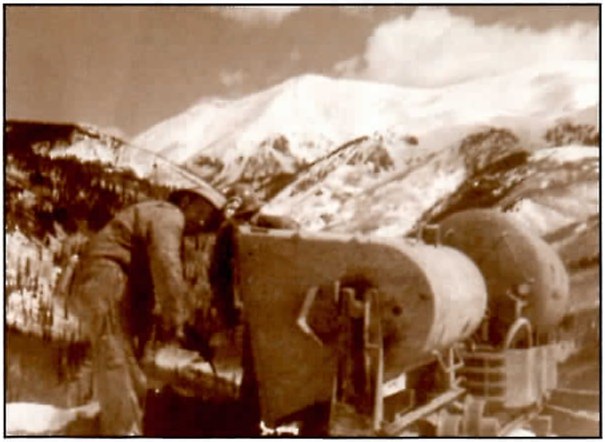
La Garita Mountain, snow capped and cold.
"Tell us your secrets, where is your gold?"
Frankie Davis is Frank Davis's son, John's first cousin, per family knowledge. "Please Go to Hell" and "Echoes from the Thundermug" both name his leasing partner in the Amethyst Mine as Paul Murray. Whether Paul Snyder is a second partner or a slip for Murray is not settled here, and the caption is kept as printed.
Introduction
In our first literary effort, Once Around the Thundermug, we made a brief trip through the "growing up" years of a group of kids lucky enough to be born in a town called Creede and in the best age any generation of humans could hope to live. It was an era where water was drawn from wells with a dip bucket and a biffy stood proudly a short distance from each house. We were acquainted with the old timers who created the boom with hard work and mining savvy and we learned lessons from the roughest of the miners and teamsters as well as the gentlest of the ladies. Some of the lessons were not appreciated by our parents.
There were inaccuracies in the first publication and we apologize for them. I tried to make a Hollander of Elsie Broadhead and learned she came directly from Scotland. Joanne Tankersley has done a painstaking job of researching history of Mineral County oldsters and brought this to my attention. My thanks to her.
The correction refers to the Mrs. Broadhead of "Once Around the Thunder Mug," Chapter II, whom John describes there as "this squat, gentle lady with the low voice and slight Dutch accent" (see "Grandparents, the Building Blocks"). That page has not been changed; the two books are kept exactly as printed, and this note ties them together. The book does not say who Joanne Tankersley is. "Echoes from the Thundermug" mentions a Joanne, also called Joan, who was the wife of Seth E. "Tank" Tankersley, but nothing here confirms that she is the same woman.
I have never been overly accurate with words or firearms. I tried to kill an older brother in the aftermath of a serious argument in the early '30's. I lost the argument and I missed the first shot standing and the next two running as he was in low silhouette. The light was poor in the room and the rear sight was elevated.
John does not name the brother. As printed, "the early '30's" reads as a decade, but John was born in 1927, which would make him a small child in the early 1930s, so he may mean his own early thirties, the late 1950s. The book gives no other date, and the passage is kept exactly as printed.
I will admit, also, that I have never been overly truthful. I tried very hard, the first year of our marriage, to be open and truthful with my bride, but I soon learned that women will believe a poorly conceived lie before they will accept a truth sworn to on a stack of Bibles. It is just their nature and it has worked to my advantage to hold the truth in reserve in case all else fails.
With apologies and admissions in order we shall protect ourselves further by declaring the following stories to be truths, half truths and outright lies. We will be held accountable only for the half truths.
I spent the first 50 years of my life making every error humanly possible, some of them three or four times. I spent the next 10 years hoping I was the only one who knew and the years since trying to rectify the worst of the errors.
Our priorities change too fast as we age. At 6 years of age I knew the most important thing in the world was to own a .22 caliber Winchester rifle. At 10 years of age a bicycle put the rifle on a back burner.
I wasted all those years setting useless priorities when the real necessities boil down to indoor plumbing and soft toilet paper. Both were a long time coming in the little mining town of Creede, Colorado.
While working with a crew of oldsters at the Commodore Mine I was full of piss and vinegar and showing off at every opportunity. I slapped a 300 pound length of rail into place and was starting to fishplate it to another when John Slater looked at me and said, "You're a real hot-shot, Kid, but you'll see the day when a good bowel movement will be the most exciting thing you can look forward to." He was right.
If you visited Creede in the '30's and came in from the east, the first place you would pass on the left belonged to a venerable prospector named Jack Fleming. Jack was a born optimist and a favorite of mine. When gold prices improved he had a foot of gold ore on the footwall. When silver prices were high he had a foot of silver ore on the hanging wall and when uranium became a target he told me he had a foot of you-ran-ee-um between the gold and silver ores. He had lost an eye and a foot in the trade he loved with a passion, but he was always the first to head for the hills and the last to return.
If you visited Creede from the west, the first buildings you passed belonged to the Allens. They were grouped under the embankment where the road inclines to the lower end of town. On making the turn to Creede proper, the first cabin on the left belonged to Sam Funk who was watchman for the Sulphur Mill, a large concrete structure, now utilized by Mineral County. Mr. Funk could speak the Ute tongue very well having journeyed to the area when the Ute tribe still had encampments in the valley. The sulphur mine had closed, but there was much raw ore still in the mill which was put to good use in fumigating homes infested with bedbugs, a scourge at that time.
An early morning ritual of upper Creede businessmen was rolling out the awnings. They were all very colorful and probably impressed me more than any other sight. One could hear laughter and good natured kidding from sidewalk to sidewalk as Mr. Joel Eaves lowered his candy striped canvas followed by John "Hoot" Owsley and across the street Sis Parsons would be fitting his crank to the slot. Up Main Street, near the firehouse, Stanley Parker would shade the windows of his drug-store as Wallace Leary lowered the awning of Tomkins Hardware Company, a large building also housing the bank.
John describes the same morning ritual, and the same two men, Mr. Eaves and Mr. Owsley, in "Echoes from the Thundermug," "The Magic Age Is Five," with different details: there Mr. Eaves cranks out a "red and white striped awning" just before Mr. Owsley lowers an "orange awning."
Hoot Owsley was a favorite with locals and tourists alike. He and his wife, Kate, were fishing for trout every free minute and Hoot thrilled the tourists with stories of the big ones, not the ones that got away, but the ones he caught and he had proof in his pictures. They had a large Studebaker sedan to transport them to their favorite fishing holes. They were an impressive pair when decked out in fishing gear and Kate, with her ever present bonnet tied with a wide red ribbon under her chin, smiling and waving to all they passed.
The town was fairly self-sufficient during those years and we would probably have survived had we been isolated by both road and rail closures. We were very appreciative of the fruit trucks that came in late summer and meats from packing houses afforded a change from our main staples of trout and venison. Dr. McKibbin and practical nurses could handle nearly any emergency and patients had a high threshold of pain. I remember Dr. McKibbin sending for my Father when a sheep-herder rode in with a hole in his belly. He had picked up a blasting cap at the Resurrection Mine on his way back to his herd. The details were never clear, but it had gone off in his watch pocket tearing flesh and embedding bits of cloth and belt in the wound. Dad and the doctor's son held the poor fellow as the entrails were cleaned and the torn flesh stitched. He made a full recovery and visited again the next year. Our next practitioner, Dr. Sprecher, disliked adenoids and tonsils. His office was over the Economy Grocery where the glands of many Creede children were removed and dumped in Willow Creek, the nearest receptacle. Each patient received a bowl of ice cream when able to sit up after surgery. For the most part the treat was promptly thrown up, along with swallowed blood, and also consigned to Willow Creek.
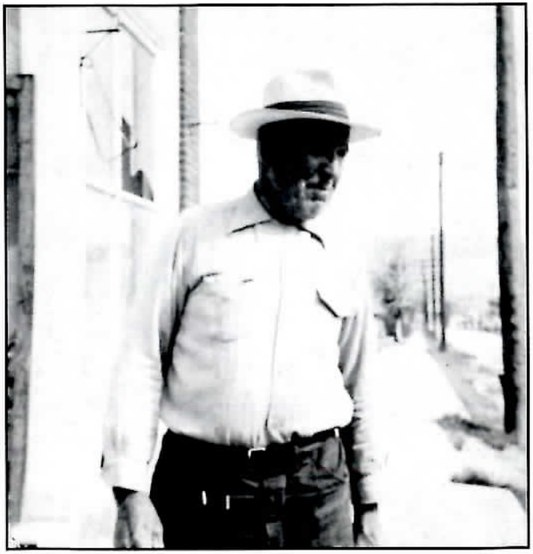
"The ore's in West Willow," we heard him say
"the Lord put it here and it's there to stay."
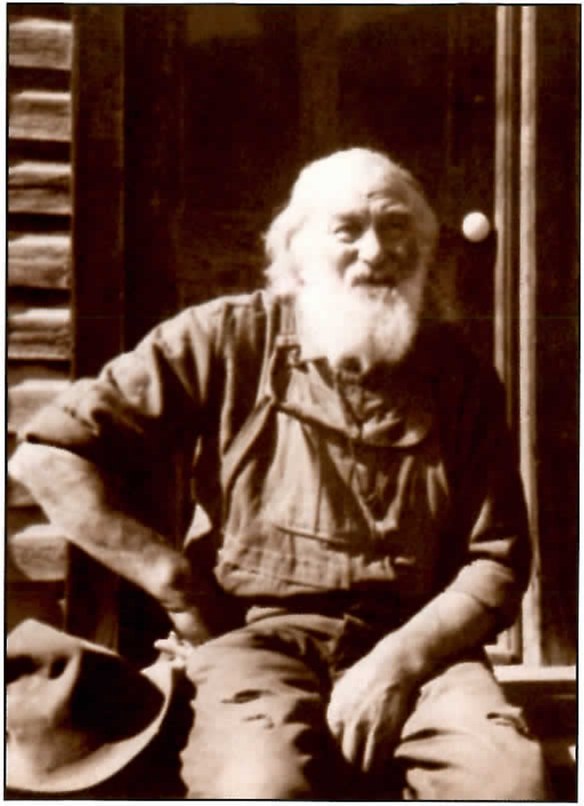
"You're all wet Jack, better listen to me
the gold's in Red Mountain, as plain as can be."
Jack Fleming is also named in the Introduction of "Once Around the Thunder Mug," where he is prospecting with Noel Roberts, "only a round away from bonanzas." Fred Gulzow appears in "Echoes from the Thundermug," in "Prospectors Were a Visionary Lot Who Built the West."