"Who Upset the Thunder Mug": Chapter III
Chapter III runs from printed page 19 through page 28 and holds eight stories, most of them set above ground in and around Creede: dance-hall fights, a night of drinking that ends in a mock killing, John's wedding, three Model T mishaps, the town garbage route, and a dog with a remedy for raging hormones.
Never Let Your Mouth Overload Your Rectum
The loudest voice is 90 per-cent of the argument, but not necessarily the winner.
We were tough. We weren't scientific fighters, but working at elevations from 9,000 feet to 11,000 feet expanded our lungs and served to make us durable enough to outlast most of our opponents. Hank Slaght liked to tangle with what he called "Spudrollers." Any man from the San Luis Valley was a spudroller in Hank's eyes.
We were at a dance at Blue Creek one Saturday night when Hank took a fancy to a cute little blonde from Center. She was with somebody when Hank walked up to them and said, "Hey spudroller, go plant yourself somewhere, I'm going to dance with your girlfriend." Hank hadn't measured this farmer very well. He shoved our miner away and invited him outside to finish the conversation. The farmer could fight. He had Hank on his back within seconds, but Ray and Danny were right there to help him up and push him back in the action. Another exchange and Hank was again on his elbows with his good friends pulling him to his feet. The third time Hank hit the turf he had blood running from his nose and one eye was swelling. He grinned at his pals and moaned, "Don't any of you sonsabitches pick me up again."
Another night, another dance and we were squared off with a fighting group from the San Luis Valley. We were not faring well. Hank was the first to smell the tulips, I hadn't been able to get my second wind and I could see that David was being severely pummeled. Our salvation came in the form of a broad shouldered lad from Goat Hill in Pueblo, a friend of the Blackburns. This young fellow was of Yugoslavian descent, son of a steelworker, and had learned his lessons well in the toughest section of the steel city. The tide turned in minutes and the challengers were soon on their way to a lower climate.
Seth E. "Tank" Tankersley was built like a tank and just about as hard to stop. While in the paratroopers Tank and a buddy were on pass and took in a carnival. They won a ham that had been on the rack so long the bone stuck out of one end several inches. They had been drinking and during the course of the evening had annoyed the Carnie hands to a point that one yelled, "HEY RUBE!" and the fight was on. They were doing very well. Tank had dispatched one to dreamland and his buddy had walloped a couple with the hambone when one of the Carnies caught Tank with haymaker and down they went with Tank on the bottom. His buddy was waiting to get a clear shot with the ham and help him out when they got to their feet. Tank made a swing, the Carnie ducked, and my old friend got the knobby end of the hambone square on the nose. And that, dear friends, is how Seth E. "Tank" Tankersley's nose was rearranged so he could smell around corners.
Those who remember the dances at Shaw Springs, north of Del Norte, may also remember a spudroller from the Hooper area who talked a better fight than anyone I've seen. A dance never ended that he didn't choose someone only to have his wife and friends hold him and plead with him not to hurt anyone. I thought he must be the toughest hombre around those parts until one night he was bumped by a fellow from Alamosa. The man from Alamosa was a gentleman, he apologized, and started to walk on. The tough would have none of it. He spun him around and told him to get his dukes up. Unfortunately, his wife and friends were in the dance hall and the rest of us were willing to watch. The gentleman from Alamosa proved to be experienced in back alley brawling and fed the loudmouth so many fists so fast he couldn't even yell for help. I never saw him at Shaw Springs again.
The epigraph under the title is printed on its own line, as it is here. Seth E. "Tank" Tankersley, who "jumped into battle with airborne troops in World War II," is described the same way in "Echoes from the Thundermug," "Women Can Scare Strongest Man." The David who is "severely pummeled" is not identified. "Once Around the Thunder Mug" and Echoes both name a David Manning among John's boyhood friends, and Echoes has him escorting John to a dance at Shaw Springs in "Campaign's Growing Pains," but this story does not say whether he is the same David. Hank Slaght is the miner of "A 'Runner' in 66 Raise" in Chapter II.
9 Bells for a Shower
The best time of day for the younger miners was that period when our rounds had been detonated in drifts, raises and stopes and we were in the dry room of the Amethyst Mine waiting for transportation to town. This was the half hour when, with luck, we could coax one or more of the old timers who had been relegated to sorting waste rock from ore, making up primers or building ladders, to take us back in time to their first years of breaking rock.
Gus Swanson was with us then. The first time I saw Gus was a summer day when several of us little shavers walked from town to the imposing tramhouse that rested near railroad tracks in lower West Willow Creek. Ore was lowered on a network of cables from Commodore 4 ore bin in a continuous circuit. Gus Swanson was the stocky fellow unlatching the buckets and dumping their contents in bins from which the gondolas would be loaded. He was a powerful man who never seemed to tire, but now, at the Amethyst, age and years of manual labor had taken their toll. It was hard to get Mr. Swanson to open up, but his stories, seasoned with a heavy Swedish accent, were exciting and a treat for us all. Gus Prince, a wonderful old gentleman, had a fabulous memory as well as an exciting mining career. He had difficulty talking due to a cancer operation that required removal of a portion of his larynx. He had a permanent hole in his throat covered by gauze and he drew deeply of air through the hole and returned it in an exhausting method of speaking he had learned after the operation. Tiring as it was this late in the day, Mr. Prince entertained us royally.
One of my favorite stories from the old timers concerned the Last Chance Mine when the main shaft was in operation. The hoist-man was a dependable old "Cousin Jack" who had worked the tipples of England as a youth. He was startled from his routine one shift when he received a signal to stop on 7 level then 9 bells followed by 1 bell to raise the skip. It scared him as 9 bells was an emergency signal and usually meant serious injury or dangerous condition. The hoist was powered by steam and he advanced the throttle to get the skip to the collar as quickly as possible. With the skip at platform level he ran to a railing where he could look down and saw Mike O'Rourke step out.
"What's the trouble, Mike?" he yelled.
"No trouble, Tommy, I just had too much of Paddy's home brew last night and I really have to go."
Tommy waited until Mike returned from the toilet and was securely in the skip then dropped it several feet below the collar. He locked the brake, walked down the single flight of stairs to the floor where he unbuttoned his fly and urinated all over little Mike through the metal grille on top of the skip.
"Give me 9 bells again, yuh little bastard, and ye'll get worse than that." he advised.
"Please Go to Hell" describes Gus Prince and Gus Swanson together, as ore sorters and "two of the finest senior gentlemen at the Amethyst Mine," in "Dedication and The Amethyst Crew '1947,'" which matches the roles they hold here. Gus Swanson also sits at the poker table in "Once Around the Thunder Mug," "Lessons from a Barber's Chair," and "Echoes from the Thundermug" follows his journey from Sweden in "The Magic of Barbershops." "Cousin Jack" is a traditional name for a Cornish miner; the hoistman "Tommy" and Mike O'Rourke are given no other identification.
Rocky Mountain Fever
Man lusts after woman and he always will
it's his nature to probe the mysterious
Her anatomy... he will study until
the lady begins getting serious.
June has always been my favorite month. After a long hard winter of blasting rhyolite and quartz veins to pieces in a hard rock mine it was a tremendous relief to get out a fly rod and work the riffles under willows of the Rio Grande where large Rainbow Trout would be growing even larger from feeding on swarms of willow flies dropping to their open mouths.
I picked up Willis in midtown then made a quick stop for a six pack of beer we would lay in the edge of the river to cool until we had our fill of fishing. We made a U turn near the courthouse and were heading south when Willis spotted Gracie coming out of the local beanery.
"Hey Gracie, wanta go fishing?" he hollered. I stopped and Gracie came to his side.
"I don't want to fish, but I'll come and watch you."
Fishing and females don't mix and I wasn't pleased with the extra company snuggled up to Willis though I did like the color of her shorts and the color of everything else that separated her shorts from her shoes. I had a feeling I would be the only one casting a Gold Ribbed Hares Ear under the willows.
I was right. As I was stringing line through the eyes of my favorite bamboo rod Willis kept his eyes elsewhere and informed me that he and Gracie were going to take a blanket and discuss foreign policy in the shade of some spruce trees on the other side of the park away from the river.
It was wonderful fishing. In less than two hours I had enough Rainbows and Browns for our evening meal. I headed back to the car to take off the hot boots and open a beer. I found Willis in the front seat looking uncomfortable, Gracie in the back seat looking for something I couldn't see, and the beer still in the shallow waters of the Rio Grande.
After I drifted out of sight it seems their discussion progressed to domestic affairs with one thing leading to another until they were partially unclothed and groping for further communion with nature. Joining me at the fishing hole was the last thing Willis had on his mind when a woodtick found it's way onto the blanket and from the blanket to the right thigh of Gracie who feared woodticks nearly as much as she feared snakes.
If this had been a bronc riding contest in a rodeo, Willis would have failed to qualify. He was thrown into Spruce cones and tall grass as Gracie went into low orbit. Willis is still with us and will tell you he doesn't remember such a fishing trip, but to this day if a woodtick falls within his sight it is not just executed it is totally obliterated.
Willis and Gracie are given no surnames and are not named elsewhere on this site. The printed "it's way" is kept as printed.
A Wake for Herb
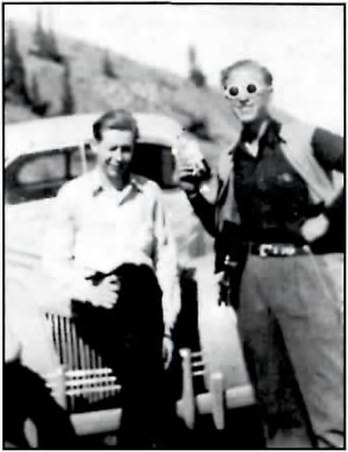
Damn right we killed him, the last page in his book
should read "he's to leap before he's to look."
We had spread good cheer far and wide and were returning to the Silver Dollar Bar & Grill. Somewhere, along the route, we had lost one tire chain which had slowed our progress, but we were now nearing main street from the mesa road. Skinner was mumbling that his nose was broken and was trying to stem the flow of blood with a dirty handkerchief after drenching the seat behind Turnipseed's head. He was either not fully in or he was trying to exit when Turnipseed forcefully closed the car door. In any event his nose was rapidly growing in size and he was losing much blood from the inner workings.
It was cold, it was snowing and we had little area on the windshield that wasn't fogged or snow covered, however, I could see a solitary figure trudging up the distant sidewalk with his coat collar up around his ears leaning into the wind driven snow.
"Hey, there's Pee Wee," I called to my partners, "should we pick him up?"
"Pick him up hell," Turnipseed growled, "kill the little bastard."
I don't recall there being any malice aforethought. It was just that we decided he had outlived his usefulness and we should help him exit this life. The fact that he was a good dancer and always had female company may have been a factor in the decision. He was near one of the Larson cabins and I was having problems getting traction with only one chained tire, but just when I thought he was going to reach safety both rear wheels bit dirt and Les slammed his foot down on top of mine to give us full open throttle. The old Chevy fairly vaulted ahead and the last I saw of our victim was when he heard the roar of the engine and turned to face us. His arms flew up and there was sheer terror in his eyes before the impact that dropped him from sight. It took several minutes of spinning and slewing to get off the corpse and head up the street again.
There was mixed reaction among the patrons in the bar when we informed them that Pee Wee was no longer among the living. Someone suggested a wake and while none knew the exact procedure we sang a few of his favorite songs, one of the crew recited The Ballad of Dan McGrew, a favorite of the departed and Dolly gave a passable Eulogy. Herbert "Pee Wee" Hutchinson would have liked it. Leola got me aside and asked, "You didn't really kill him did you?" I assured her we had. She looked worried as she returned to her duties behind the bar.
Next morning we crossed the little bridge behind the hotel and started down the street for breakfast and recovery. Mary Thom, Pee Wee's mother, hailed us from the other sidewalk.
"Have you boys seen Herb this morning?"
Skinner answered honestly that we hadn't.
"Well, I thought he might have been with you, he didn't come home last night and that isn't like him." "If you see him tell him to get his butt home so he can go to work tomorrow."
Never have three drunks sobered up so fast. I was all for leaving for Butte or Bisbee, but Les Turnipseed insisted we would stay and face the music. First order of business would be to find the body then notify Glen Holzworth, the town Marshal. We slogged in deep snow to where I thought I had steered into him. There were still faint signs where we skidded, but none of the humps we uncovered looked like our former pal or were clothed.
We returned to the bar for coffee and therein we found our corpse forking through a plate full of ham and eggs. Pee Wee was non-communicative for several minutes then cursed us roundly before entering into the details of his escape. We had hit the sidewalk just before the bumper reached him giving him time to fall backwards into the snow. The only injury was to his jacket where oil and grease from the steering gear and pan had rubbed off on it as we backed off his carcass. Certain we would try again if he moved he waited until we were well on our way then found refuge with a lady friend.
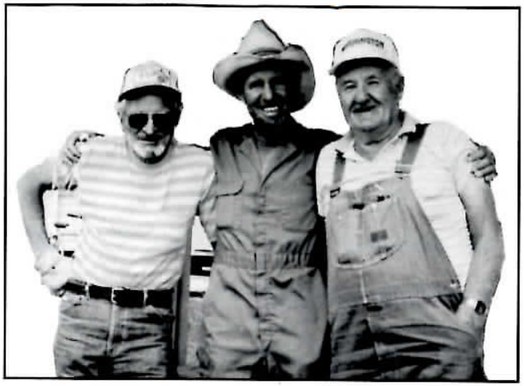
The Executioners
The pardon came through, we're finally free
and we're ready and willing as everyone can see,
old Skinner and Turnipseed, the Chevy and me
to prepare a new wake for our good friend, Pee Wee.
On the printed page (p. 22) the photograph of Pee Wee sits above this story's heading, at the foot of the previous story; it is set here because its caption and couplet belong to this story. The caption names the three men in "The Executioners" but not which is which. Herb "Pee Wee" Hutchinson is the same friend who appears in "Echoes from the Thundermug," in "A View from the Barroom Floor," as the crew's "poet, thespian and stand up comedian" alongside Gavin Skinner and Les Turnipseed, and in "Early-Morning Call Jogs Memory of Days in Local Choir," where Les sets his back on fire during a solo and he is billed afterward as the "Pink-Cheeked Troubadour of Creede, Colorado." "The Ballad of Dan McGrew" is his recitation in both. The Silver Dollar Bar and Grill is also named in "Wet Bags and Dry Flies." A "Mary Thom" appears in a photograph caption in the "Memories" section of Echoes, and Echoes names a Glen Holzworth in "Married Life and Mining Camps, Part Three"; this story does not say whether either is the person named here. Dolly and Leola, the bar staff, are not further identified.
Wedding Bells and Chesapeake Retrievers
Every man should get married at least once if only to experience complete frustration. Female minds run in different channels than male minds if they follow any channels at all. I have tried to remember that women evolved from a single rib of Adam, the first man, and if they appear a little boneheaded they deserve to be excused.
Inez and I had been dating for a couple of years between fishing trips, hunting trips and parties with my bachelor friends. It was an enjoyable relationship until one evening, after watching a movie, she asked me if I wouldn't like to go to a wedding the following Saturday. Weddings usually generate a little excitement and nearly always have a punch bowl so I said, "Sure, I'll take you."
We were early, I guessed. There was a distinguished looking gentleman with a book in his hand which he opened as he talked to Inez and his niece in Spanish. On my right stood a husky, middle aged fellow in western wear with a large pistol in a holster hanging off his right hip. He introduced himself as Santiago de Montoya, Sheriff of Taos County, and added that he was one of the witnesses.
I was looking around for the rest of the wedding party when Inez suddenly parted two of my ribs on the left side with her elbow and whispered, "I like fried chicken."
It hurt like hell and I fairly shouted, "I do too."
The old fellow closed his book, smiled at us, and said, "I now pronounce you man and wife, you may kiss the bride and don't forget to tip the witnesses."
That was well over 40 years ago and I haven't trusted a Spanish speaking Justice of the Peace to this day, however, we have had an interesting married life with probably more excitement than your ordinary, planned weddings in colorful surroundings, with weeping mothers and punch bowls.
This is the story of John and Inez's wedding. John's page records the marriage as taking place in Taos, New Mexico, per family account, and notes that no license or date has been found. This story places it in Taos County, with the county sheriff, "Santiago de Montoya," as one of the witnesses, and says it happened "well over 40 years ago" as of the book's 1993 copyright. The book gives no date. "Echoes from the Thundermug" tells the same wedding from another side in "Wedding Reminds Us of Our Own": a spring snowstorm on the drive to Taos, a county clerk, a justice of the peace, and $12 to cover fees and tips for the witnesses.
One of the first things we did together was to purchase a registered Chesapeake Retriever puppy. I have always had a special fondness for the Chesapeake breed relating to my childhood when the Spillman family in Alamosa gave Dad Bill a male puppy from a new litter. We called him Scrappy from a comic strip of that era and our latest retriever was name "Pogo" also derived from a comic strip character. I will never forget Scrappy's faith and trust in his master in a perilous situation of my making.
Mom Jo was still trying to raise strawberries in the red clay and rocks of Missouri with Joel and Scooter as her able assistants. I had returned to Creede to be with Dad Bill and our only transportation was a tall bicycle with a flat tire. Walter Dilley, of Del Norte, called Dad at his courthouse office with the news that the town of Del Norte had traded a Model T truck to his agency for a new Chevrolet and he would hold the Ford for Dad. He caught the first available ride downstream and returned with our wood hauler.
Dad's love for fishing was eclipsed only by his love for sawing firewood. Within the week he had license plates on the truck and we were headed for Snowshoe Mountain with axes, a two man saw and Scrappy, the dark brown duck retriever, pacing back and forth on our new rolling stock. We crossed the Rio Grande and headed up Quinlevan grade to Moonshine Mesa. We had remembered everything except to fill the gas tank to the very top. With gravity feed to the carburetor and the steepness of the grade a motorist in a Model T either kept the tank full or went up in reverse. We made the first grade without a problem and were halfway up the next, steeper, pitch when the engine sputtered and died.
"Jump out and put rocks under the rear wheels." came the order and within seconds I had two rocks firmly holding the truck. "What I'll have to do," he went on, "is kick it out of gear and I won't have any brakes when I do that so you'll have to keep blocking me every two or three feet."
The old dog was peering over the side at me as I threw one rock aside and used the larger one to stop the truck. We were regressing "backing down" well. His plan was working. Scrappy was on his belly watching my every move as I stopped them again with little effort so I decided to speed the process up and go five or six feet at a time. That was the second mistake of the day. The Ford bumped the boulder, nearly stopped, then crawled over my barricade. Truck, axes, saw, Chesapeake Retriever and Dad Bill were now in free wheeling as most of my life passed before my eyes.
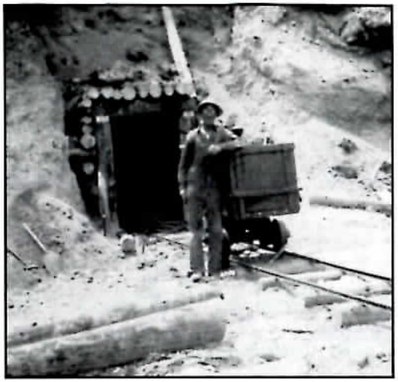
Square Set Timberman
A square set portal headed right for the fault
To tap the treasures of King Solomon's vault
The old bugger looked pretty wild eyed as he passed me and realized he had a fast trip ahead of him. Scrappy never showed a hint of fear. He had all the confidence in the world in his master and was sure they would coast to a smooth stop further down the road. He held that confidence until Dad banked the vehicle with a fast left turn, even as it crawled up the bank and began to tip at a dangerous pace. It all appeared in slow motion to me with Scrappy clawing to hold his footing, my poor old Father holding tight to the steering wheel with eyes as big as teacups just before it overturned with a horrendous crash. Scrappy stayed with his position until the very last instant then leaped clear and came running to me then turned to bark at the dusty figure trying to hoist himself from the driver's side. He paused for a minute to wipe blood from his nose and a cut on one cheek then yelled, "Gawdammit, don't just stand there, run up to Swineharts and see if Cecil can come help us." Cecil Owens was there and as luck would have it had his team of black horses in the corral. He harnessed them, looped a chain over the back of the nearest one and we were on our way. The team struggled to get the truck back on it's wheels, but pulled it on to the top with ease.
Bill Jackson was not easily deterred from a goal. We went on to saw a full load of wood and returned with no more undue excitement, but thereafter he always backed up Quinlevan grade with Scrappy at the rear barking directions.
"Dad Bill" is William Thomas "Billy" Jackson, and the photograph is his; "Joel and Scooter" are Joel and Scooter, John's older brothers (the 1930 census entry on his father's page lists Joel at 8, William C. at 5½ and John at 2½), and "Mom Jo" is Alice Josephine Davis. On the printed page (p. 26) the photograph and its couplet sit beside the truck-wreck paragraph with the text wrapped around them; they are set here just before that paragraph. The truck, Scrappy and the Spillman puppy also turn up in "Echoes from the Thundermug," in "Dog Gets Sharp Lesson," where Dad Bill's Scrappy is "a pup from the kennel of Spillmans of Alamosa." "Swinehart's ranch" is the ranch east of the Lane place named in "Once Around the Thunder Mug," "Grandparents, the Building Blocks." "Was name" for "was named" and "on it's wheels" are as printed.
Revolutions and Bloodletting
Old Bill Jackson wasn't the only one to put scars on a Ford. I was a passenger in a Model T Ford Roadster piloted by Allen J. Hosselkus on a return trip to Creede in the days when Colorado Highway 149 was an unpaved right of way with sparse gravel and teeth chattering washboard.
This early vintage had a lath top covered with canvas which was in turn covered with several layers of tar. I mention this because it contributed to the many scars on my head. Allen was a good driver and I can't recall the various factors that turned him into a poor driver preceding our tumble from the road resulting in a one quarter roll as it would be described in a police report today. I remember the radiator cap revolving to an eastward direction just before my head went through the roof. I don't believe I tore the tar coated canvas, but the jagged edges of the lath held my head securely from which a generous amount of blood was beginning to flow.
Mr. Hosselkus had ended the ride astraddle of my mid-section and was earing the throttle down as if it might somehow return us to a vertical position.
"Listen to her, Jackson," he yelled, "hell, it didn't even kill the engine."
I told him I wasn't hearing well with my head out the top. Which was the first inkling he had that there had been upper damage to his automobile.
Another time and in a different Ford of newer vintage, we were chasing high altitude split-tail quail on the Bachelor Road above Creede when a sharp corner appeared and disappeared just as suddenly in the headlights. Allen J., David Blackburn, Gordon Hosselkus and I were crammed tightly on a single seat in the pickup which probably saved our lives as our pilot bettered his previous record with three complete rolls or more. There was no need to count beyond that as the cab was level with the hood, the fenders were beyond further damage and the bumpers were wrapped tidily around the tires.
All that commotion and we never did bag a split-tail.
"Earing" is printed this way and is kept. Allen Hosselkus is named in "Echoes from the Thundermug" as one of Creede's lightweight boxers, in "Boxers Highlighted Old Traveling Circuses," and Gordon Hosselkus, called Allen's cousin in "Please Go to Hell," appears in its "Hellions and Moonshiners." The Blackburn family, and a Bob Blackburn among John's boyhood friends, are named in Echoes; this David Blackburn is not further identified.
Why Dogs Shouldn't Chase Garbage Trucks
If I had been an automobile I would have been recalled before the first oil change; however, there was a time when I felt most important to my fellow man and performed a needed service.
I was the duly appointed garbage hauler for the City of Creede a long time ago and it wasn't without its problems. A large dog chased my Model T truck every time I passed a certain area on Main Street. I had no doors on the vehicle and the dog also liked to test the strength of my left trouser's leg. I was picking up trash and garbage at a house on 5th street and the owner had come out to help me load. I showed him where the dog had just put holes in my pants.
"You can cure him of that, Johnny," he advised, "tie a gunny sack on one front wheel next time you pass that way."
I found a large sack at home that had formerly held a hundred pounds of potatoes and fastened it snugly to the outer edge of one of the wooden spokes of the left wheel. I made a round of the houses in the upper end of town and started down Main Street. I could see the old dog crouched near a cottonwood tree ready to try for a rubber tire or a human leg, whichever came first. The rubber tire with the flapping gunny sack came first and he sank his teeth in the outer reaches of the sack. Both of us were unprepared for the effects after that.
The poor bugger received two bone jarring thumps to the road before the next revolution threw him in a long arc to again connect with the road, then momentum rolled him up in a dusty ball. I like dogs and I was afraid I might have killed him, but he recovered his wits and footing at the same time, shook himself and retired to a shady spot by his home. I was never again troubled by that particular dog, but I kept the sack and some baling wire under the seat in case any other dog along the route didn't like the sound of my truck.
I was an independent operator and I suppose, in this era where college degrees are handed out like baseball cards, I would be called a Sanitary Engineer. We have become a nation of professional people instead of laborers, all due to educated people who create titles for those of us in the less intelligent bracket. C. Edward Snow was my helper for most of that period. Ed was afflicted with poor eyesight and wore thick lensed glasses, but his sense of smell was extra sensitive. A lady on the mesa always soaked her babies diapers in a 5 gallon bucket then dumped the extract in a garbage can. This stomach turning smell was nearly more than Ed could stand. So one day, when we had collected a little over a dollar he suggested we get Bob Weir to buy us a gallon of Tokay wine and change the aroma. It improved the job and our outlook tremendously. Each time we stopped for loading we would take a drink, then Ed would remove the radiator cap and give the Model T a slug. There was a small hole in the center of the four pronged cap and when the engine reached boiling stage Tokay scented steam would hiss from the cap and perfumed both haulers and garbage. It worked well until the truck got drunk and removed several feet of Mr. Stone's rear fence.
This is the same business, truck and partner told in "Echoes from the Thundermug," "So Long to Ed Snow," where "Snow and Jackson" haul garbage in the Model T for a city franchise, take Tokay wine against the smell, and the truck "whistled wine-scented steam from the small hole in the brass radiator cap." Echoes also describes Ed's poor eyesight and lifelong career in electronics. This version does not mention Hank McCaulley, who held the route before them in Echoes. Bob Weir and Mr. Stone are not further identified.
A Hot Dog Story
You'll wonder where ol' Yeller went,
when you brush his rear with liniment.
A miner who lived a block north of us in lower Creede had a bitch dog rearing to start a kennel, if that is the proper word when female dogs wish to play house with male dogs. Old Yeller had whupped every single dog in our end of town including Tex Allsworth's police dog twice to win the heart of Jimmy's female.
He shook his bloody ears and vaulted the fence of the back yard where he was busily engaged in practicing "Amour" and more "Amour" when Jimmy came off shift at one of the local mines.
Jimmy wasn't pleased with the prospects of pups from this union so he called a friend who helped him corn cob Ol' Yeller's rear end to better receive a double dose of a remedy for raging hormones. The liquid was applied and Ol' Yeller cleared the fence before the stopper was back in the bottle. He never slowed until he reached the Rio Grande where he water planed three miles upstream to Bill Powell's ranch before the fire was under control.
Ol' Yeller kept his tail curled between his legs for the remainder of his natural life and hid under his master's porch every time a bitch came in heat.
This leads me to think that a little turpentine and a few corn cobs might go a long way in curing the problem of unwed mothers and errant fathers in urban America. I couldn't very well turpentine a dog, but I will volunteer my services for any other application where most needed.
The book gives "Jimmy" no surname. Milton "Tex" Allsworth is named in "Echoes from the Thundermug," "The Magic Age Is Five," as the host of singing evenings.